

A turnkey solar project can be delivered end to end and still miss the mark if its design is based on assumed loads. For businesses assessing turnkey solar projects Kenya, the key question is whether engineering, equipment procurement, installation and commissioning are planned around the facility’s actual operating requirements. When these stages are disconnected, expectations and responsibilities can become unclear.
It’s reasonable to ask what turnkey delivery includes and how the system will account for changing demand, power quality and continuity needs. A sound plan starts with operational data, not a standard system size. An energy audit can assess consumption and load profiles, power quality and return metrics, giving the design team a practical basis for decisions.
This article explains the project lifecycle, from business requirements and technical assessment through system design, procurement, installation and commissioning. It also outlines the information to prepare, the responsibilities to define and how solar generation, battery storage and power conversion equipment can be integrated to suit a facility. Powerstack Africa delivers commercial solar EPC in Kenya, connecting these stages through tailored engineering and project delivery.
Key Takeaways
- Turnkey solar projects Kenya bring assessment, engineering, procurement, installation and commissioning into an integrated delivery scope. Turnkey delivery does not automatically determine who owns or finances the system.
- Use facility load profiles and site conditions to shape the system design, then follow each delivery stage through testing and handover.
- Compare turnkey EPC with separately contracted stages and financed arrangements by examining responsibility boundaries, procurement coordination and asset ownership.
- Prepare electricity bills, interval data where available, operating schedules, critical-load details and site drawings before engineering begins.
- Energy audits can give commercial solar and storage design a stronger operational basis by assessing consumption, load profiles, power quality and return metrics.
What Turnkey Solar Projects in Kenya Mean for Energy Users
For a business, solar equipment is only one part of the investment. The system must be assessed against facility demand, engineered for site conditions, integrated with the electrical infrastructure and tested before handover. Turnkey solar projects Kenya bring these connected responsibilities into a coordinated delivery scope, taking the work from requirements through to an installed and commissioned system.
In brief: A turnkey solar project is an integrated service scope that takes a facility’s requirements through engineering, procurement, construction, installation and commissioning. It is solar project delivery, not solar panel manufacturing. Manufacturing produces equipment; project delivery selects and integrates equipment into a working system designed for the site.
Kenyan businesses often need to manage grid reliance alongside electricity operating costs and the effects of interruptions on production or essential services. Solar can contribute to a facility’s energy strategy, while storage and power conversion may support specific load-shifting, peak-shaving or continuity objectives. The right design depends on how and when the facility uses electricity. The wider Solar power in Kenya overview provides context on the technology’s applications in the country.
What does turnkey solar delivery include?
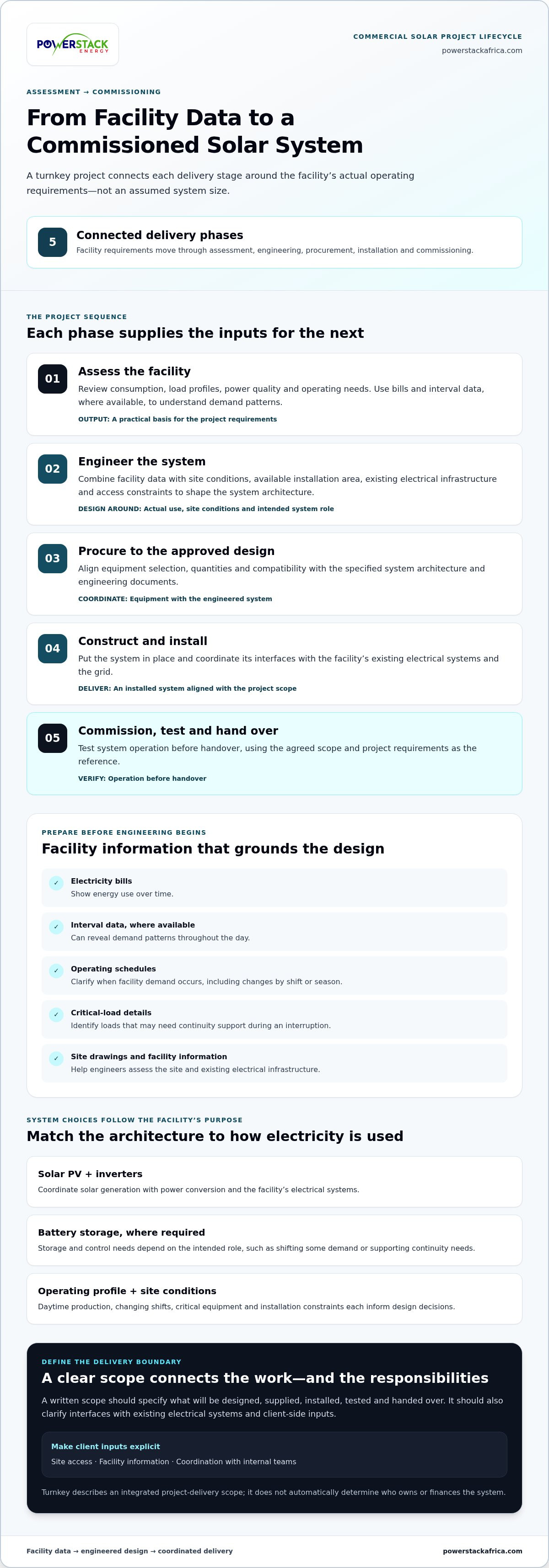
Connected workstreams typically begin with assessing the facility and translating its requirements into an engineered design. Procurement aligns equipment with that design. Construction and installation put the system in place, and commissioning tests its operation before handover. Since deliverables vary by project, the boundary between project-team and client responsibilities should be explicit.
A written scope should identify what will be designed, supplied, installed, tested and handed over. It should also describe interfaces with existing electrical systems and client-side inputs, such as site access, facility information or coordination with internal teams. This differs from buying an inverter, batteries and panels in separate transactions: equipment purchases alone do not assign responsibility for integration or commissioning.
Which Kenyan facilities may consider a turnkey project?
Commercial and industrial facilities are the core audience. A manufacturer with daytime production, a warehouse with changing shift patterns and a business with critical equipment each have distinct demand profiles and priorities. Suitability depends on operating schedules, electricity demand, site conditions and the intended role of solar or storage. A design based on actual operating data is more useful than one based only on a monthly bill. For industrial-specific considerations, see this guide to solar EPC for industrial facilities in Kenya.
Before considering system size, identify which loads operate during solar generation hours, which need support during an interruption and whether demand changes by shift or season. These details define the project’s technical purpose and help shape decisions about solar, storage and conversion equipment. Residential installations also use solar project delivery, but their requirements and priorities differ from those of a commercial facility.
How a Turnkey Solar Project Moves from Assessment to Commissioning
A well-managed solar project follows a sequence of technical decisions, with each phase supplying the inputs needed for the next. In turnkey solar projects Kenya, this sequence connects facility data, system design, equipment selection, site work and commissioning under a defined project scope. Early decisions affect equipment requirements, installation interfaces and the checks needed before handover.
Assessment and engineering establish the project basis
Start with evidence from the facility. An energy audit can review consumption profiles, load profiles, power quality and operating needs. Bills show energy use over time, while interval data, where available, can reveal demand patterns throughout the day. Operating schedules and critical-load priorities help distinguish routine consumption from loads that may need particular continuity support.
Engineers combine these inputs with site conditions, such as the available installation area, existing electrical infrastructure and practical access constraints. They then develop a system architecture suited to the project. The design may coordinate solar PV with inverters and, where required, battery storage and power conversion equipment. For example, a facility seeking to shift some demand may need a different storage and control approach from one focused mainly on daytime solar use.
The design should also account for how the solar system interfaces with the facility’s electrical systems and the grid. Applicable Kenyan interconnection, licensing and technical compliance requirements can change, so verify them against current rules during project planning. Establishing these requirements before procurement helps avoid designing around assumptions.
Procurement, construction, and commissioning complete delivery
Once the design and scope are approved, procurement should follow the specified system architecture. Equipment selection, quantities and compatibility need to align with the engineering documents. This keeps purchasing connected to the intended system instead of treating panels, inverters and batteries as unrelated items.
During construction and installation, the project team coordinates site activities and electrical interfaces with the facility. The scope should clarify who provides site access, manages internal coordination and takes responsibility for each installation deliverable. After installation, commissioning checks that equipment and system connections operate as intended. Record the checks and results in project documentation.
Handover should give the facility team the information needed to understand the installed system. Depending on the agreed scope, this may include final system documentation, equipment information, commissioning records and operating guidance. It should also identify responsibilities that remain with the facility after project completion, rather than leaving operational ownership ambiguous.
Each project phase informs the next: verified site data shapes the design, the approved design guides procurement and installation, and commissioning validates the completed system against its intended scope. For a commercial project, an energy audit and solar EPC approach can connect facility requirements with engineering and delivery planning.
Turnkey Solar in Kenya: Compare Delivery Scope, Financing, and System Options
Compare a solar proposal on two separate dimensions: who delivers the project and who owns or finances the assets. Turnkey EPC describes an integrated engineering, procurement and construction scope. It does not, by itself, mean the system is leased, financed by a third party or owned by the EPC provider. For businesses assessing turnkey solar projects Kenya, separating these questions makes responsibilities and commercial terms easier to evaluate.
Turnkey EPC versus separately managed project stages
Delivery models differ in how they assign coordination and accountability. The table outlines typical distinctions. Actual responsibilities depend on the written project scope, so compare deliverables and interfaces rather than relying on labels alone.
| Scope or consideration | Turnkey EPC | Separately contracted stages | Financed solar arrangement |
|---|---|---|---|
| Design and engineering | Coordinated within the EPC scope | May sit with a separate designer or contractor | Defined by the project and financing agreements |
| Procurement and coordination | Managed as part of an integrated delivery scope | Client or appointed parties coordinate between suppliers | Set by the relevant project and finance contracts |
| Installation and commissioning | Included when specified in the EPC scope | Assigned through separate contracts, with interfaces to manage | Responsibility depends on the agreed delivery structure |
| Ownership or financing | Not determined by the EPC label | Usually addressed separately from stage contracts | Specified in the financing or ownership arrangement |
An EPC arrangement can reduce the number of handoffs the client must coordinate by bringing work into one integrated scope. With separately contracted stages, the client may have more direct control over individual appointments but must manage the interfaces between design, procurement, installation and testing. Neither structure removes the need for clear scope documents.
Review proposals for defined equipment and work deliverables, commissioning responsibilities, exclusions, client-provided inputs and handover records. Financing is a separate decision. A business can procure an EPC project and own the assets, or pursue a distinct financing structure where available. A PPA or lease is not an inherent feature of turnkey delivery; ownership, payment obligations and responsibilities belong in the relevant agreements.
Solar-only systems versus solar integrated with storage
A solar PV system without batteries supplies solar generation to facility loads according to the system design and operating conditions. Battery energy storage adds the ability to store and discharge energy, which may support load shifting, peak shaving or continuity objectives. These are distinct operating functions, not automatic outcomes. The appropriate architecture depends on the facility’s demand profile, priorities and electrical system.
For an initial comparison, identify whether the priority is using solar during generation hours or managing when energy is available to loads. Battery sizing and equipment selection require project-specific engineering, so base those decisions on verified facility data and the intended operating purpose.
Plan a Kenyan Turnkey Solar Project Around Facility Readiness
Engineering is only as reliable as the information behind it. Before a project begins, assemble a practical picture of how the facility uses electricity, which operations matter most and what the site can accommodate. This helps the design team distinguish measured requirements from assumptions and identify gaps that need investigation.
Prepare facility and energy data
Collect records that show both energy consumption and how the facility operates. Monthly bills provide a starting point; interval data and demand records, where available, can reveal patterns that billing totals alone may not show. Include seasonal changes, shift schedules and planned changes to production or equipment where relevant.
- Electricity records: Gather available bills, demand records and interval data, noting the periods each record covers.
- Operating information: Document working hours, shifts, weekends, seasonal schedules and major equipment operating patterns.
- Critical loads: Identify equipment or processes where an interruption could affect safety, product quality, production or essential services. Note which loads must remain available and when.
- Site and electrical information: Assemble roof or site drawings, electrical single-line diagrams and details of existing equipment where available. Flag known access constraints or planned site changes.
Missing records do not need to stop preparation. List what is available and identify where monitoring, a site review or additional measurements may be needed. Distinguish documented loads from estimates. This helps prevent preliminary assumptions from becoming fixed design requirements.
Align project objectives and operating requirements
Technical inputs need clear business priorities. Rank objectives such as managing electricity costs, supporting continuity, managing peak demand or increasing on-site renewable-energy use. If objectives compete, record the trade-offs for review rather than treating every goal as equally urgent. For example, assess a battery system against a defined use such as load shifting, peak shaving or a continuity objective.
Bring the relevant facility representatives into early discussions. Operations staff can explain schedules and process constraints; finance can clarify investment and return considerations; technical teams can review electrical interfaces and site information. Assign a point person to coordinate records, arrange site access and bring unresolved questions to the project team.
Plan access and safety coordination before site work. Identify site-entry procedures, work areas, relevant facility rules and the person responsible for coordinating activities with ongoing operations. Document how the existing electrical system connects to the grid and flag interface questions for engineering review. Verify current Kenyan interconnection and technical requirements during project planning rather than relying on an old drawing or previous installation.
An energy audit can turn available evidence into useful design inputs by assessing consumption profiles, load profiles, power quality and return metrics. For turnkey solar projects Kenya, this structured assessment helps connect facility priorities to project engineering. Explore Powerstack’s commercial solar EPC approach to see how project delivery can align with operational requirements.
How Powerstack Africa Delivers Turnkey Solar Projects in Kenya
Powerstack Africa Energy Ltd delivers commercial and industrial solar EPC across Kenya, connecting project engineering with procurement, construction and installation. The delivery scope is aligned with the facility’s operating requirements, rather than treating solar generation, storage and conversion equipment as unrelated purchases.
That alignment starts with the project’s purpose. A facility seeking to use solar during operating hours may have different priorities from one looking to manage peak demand or support selected loads through interruptions. These objectives shape the design discussion and help clarify which system components are relevant. Turnkey solar projects Kenya should be planned around facility data and defined responsibilities, not a generic equipment package.
Connect engineering, solar EPC, and storage integration
Energy audits provide a practical basis for engineering decisions. Powerstack’s audits assess consumption profiles, load profiles, power quality and return metrics. Together, these inputs connect energy use with operational objectives and support a design tailored to the facility’s demand patterns.
Where appropriate, the project can integrate solar PV with battery energy storage and hybrid inverters or power conversion systems. Battery storage can support objectives such as load shifting, peak shaving and continuity, depending on the facility’s requirements and the engineered system. Power conversion equipment forms part of the wider system architecture, with selection and integration guided by project needs.
Powerstack offers the SAJ 50kW All-In-One Energy Storage Solution with 100kWh capacity. This is one equipment option, not a default design for every site. The suitability of any battery or conversion equipment depends on the facility’s load profile, electrical interfaces and intended operating function. Assess solar-only and solar-plus-storage configurations against the same clearly stated business priorities.
Move from project requirements to a defined scope
Before delivery proceeds, facility information and operational priorities need to translate into an agreed scope. It should identify engineering and equipment deliverables, installation boundaries, interfaces with existing electrical systems, commissioning expectations and handover information. Clear allocation of client and project-team responsibilities helps internal stakeholders understand what they need to provide and what the EPC delivery covers.
Powerstack brings commercial solar EPC, energy audits, battery storage integration, and hybrid inverter and power conversion solutions together for project-specific planning. The technical proposal should reflect the evidence gathered at the facility and distinguish confirmed inputs from assumptions. This gives operations, finance and technical teams a common basis for reviewing the system configuration and delivery responsibilities before work begins.
For a project under consideration, prepare available energy records, operating priorities and site information to support a focused scope discussion. Discuss a turnkey solar project with Powerstack Africa.
Turn Your Energy Priorities into a Project Brief
Before selecting a system, turn your operational priorities into a concise project brief. Record the decision the investment needs to support, the loads it must serve, the available site and energy data, and the teams responsible for technical and financial review. This gives engineering discussions a clear starting point and keeps proposed deliverables tied to facility requirements.
For businesses evaluating turnkey solar projects Kenya, the next step is to test that brief against a defined project scope. Powerstack Africa delivers commercial and industrial solar EPC across Kenya. Its energy audits assess load profiles, power quality and return metrics, while battery storage and power conversion options can be considered against project-specific requirements. The focus is a fit between the facility’s operating priorities and the system being engineered, not a one-size-fits-all configuration.
Bring your facility information and priority outcomes into a scope discussion with Powerstack Africa. Start a project scope discussion and take a practical step toward evaluating your energy options.
Frequently Asked Questions
What is a turnkey solar project in Kenya?
The term “turnkey solar projects Kenya” describes a coordinated project scope that can cover engineering, equipment procurement, installation and commissioning. The agreement defines the actual deliverables, including how the work connects with the facility’s existing electrical systems. Review what the scope includes and excludes, who supplies site information and what documents are handed over. Turnkey delivery alone does not establish asset ownership or financing terms.
How long does a turnkey solar project take in Kenya?
There’s no single schedule that applies to every Kenyan facility. Duration depends on assessment and design work, equipment procurement, site conditions, installation requirements and commissioning scope. To plan around operations, identify shutdown windows, restricted access periods and production peaks early. A project-specific schedule should show dependencies and decision points rather than rely on a generic estimate that may not reflect your facility’s constraints.
Does turnkey solar mean the project is financed for the customer?
No. Turnkey describes how project delivery is coordinated; it does not determine who pays for or owns the system. Those arrangements are addressed separately in the commercial terms. When reviewing a proposal, distinguish EPC deliverables from payment obligations, asset ownership and any financing agreement. This prevents a delivery label from being mistaken for a lease, power purchase agreement or other funding structure.
Can a turnkey solar project include battery storage?
Yes. A commercial solar project can integrate battery energy storage when the facility’s objectives and engineered design call for it. Storage may be considered for load shifting, peak shaving or continuity needs. A site with important loads outside solar-generation hours, for example, may assess storage differently from one focused on using solar as it is produced. Battery inclusion and configuration should follow operating data, not be assumed for every project.
What information is needed to plan a commercial solar project?
Start with electricity bills, available demand or interval records, operating schedules and a list of critical loads. Add relevant site plans and electrical drawings, plus notes on major equipment or planned operational changes. These records help engineers distinguish consistent demand from changing patterns. An energy audit can assess load profiles and power quality, then support design and return analysis. If records are missing, note the gaps so the assessment can account for them.
Which Kenyan requirements apply to a solar installation?
Applicable requirements depend on the system design, grid connection arrangement and current Kenyan rules. Verify technical, licensing and grid-interface requirements against up-to-date guidance from relevant authorities, including the Energy and Petroleum Regulatory Authority where applicable. An older summary or another facility’s approval may not cover your project. Confirm the requirements that apply to the specific installation during planning and design.
What happens after a turnkey solar system is commissioned?
Commissioning checks the installed system against the agreed design and scope, then the project moves to handover. The facility should receive relevant system configuration and operating information, along with commissioning records specified in the agreement. Clarify who will use those documents and who is responsible for routine operation. Monitoring, maintenance and ongoing support depend on separate project arrangements, so they should not be presumed from the word “turnkey.”
Ready to assess a commercial or industrial solar project? Discuss your facility’s requirements with Powerstack Africa.