
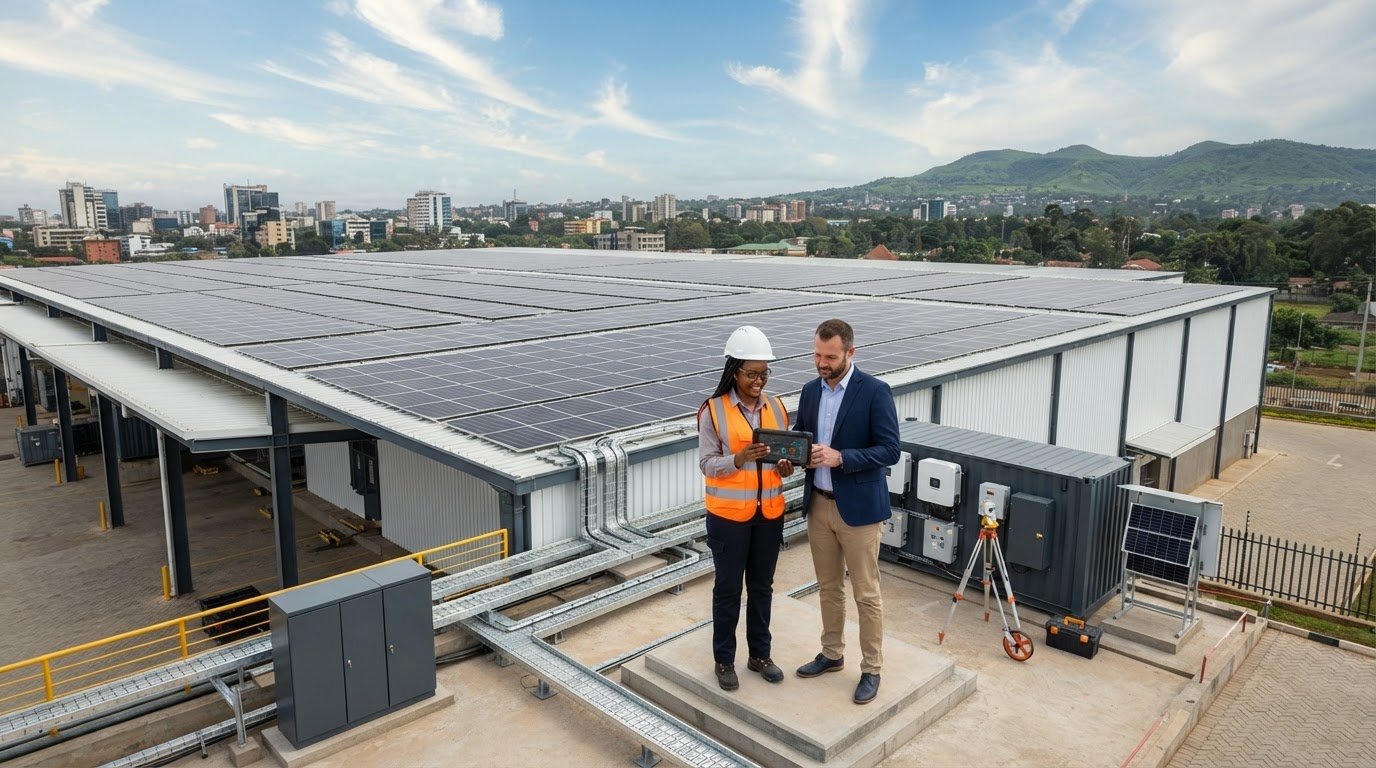
A commercial solar project is not just a panel purchase. It involves connected business and engineering decisions that must fit how a facility uses power. A well-planned commercial solar EPC Kenya project links energy requirements to system design, procurement, construction, and commissioning, with operational needs considered from the outset.
Before committing capital, businesses need clarity on what EPC covers, whether a system can match their demand, and how site and grid conditions affect project planning. This guide explains the stages and responsibilities involved, and the facility information that supports a useful assessment. It also covers how energy audits inform design and when solar generation, battery storage, and power conversion may work together to address load shifting, peak demand, or power continuity objectives.
From consumption profiles and power quality to site conditions, approvals, and commissioning, each decision should connect technical requirements with business priorities. That gives decision-makers a clearer basis for evaluating a project’s fit with the facility and its operating objectives.
Key Takeaways
- Understand how commercial solar EPC Kenya connects engineering, procurement, and construction to a facility-specific scope, rather than an equipment-only purchase.
- Follow the project sequence from baseline assessment through design, procurement, construction, testing, and commissioning.
- See how operating schedules, site constraints, grid connection, and resilience priorities shape system decisions.
- Prepare operational, site, electrical, and decision-making information to support an informed project assessment.
- Learn how energy audits, tailored engineering, and selective integration of storage or power conversion can align EPC delivery with facility objectives.
What commercial solar EPC in Kenya means for your business
A commercial solar project should start with the facility’s energy requirements, not a panel count. Electricity expenditure, daytime demand, operating schedules, resilience priorities, and site conditions all shape the investment decision. A system designed to offset daytime consumption, for example, has different priorities from one that also includes battery storage for selected loads during interruptions.
Commercial solar EPC is the integrated delivery of engineering, procurement, and construction for a facility-specific solar project. It turns business requirements into a technical design, then covers installation, system integration, testing, and commissioning. This is the key difference between an EPC project and buying panels or other equipment alone. Equipment is only one part of the project. The scope must show how the components work together and fit the facility’s electrical infrastructure and operating objectives.
Kenya’s solar sector is part of a broader energy mix, with applications across commercial and industrial settings. The Solar Power in Kenya Overview provides national context, but a business case depends on the individual facility, not the country’s overall solar potential.
What engineering, procurement, and construction each cover
Each EPC stage produces decisions and outputs that guide the next. This keeps the project tied to a defined scope instead of treating equipment selection and installation as separate tasks.
- Engineering: Facility data and business objectives inform the technical design. Inputs can include electricity consumption, demand patterns, power quality, electrical infrastructure, site conditions, and the role solar is expected to play. An energy audit can help assess these factors, while detailed system design defines the project scope.
- Procurement: Equipment is selected and coordinated against the approved design. Components need to match the specified capacity and integration requirements, rather than being chosen in isolation.
- Construction: The approved system is installed and integrated with the facility’s electrical setup. Testing checks operation against the design, followed by commissioning to place the completed system into operation.
Changes in facility requirements or site conditions can affect the scope, so handovers between stages matter. The design informs procurement, and the approved equipment and construction plan guide installation and testing.
Which Kenyan businesses may assess a solar EPC project
Commercial offices, schools, warehouses, hotels, farms, and manufacturing facilities may all assess solar, but a sector label does not establish suitability. A warehouse with regular daytime activity, a school with a different operating calendar, and a production facility with process loads each have distinct demand profiles. The right design depends on those profiles and the facility’s technical conditions.
Start by matching the energy objective to the operating pattern. A business focused on offsetting daytime grid consumption should assess its daytime loads and suitable installation areas. If load shifting, peak shaving, or power continuity is a priority, battery storage and power conversion may also be assessed. These technologies should respond to operational requirements, not be added automatically.
Feasibility depends on the facility’s consumption, site constraints, electrical configuration, and project objectives. The type of business is a starting point for assessment, not a system specification.
How a commercial solar EPC project moves from assessment to commissioning
A commercial solar EPC project in Kenya advances through connected decisions. Facility information defines the design brief, the engineered scope guides equipment procurement, and the selected equipment and construction plan shape installation and testing. If an early assumption changes, such as the timing of a critical load, later decisions may need to be reviewed. Keeping the stages connected helps align delivery with the facility’s actual operating requirements.
Start with facility data and a defined project brief
Use facility evidence rather than assumptions about what a business of its type should need. Consumption records, operating hours, and critical loads show when and where electricity is used. Note power quality concerns and existing electrical infrastructure, as these can influence system design and integration.
- Operating data: Electricity consumption patterns, demand periods, operating schedules, and critical loads.
- Site information: Roof or ground conditions, usable installation areas, and relevant site constraints.
- Electrical context: Existing infrastructure and any known power quality issues.
- Project priorities: Objectives such as daytime energy use, load shifting, peak shaving, or power continuity, separated from assumptions that need engineering assessment.
An energy audit can assess consumption profiles, power quality, and project return metrics. It informs the brief, but detailed engineering is still needed to turn findings into a defined system scope. The Institute of Economic Affairs’ discussion of Challenges in Kenya’s Energy Sector offers broader context; project design must still respond to the facility’s conditions.
Coordinate procurement, construction, and commissioning
Once the project brief and site information have been assessed, the EPC sequence moves from design decisions to implementation. Each stage produces an output that informs the next, rather than leaving equipment choices or installation details to a generic template.
- Establish the baseline: Consolidate facility consumption, operating patterns, site conditions, and objectives into a project brief.
- Engineer the scope: Translate the brief into a technical design, including system configuration and integration requirements. The approved design becomes the basis for procurement.
- Procure equipment: Select and coordinate equipment against the engineered scope so components match the design and their intended roles.
- Construct and integrate: Install the system and connect it with the facility’s electrical infrastructure in line with the project plan.
- Test and commission: Test the integrated system and document its handover for operation.
Commissioning verifies that the installed system operates against the designed project scope. Testing and handover documentation give the facility team a record of what was delivered and checked. Project-specific approvals, interconnection requirements, and applicable technical standards also need to be addressed during delivery. Powerstack Africa’s commercial solar EPC connects assessment, engineering, procurement, and construction in one project pathway.
How Kenyan site conditions and business priorities shape EPC design
Two facilities with similar electricity consumption can need different solar designs. Operating hours, demand timing, usable installation area, existing electrical systems, and the role of the grid all affect the engineering. For commercial solar EPC Kenya projects, the design should match the facility’s measured profile and objectives, not a sector-wide template.
Match system objectives to the facility’s operating profile
Compare when electricity is used with when solar generation can serve the facility. A business with substantial daytime demand may be able to use solar directly during operating hours. If demand falls outside those periods, assess how generation, grid supply, and any storage should work together. Reducing grid reliance and maintaining selected loads during interruptions are separate objectives.
Substantial daytime demand: Assess how solar PV could serve active loads, alongside suitable roof or ground area and the facility’s electrical configuration.
Demand outside solar production hours: Assess the timing and scale of loads before deciding whether storage or continued grid supply is appropriate.
Continuity priority: Identify critical loads and the operational requirement. Battery storage and power conversion may be assessed for selected loads, but continuity depends on a validated system design.
Constrained site: Review usable installation area and the existing electrical system before defining a feasible project scope.
These are assessment paths, not standard system prescriptions. Expected savings or uninterrupted supply should not be promised without facility data and a validated design.
Assess site, grid interface, and storage requirements
Site conditions determine what can be installed and how the system can connect. Assess available roof or ground area, physical constraints, and the facility’s existing electrical infrastructure. Grid connection is also project-specific: the intended system configuration and the facility’s interconnection context influence design decisions. Kenya-wide grid conditions provide useful context, but cannot replace an assessment of the individual site.
Solar PV, battery storage, and power conversion should be engineered as coordinated options. A battery may support load shifting, peak shaving, or power continuity where the operating profile justifies it. Its role depends on the loads to be served and how the system is designed to integrate. Without that assessment, storage can be mismatched to the business objective.
Before finalizing the design, verify the current Kenyan approvals, interconnection requirements, and applicable technical standards for the project. These requirements should inform the scope and delivery plan, rather than being treated as generic assumptions. Apply the same discipline to performance expectations: use facility data and documented design decisions to establish what the system is intended to do.

What to prepare before starting a commercial solar EPC project in Kenya
A focused readiness pack turns an initial discussion into a useful project assessment. It shows how the facility operates, what the site can accommodate, and which business objectives should guide the scope. For a commercial solar EPC Kenya project, early inputs help identify questions for assessment, but they do not replace detailed design calculations or a validated performance model.
Organize operational and electrical information
Start with records that show how the facility uses electricity over time. A bill shows consumption, while schedules and interval data, where available, help reveal when demand occurs and how it changes during operations.
- Energy use: Gather recent utility bills, interval data where available, operating schedules, and known demand peaks.
- Critical loads: Identify equipment that must remain available and describe any continuity requirements.
- Existing supply: Record backup systems or other generation assets, including how they are used in normal operations.
- Electrical records: Collect relevant single-line diagrams, electrical documentation, and details of known power quality concerns.
- Site details: Note potential roof or ground installation areas, access constraints, and known site conditions that could affect assessment.
Flag data gaps rather than filling them with estimates. If schedules have changed, explain when and why. If power quality issues are intermittent, describe the conditions in which they occur. This helps distinguish measured facility conditions from assumptions that need investigation.
Define decision criteria and project boundaries
Agree on project priorities before comparing technical options. These might include energy-cost management, reduced grid reliance, resilience for selected loads, or implementation in phases. Priorities can compete. A continuity objective, for example, may require a different assessment from a project focused primarily on daytime demand.
- Set decision roles: Identify the operations, finance, and facilities stakeholders who will provide input, assess the business case, and make decisions.
- Define boundaries: State which buildings, operating areas, or loads are within the assessment, and note any planned operational changes.
- Record constraints: Include site access, operating restrictions, internal approval steps, and relevant project timing considerations.
- Separate targets from estimates: Label assumed capacity, savings, and returns as preliminary until engineering assessment validates them.
An energy audit can help identify consumption profiles, power quality issues, and project return metrics. Its findings inform project decisions, but do not determine final system capacity on their own. Detailed design must account for the facility’s electrical configuration, site conditions, and objectives.
Useful EPC assessment inputs include utility and load data, operating schedules, critical loads, site and electrical records, known constraints, project priorities, and the stakeholders responsible for decisions. Organize these details first so the assessment can establish what needs further measurement or engineering.
Powerstack Africa’s commercial energy audit can assess your facility’s operating data and objectives as part of project planning.
How Powerstack Africa delivers commercial solar EPC across Kenya
Powerstack Africa Energy Ltd delivers turnkey commercial and industrial solar EPC across Kenya. The work connects facility objectives with assessment, engineering, procurement, construction, and commissioning. Instead of starting with a standard equipment package, the project scope is developed around the site, electricity use, and operational priorities. This gives decision-makers a clear path from the business brief to an engineered system.
Energy audits establish useful decision inputs by assessing consumption profiles, power quality, and project return metrics. These findings inform the design process but do not replace detailed engineering. Custom engineering translates facility requirements into a technical scope, which then guides equipment selection and construction planning.
Integrate solar EPC with storage and power conversion where needed
Solar PV, battery energy storage, hybrid inverters, and power conversion systems are considered in relation to project requirements, not added automatically to every installation. The design should define the operating role of each component and how it fits the facility’s electrical systems and energy priorities.
- Solar PV: Designed in relation to site conditions and the facility’s electricity use.
- Battery storage: May support load shifting, peak shaving, or power continuity objectives where the operating profile supports those goals.
- Hybrid inverters and PCS: Coordinate power conversion and energy flow between solar generation, batteries, and facility systems as defined by the design.
Storage requirements depend on the loads and outcomes the business wants to address. A continuity objective, for example, should identify which operations matter and how the proposed system is intended to support them. Engineering determines the appropriate configuration. This keeps storage capacity and equipment selection tied to an operational purpose.
Move from project brief to a tailored EPC assessment
A useful starting brief brings together utility bills and available interval data, operating schedules, known demand peaks, critical loads, power quality concerns, site information, and relevant electrical records. Add priorities that will guide the project, such as energy-cost management, reduced grid reliance, resilience, or phased implementation. These inputs focus the assessment; detailed capacity and performance decisions follow engineering review.
Powerstack Africa Energy Ltd provides a commercial solar EPC Kenya service that connects those inputs to a facility-specific assessment and scope. The delivery pathway brings energy auditing, tailored engineering, procurement, and construction into an integrated project, with battery storage and power conversion incorporated where operational requirements call for them. The project plan is grounded in the facility’s conditions and objectives, rather than assumptions based on its sector or equipment alone.
Prepare your facility data and project priorities to begin shaping a tailored assessment with Powerstack Africa Energy Ltd.
Turn your energy priorities into a project brief
Convert your facility’s priorities into a clear basis for decision-making. Identify the operational outcomes that matter most, the constraints that could affect delivery, and the evidence your team needs to evaluate the investment. This gives a commercial solar EPC Kenya assessment a practical starting point and keeps technical choices connected to business requirements.
Bring operations, facilities, and finance into the discussion early. Their shared input can clarify project boundaries and how the proposed system will be assessed. Treat unresolved questions as items for engineering review, not assumptions about capacity or performance.
Powerstack Africa can help move that brief toward a facility-specific EPC assessment, with energy audits and storage or power conversion considered in line with project requirements. Begin planning your commercial solar EPC project with a clear basis for evaluation.
Frequently Asked Questions
What does commercial solar EPC include in Kenya?
Commercial solar EPC includes engineering, procurement, and construction delivered as one project against a defined facility scope. Engineering translates site and energy requirements into a design; procurement aligns equipment with that design; construction covers installation and system integration. Testing and commissioning check the completed system against its intended scope. This differs from buying panels or inverters alone, which does not establish how equipment will work within a facility’s electrical setup.
How does a commercial solar EPC project work from assessment to commissioning?
A commercial solar EPC project starts with facility assessment and defined objectives. Engineering develops a technical scope from those inputs, and procurement follows the approved design. Construction installs and integrates the system, followed by testing and commissioning. Each stage informs the next: a change in operating requirements, for example, may affect system design and equipment selection. Commissioning confirms the installed system’s operation against the project scope.
Can a commercial solar EPC system include battery storage?
Yes. A project can include battery energy storage where the facility’s requirements support it. Storage may be considered for load shifting, peak shaving, or power continuity. A business might assess storage for specific critical equipment rather than assume the entire site needs backup. The system design must determine how batteries, power conversion equipment, solar generation, and facility loads work together. Storage should serve a defined operational purpose, not be added by default.
How is a commercial solar project tailored to a facility’s electricity demand?
Design is informed by how much electricity a facility uses, when demand occurs, and which loads matter operationally. Interval data can reveal differences between shifts, while schedules can explain changes in demand across operating periods. A facility with processes running overnight, for example, has different timing considerations from one whose main activity occurs during the day. Engineering assessment uses this context alongside site and electrical information to develop a suitable configuration.
What information should a business prepare before a solar EPC assessment?
Prepare utility bills, available interval readings, operating schedules, known demand peaks, and a list of critical equipment. Include site details, relevant electrical records, backup or generation assets, and known power quality concerns. Label records by building, meter, or operating area and note recent changes in production or hours. This helps distinguish current conditions from historical data and gives the assessment useful operational context.
Do commercial solar EPC projects in Kenya require approvals or grid coordination?
Some projects require approvals or coordination related to their configuration and grid connection. Applicable requirements depend on the project, so current Kenyan approvals, interconnection requirements, and technical standards should be verified during planning. Do not assume that an arrangement suitable for one facility applies to another. Early attention to the grid interface helps identify requirements that may affect system design, project scope, and delivery planning.
How does an energy audit support a commercial solar EPC project?
An energy audit gives the project team a structured view of facility consumption, load profiles, power quality issues, and return metrics. It can help identify when demand occurs and which operating conditions may influence a solar or storage assessment. For commercial solar EPC Kenya, audit findings are useful decision inputs, not a final system design. Engineering must still assess site conditions, electrical integration, and defined objectives before confirming the project scope.