

The right industrial solar system starts with production data, not a panel count. For solar EPC for industrial facilities in Kenya, the central question is how generation will align with operating schedules, electrical infrastructure and demand across shifts. A design based on capacity alone can overlook the loads that matter most.
It is reasonable to ask whether installation could disrupt production, how much solar power a facility can use as it is generated, and whether solar alone can meet its resilience needs. A sound assessment maps these operating conditions before system sizing and project execution are defined.
This 2026 guide explains what industrial EPC covers, how solar generation can work with existing facility infrastructure, and what information supports an informed assessment. It also explains how energy audits examine consumption profiles, load patterns, power-quality issues and project return metrics, and when battery storage may support load shifting, peak shaving or power continuity.
Key Takeaways
- Assess operating hours, site space and electrical infrastructure to establish whether a solar project fits the facility.
- Understand the industrial EPC sequence, from assessment and engineering through construction, testing and handover.
- Compare the roles of solar PV, grid supply, generators and battery storage before deciding how they may work together.
- Prepare electricity bills, interval data, operating schedules and generator-use records for a more informed assessment.
- See how solar EPC for industrial facilities can be tailored to site conditions, with energy audits informing project design and evaluation.
Why industrial facilities in Kenya assess solar EPC around operations
For an industrial site, solar feasibility depends on the work happening beneath the panels. A production line may operate during daylight, run across shifts or rely on equipment with high start-up demand. These patterns affect how much solar generation the facility can use on site and how the system should connect to existing electrical infrastructure.
Industrial solar EPC is the coordinated engineering, procurement and construction of a solar project designed around a facility’s production demands and electrical systems, not simply the purchase of panels as standalone equipment. Equipment selection follows an assessment of site conditions and demand, rather than setting the project scope before its operational needs are understood.
What distinguishes industrial solar EPC from a standard solar installation?
Industrial design starts with how the facility uses power. Engineers review operating shifts, production schedules and demand patterns to understand when solar generation can serve active loads. A site that runs most processes during the day has a different profile from one with substantial night shifts or demand peaks outside solar generation hours.
Existing infrastructure also shapes the design. The project must account for the facility’s grid connection, distribution equipment and any standby generators. These systems affect how solar integrates with the site and interacts with other power sources. Where a facility manages interruptions or uses generators to support operations, planning should reflect its actual arrangements rather than assume solar will replace them.
Engineering comes before procurement and construction. The Solar Power Overview describes solar technologies and applications, but an industrial EPC assessment must translate relevant options into a site-specific design. Usable roof or ground space, shading, structural conditions, electrical infrastructure and facility demand all inform feasibility. This sequence helps define the project around operational requirements before equipment is selected or installation work is planned.
Which industrial facilities may assess solar EPC?
Manufacturing plants, warehouses and energy-intensive processing facilities may assess solar EPC when site conditions and energy use indicate a potential fit. Their operating demands differ. A warehouse may have large roof areas and daytime lighting or refrigeration loads, while a plant may run motors and process equipment on defined shifts. Processing facilities may have continuous or variable loads tied to production cycles.
These examples are starting points, not a guarantee of suitability. A practical assessment considers usable roof or ground space, electricity consumption patterns, operating hours and electrical systems. Energy audits can examine consumption profiles, load patterns, power-quality issues and project return metrics. The findings give facility teams a grounded basis for deciding whether a solar project aligns with operations and which constraints need further engineering attention.
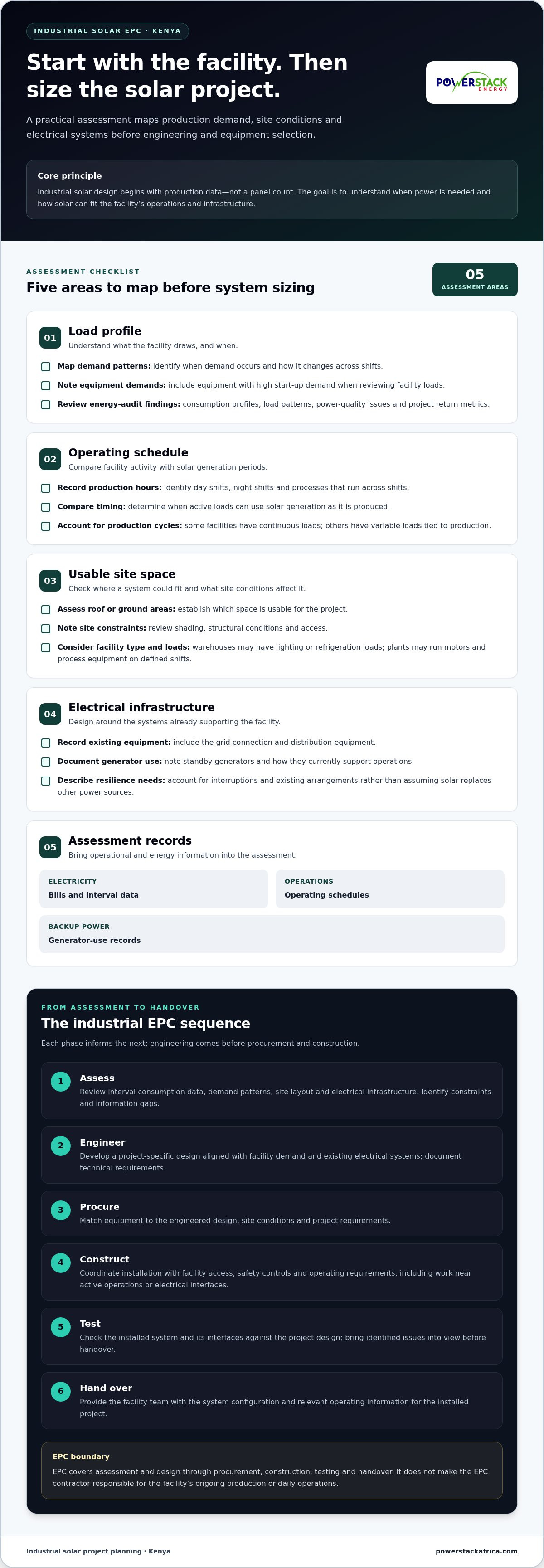
- Load profile: Identify when demand occurs and how it changes across shifts.
- Operating schedule: Compare production hours with expected solar generation periods.
- Site space: Assess usable roof or ground areas, including shading and access conditions.
- Electrical infrastructure: Record how grid supply and generators currently support operations.
What industrial solar EPC covers, from facility assessment to handover
Industrial EPC turns facility requirements into a defined solar project, with each phase informing the next. Assessment establishes the operating and site conditions. Engineering converts them into a design, procurement and construction deliver it, and testing and handover close the project scope. This discipline is part of Kenya’s wider industrial energy discussion, reflected in the KIPPRA Report on Solar Energy in Kenya.
The EPC boundary runs from assessing and designing the project through equipment procurement, construction, testing and handover. It does not make the EPC contractor responsible for the facility’s ongoing production or daily operations. For solar EPC for industrial facilities, that distinction helps teams plan where project work meets plant procedures.
- Assess: Review available interval consumption data, demand patterns, site layout and electrical infrastructure. Identify constraints and information gaps that affect the project scope.
- Engineer: Develop a project-specific design that aligns the proposed solar system with facility demand and existing electrical systems. Document technical requirements before selecting equipment.
- Procure: Match equipment to the engineered design, site conditions and project requirements. Procurement should follow the design, not substitute a generic equipment package.
- Construct: Coordinate installation with facility access, safety controls and operating requirements. Plan work sequencing with the site team, especially near active operations or electrical interfaces.
- Test: Check the installed system and its interfaces against the project design. Testing helps establish readiness for handover and brings identified issues into view.
- Hand over: Provide the facility team with system configuration and relevant operating information as a reference for the installed project.
How engineering translates facility data into a project design
Engineering connects facility records to decisions about system layout, electrical integration and equipment requirements. Interval consumption data and demand records show how site use varies over time. Site plans help assess available installation areas and access. Structural capacity, shading, safety controls and production constraints also inform the design where applicable. The resulting technical requirements should reflect the facility, not assumptions carried over from another site or a standard package.
How construction, testing, and handover fit the EPC scope
Construction brings the engineered design onto the site. Coordinating with facility personnel helps sequence work around access restrictions, production areas and electrical interfaces. The project plan should reflect actual site conditions. Testing checks the completed installation and its interfaces before handover. Configuration records and operating information give facility teams a reference for the delivered system, while making clear that project completion is separate from ongoing facility operations.
A facility-specific scope gives operations and engineering teams a shared basis for planning. Powerstack Africa’s commercial and industrial solar EPC brings assessment, design, procurement and construction into a coordinated project framework.
Can industrial solar support operations without replacing every power source?
Yes. Industrial solar can form one part of a facility’s power mix. Installing solar PV does not automatically replace grid supply or standby generation, and solar generation alone does not guarantee uninterrupted power. The practical design question is how the facility’s sources work together during normal operations, demand peaks and supply interruptions.
Timing matters. Solar produces energy during daylight, while facility consumption may vary by shift, process or production schedule. If generation and demand do not align, the project design must account for the difference. An assessment should consider when energy is available, when the facility needs it and what role existing sources already perform.
| Power source | Typical role in the facility | Planning consideration |
|---|---|---|
| Solar PV | Generates electricity on site during daylight hours. | Compare generation periods with the facility’s daytime demand and electrical arrangement. |
| Grid supply | Provides the facility’s connected electricity supply. | Account for how the site uses grid power alongside solar generation. |
| Generator | Can provide complementary or standby supply, depending on the facility’s setup. | Understand when it operates and how it is integrated with existing systems. |
| Battery storage | Can store energy for later use and may support load shifting or power continuity. | Assess its role against the facility’s operating priorities and system design. |
What role can solar PV play in an industrial power mix?
Solar PV can contribute to active facility loads while the system is generating. For example, a site with daytime production may use solar alongside grid supply, with the grid remaining part of the overall arrangement. The contribution depends on site conditions, system design and consumption patterns. Without project-specific analysis, it is not sound to assign a percentage of facility demand that solar will serve.
When might battery storage or a generator enter the discussion?
Storage may be considered when a facility wants to shift some energy use or support power continuity. A generator may remain a complementary source rather than an automatic replacement target. The appropriate roles depend on operating priorities and how each source interacts with the facility’s electrical systems. Battery sizing and load-shifting strategies should be based on the facility’s actual load profile and intended use.
For solar EPC for industrial facilities, treating each source as part of a coordinated architecture keeps the design grounded in operating needs. It also helps facility teams distinguish solar’s energy contribution from the separate need to plan for continuity during interruptions.
How to prepare an industrial facility for a solar EPC assessment
A useful assessment begins with a clear picture of how the facility consumes power and how its site operates. Gather existing records before the site review, and note gaps rather than filling them with estimates. This helps focus the assessment on real operating conditions, constraints and priorities. For solar EPC for industrial facilities, good initial information makes project discussions more specific and productive.
Which energy and operating records help scope the project?
Gather electricity bills and any available interval meter data or demand records. Add operating schedules showing shifts, shutdown periods and seasonal changes. Generator-use records can help explain how the facility manages supply interruptions. Where possible, distinguish essential loads from flexible or non-critical consumption, and identify processes that cannot be interrupted or easily rescheduled.
- Electricity records: Recent bills, meter data, interval consumption and available demand information.
- Operating patterns: Production shifts, planned shutdowns, seasonal changes and significant differences between operating days.
- Backup supply: Generator-use records showing when generators operate and which loads they support.
- Load priorities: Critical equipment and processes, plus loads that may be flexible or non-essential.
- Future plans: Planned expansions, new equipment or production changes that could affect future demand.
Keep records in their original form where practical. A bill, meter export or operations schedule provides useful context. A short note about unusual production periods can make the data easier to interpret.
What site and infrastructure information should teams assemble?
Prepare available site plans and electrical drawings, along with information about grid and generator connections. Mark potential roof or ground areas, access routes, known shading and locations where work could affect production. Note known structural limitations or operational restrictions so they can be considered during the feasibility assessment.
- Site layout: Available roof or ground areas, access points and nearby obstructions or shading.
- Electrical documentation: Existing drawings and records describing the facility’s electrical infrastructure and power connections.
- Operational constraints: Restricted work zones, sensitive processes, safety controls and periods when access is limited.
- Project changes: Planned construction, equipment additions or site modifications that may affect design assumptions.
For a project in Kenya, identify grid-connection, electrical and environmental requirements for current, project-specific review. Requirements can depend on the project and site context. Separate confirmed information from items that still need review, and do not rely on an old project file or generic checklist as a substitute for assessing the proposed installation.
Prepare these records and site notes for a facility-specific assessment with Powerstack Africa’s industrial solar EPC team.
How Powerstack Africa delivers industrial solar EPC across Kenya
Powerstack Africa Energy Ltd delivers commercial and industrial solar EPC as a facility-specific engineering, procurement and construction service across Kenya. Projects begin with the facility’s energy use and operating constraints, not a preselected panel capacity. This gives technical and operations teams a shared basis for assessing how a solar system could fit the site, connect with existing infrastructure and be planned around production requirements.
How Powerstack connects energy assessment with EPC planning
Powerstack Africa’s energy audits examine consumption profiles, load patterns, power-quality issues and project return metrics. These findings help clarify facility demand and identify constraints relevant to project planning. The assessment informs system design and procurement decisions; it does not presume a particular system size or outcome before the site and its operating needs are understood.
Where the assessment supports considering storage, battery energy storage integration can be included as a project option. Its relevance depends on the facility’s objectives, such as load shifting, peak shaving or power continuity. Solar generation, storage and existing supply infrastructure are considered in relation to the site rather than treated as a standard package.
What to include in an initial project discussion
A concise facility brief helps focus the initial discussion. Describe the operating context and share the records available, then flag constraints that could affect assessment or installation planning. Complete data is useful, but a clear note about missing records or upcoming changes is more helpful than an unsupported estimate.
- Facility profile: Describe the facility type, main processes and operating schedule, including shifts and planned shutdowns.
- Energy records: Share available electricity bills, interval or meter data, demand records and generator-use information.
- Power sources: Summarize how the facility uses grid supply, standby generators and any existing energy systems.
- Operational priorities: Identify critical loads, production-sensitive areas, access restrictions and periods when work could affect operations.
- Site information: Note potential roof or ground areas, available electrical drawings, known shading or structural concerns, and relevant site access details.
- Future changes: Flag planned expansions, new equipment or process changes that could alter the facility’s demand or layout.
These inputs help connect audit findings to a project scope shaped around the facility. Powerstack’s coordinated EPC planning considers engineering, equipment procurement and construction in the context of site requirements and production priorities. Grid-connection, electrical, environmental and other applicable requirements should be reviewed for the specific project as its scope develops.
Bring your operating context and available records to an initial discussion about a facility-specific assessment. Discuss an industrial solar EPC project with Powerstack Africa.
Set the next project decision around your facility
Align the people who will evaluate and deliver the project internally. Operations can define production constraints, engineering can identify interfaces and information gaps, and finance can set criteria for assessing capital priorities. Agreeing on these roles early gives the project a clear decision path and keeps technical assumptions connected to business needs.
Before deciding how to proceed, define what the facility needs to learn from an assessment. Identify operating conditions that require validation, constraints the project must respect and how proposed options will be judged against facility priorities. This gives your team a practical framework for evaluating solar EPC for industrial facilities without presuming a system size or outcome before the relevant information is reviewed.
Bring those priorities and the records your team has available into a focused project discussion. Plan your industrial solar EPC assessment with Powerstack Africa. A clear brief is a strong starting point for a measured, facility-led decision.
Frequently Asked Questions
What does solar EPC mean for an industrial facility?
Solar EPC means one coordinated project covering engineering, procurement and construction of a facility’s solar system. For an industrial site, the design must account for production needs and how the system connects with existing electrical infrastructure. The EPC scope generally concludes with testing and handover, while the facility continues to manage its own operations. This gives teams a defined project pathway rather than a separate panel purchase without site-specific design.
How does an industrial solar EPC project affect factory operations during construction?
Construction can affect access to work areas and may require coordination around production. The specific impact depends on the facility layout and project scope. For example, work near a loading zone or electrical equipment may need sequencing to avoid conflicting with scheduled activity. Before construction, operations and engineering teams can identify restricted areas, production-sensitive periods and electrical interfaces that require coordinated planning. The project plan should reflect those conditions.
Can solar power an industrial facility when the grid is unavailable?
Solar PV alone should not be assumed to keep an industrial facility powered during a grid outage. Whether a system can supply selected loads during an interruption depends on its design and the equipment integrated with it. A facility that needs continuity should identify critical loads and assess whether storage or another power source belongs in the system architecture. The design must be evaluated for those operating conditions rather than inferred from panel installation alone.
Does an industrial solar EPC project include battery storage?
Battery storage can be integrated into an industrial solar project, but it is not automatic in every EPC scope. The assessment should establish whether storage addresses a defined facility need, such as shifting energy use or supporting continuity for selected loads. If included, storage planning should account for its intended use and interface with solar, grid supply and other site systems. Battery capacity and operating strategy require project-specific analysis.
What information is needed for an industrial solar assessment in Kenya?
Prepare electricity bills, available meter or interval data, production schedules and generator-use records. Also note critical loads, planned equipment additions, shutdown periods and site access constraints. Electrical drawings and details about existing grid and generator connections can help clarify the facility’s setup. If records cover unusual production periods, annotate them so demand patterns are not misread. Current grid-connection, electrical and environmental requirements should be reviewed for the specific project.
How long does it take to complete an industrial solar EPC project?
There is no single reliable duration for every industrial EPC project. The schedule depends on factors such as assessment findings, design complexity, equipment procurement, site conditions and how construction can be coordinated with facility operations. Project requirements may also affect planning. A useful timeline can be developed once the scope, site constraints and execution sequence are defined. Avoid treating a generic estimate as a commitment for a particular facility.
Does an industrial facility need a generator if it installs solar?
Installing solar does not automatically remove the need for a generator. The decision depends on the facility’s continuity requirements, existing power arrangement and how solar performs alongside other sources. A plant with critical processes may retain a generator as complementary supply while evaluating storage or other configurations for specific needs. Start by documenting which loads must remain available during interruptions and how the facility currently supports them. The system design can then assess the appropriate role of each source.