
A 100 kWh battery can run a 10 kW load for 10 hours in a straightforward calculation, but that doesn’t automatically make it right for your business. How to size a commercial battery system depends on power demand, required operating duration, usable energy and conversion losses.
Your facility’s total demand is only part of the picture: essential equipment may have different power and backup requirements. This guide explains how load profiles, site conditions and operating priorities shape a practical battery design for your business in Kenya.
Key Takeaways
- Use interval demand data to identify which business loads matter most and when they peak.
- Account for electrical capacity, equipment start-up demands, installation space and site conditions before selecting a system.
- Match battery power to the load’s required output and usable energy to how long it must run.
- Set the operating strategy around your priority, such as backup power or peak-demand reduction, before finalising the system design.
Battery sizing from business load and critical equipment
Size storage around the loads you need to support, their peak demand and the required backup duration. Assess the battery’s energy capacity separately from the power conversion system (PCS) output.
Sizing From Daily Energy and Peak Demand
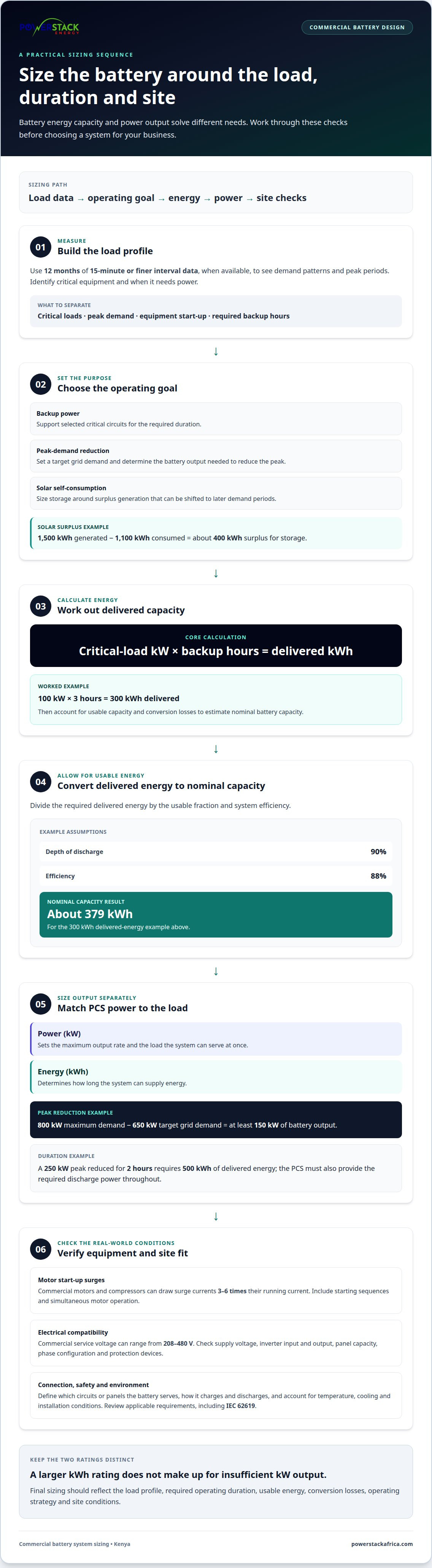
Multiply critical-load demand in kW by backup hours to calculate delivered kWh; then allow for usable capacity and losses. Use 12 months of 15-minute or finer interval data, when available, to reveal demand patterns. A 100 kW load for three hours needs 300 kWh delivered; at 90% depth of discharge and 88% efficiency, nominal capacity is about 379 kWh. Factory and retail needs differ: a factory may peak at 1.5 MW for 20 minutes, while retail refrigeration may need 150-200 kWh for 12-18 hours.
Separating PCS Power From Battery Energy
PCS power, measured in kW, determines the maximum output rate; battery energy, measured in kWh, determines how long that output can continue. Size each independently against the operating requirement. For example, reducing a 250 kW peak for two hours requires 500 kWh of delivered energy, while the PCS must provide the required discharge power throughout that period. A large battery alone cannot compensate for insufficient PCS output.
Sizing for Solar Self-Consumption and Demand Charges
For solar self-consumption, size energy storage around surplus generation available to shift into later demand periods. A facility generating 1,500 kWh and consuming 1,100 kWh has about 400 kWh of surplus for storage. For peak reduction, compare the site’s maximum demand with its target grid demand: an 800 kW maximum and 650 kW target require at least 150 kW of battery output. The operating strategy determines when the battery charges and discharges.
Accounting for Motor Surge Loads
Inverter selection must accommodate both continuous load and motor start-up surges. Commercial motors and compressors can draw surge currents 3-6 times higher than their running current, so a rating based only on steady demand can be inadequate. Include starting sequences and simultaneous motor operation in the load assessment. As a reference point, a 125 kW, 400 V three-phase PCS output at unity power factor corresponds to approximately 180 A before model-specific limits apply.
Site electrical and environmental assessment
Site conditions matter as much as the load profile when sizing commercial battery storage. Check electrical compatibility, connection topology, temperature and installation conditions before selecting equipment.
Checking Grid and Electrical Compatibility
Compatibility means matching the battery, inverter and site electrical supply so they can operate together. Commercial service voltage can range from 208-480 V, so an engineer should compare the site supply, inverter input and output, and existing panel capacity. The assessment also considers phase configuration, protection devices and how the battery will connect to current equipment. This prevents an otherwise suitable storage system from being mismatched to the facility.
Grid Connection and Electrical Topology
Electrical topology describes how the grid, battery, inverter and business loads connect. For a grid-tied installation, the design must define whether storage serves selected critical circuits or a broader facility panel, and how it charges and discharges. If peak electricity rates influence operation, compare the facility’s consumption periods with its tariff periods. That schedule helps determine when stored energy can offset grid demand. A site-specific electrical assessment can map these connection and operating requirements.
Safety and Electrical Standards
Battery safety assessment considers chemistry, equipment integration, temperature and installation conditions. Lithium iron phosphate batteries are listed with a cycle life of 4,000-10,000 cycles, while lithium nickel manganese cobalt batteries are listed at 2,000-6,000 cycles. Lead-acid and lithium-ion choices also differ in operating characteristics and lifecycle considerations; selection should reflect the duty cycle and site design, not chemistry alone. Review relevant electrical and battery standards, including IEC 62619, alongside the project’s design requirements. Commercial batteries commonly use air or liquid cooling, so the engineer should account for heat management and the actual installation environment.
Difference between battery power and energy capacity
How to size a commercial battery system starts with matching its output power to the required operating duration. Power, measured in kW, is the rate of energy delivery; energy capacity, measured in kWh, indicates how much energy the system can supply over time. Both ratings must suit your load profile and intended use.
Power Rating Versus Energy Capacity
A 50 kW / 200 kWh configuration can provide 50 kW for about four hours at nominal capacity. The power rating sets the maximum load the system can serve at once. The energy rating describes its stored electricity. A facility with high short-term demand needs sufficient power; a lower load running longer needs greater energy capacity. One rating cannot replace the other.
Calculating Nominal Capacity From Usable Energy
When you determine how to size a commercial battery system, account for usable depth of discharge and system efficiency. Both affect how much stored energy reaches the loads. Divide required delivered energy by the usable fraction and efficiency to estimate nominal capacity. Under the stated sizing assumptions, a 200 kWh delivered-energy requirement corresponds to approximately 234 kWh of nominal battery energy.
Commercial Battery Capacity and Backup Duration
Estimate backup duration by dividing usable energy by the expected load in kW. A 100 kWh storage system with a 20 kW power rating can deliver 20 kW for five hours at nominal capacity, before accounting for usable limits and conversion losses. Commercial backup periods may range from 12-24 hours, depending on critical loads and operating needs. Tariff-based operation also affects capacity requirements because discharge timing follows facility consumption.
Accounting for Degradation and Warranted Capacity
Battery capacity can decline with use, so consider the usable capacity over the planned operating life. Review the manufacturer’s warranty terms and how retained capacity is defined. The design should meet the facility’s demand and backup requirements as capacity changes. A system sized only for its initial rating may provide less usable energy over time.
Battery power, usable energy and operating strategy
System sizing depends on the operating task, not capacity alone. For industrial battery storage, define the required output, usable energy, discharge duration and recharge window. A 100 kW / 200 kWh system can theoretically deliver 100 kW for approximately two hours. Actual operation also depends on usable capacity, conversion efficiency and system limits.
Set the control strategy before choosing the final configuration. Backup operation reserves energy for critical loads, while peak shaving discharges the battery during selected demand peaks. Solar self-consumption stores surplus generation for later use. These priorities can compete: keeping a backup reserve leaves less energy available for daily commercial load shifting. Specify which loads take priority and when the battery can discharge.
Depth of discharge affects how much nominal capacity can serve the load. One sizing example uses 90% depth of discharge, leaving part of the stored energy outside the planned usable range. Efficiency also reduces delivered output between charging and discharging. For a 40 kW critical load running for several hours, define the required duration first, then calculate delivered energy and account for system limits.
- Backup: Set a reserve for critical equipment and the required outage period.
- Peak shaving: Match discharge power and duration to the target demand reduction.
- Solar shifting: Align charging with surplus generation and later consumption.
A 500 kWh battery paired with a 100 kW power conversion system cannot continuously deliver 200 kW. Battery energy cannot compensate for insufficient output power. Confirm that the battery, inverter and site voltage configuration support the intended operating mode. Supplier specifications should also define usable capacity and efficiency assumptions used in the design.
Define your priority and dispatch schedule with an energy storage assessment before finalising system operation.
Powerstack Africa Energy: Battery Energy Storage Systems
Powerstack Africa Energy Ltd delivers Battery Energy Storage Systems for commercial and industrial facilities planning backup, peak-demand reduction or solar energy storage. Involve the team when your load profile, critical equipment and operating strategy need to inform a coordinated system design.
Energy Audits assess facility consumption and identify requirements that inform battery selection. If storage needs to work alongside on-site solar, Commercial Solar EPC can support the wider project design. Hybrid Inverters & PCS address the conversion and power-control requirements for connecting storage to business loads.
The right configuration depends on your site’s electrical conditions, required output and backup duration. Discuss your facility’s operating priorities and project requirements with Powerstack Africa Energy Ltd.
Contact Powerstack Africa Energy Ltd to discuss your commercial battery requirements.
Put Your Battery Design Into Project Context
A battery project should support your facility’s wider plans and operational decisions. Consider how production schedules, planned equipment changes and continuity requirements may affect future energy use. This context helps keep the design relevant as business needs evolve.
Powerstack Africa Energy Ltd’s engineering team can help turn your project objectives into a practical design brief. Clear priorities make it easier to align technical decisions with the facility’s operating plans.
Explore the next step for your battery project and move your planning forward with a clear operational direction.
Frequently Asked Questions
Is a 100 kWh battery enough for commercial use?
It can be, if its output and usable energy match the facility’s priority loads and operating period. For example, the SAJ 50 kW All-In-One Energy Storage Solution has 100 kWh capacity and a theoretical runtime of about two hours at a 50 kW load, before losses. A site with higher demand or longer backup needs requires a different system configuration.
What information is needed to size a commercial BESS?
A useful assessment needs interval electricity consumption, peak demand, critical equipment, site electrical details and the intended operating purpose. Include solar generation data if the system will store surplus energy. For a stronger demand profile, use at least 12 months of 15-minute or finer interval data when available. Note planned changes to production or operating hours, since these can alter future demand.
What should you prepare before requesting a BESS proposal?
Prepare recent electricity bills, available interval load data, a list of critical equipment and any site electrical drawings. State whether your priority is backup, peak shaving, solar self-consumption or a combination. Include the required backup period and any known motor-starting or production constraints. These details help the design team assess the facility’s operating needs and develop a project-specific proposal.
How do you size a commercial battery inverter for peak power and backup loads?
Base inverter output on the highest simultaneous load the battery must support, including motor starting and other short-duration surges. Then match its voltage, phase and connection requirements to the facility supply. For backup, identify which circuits need to operate together during an outage rather than counting every installed load. This defines the inverter’s duty and avoids assuming the entire site needs backup.
How many hours of battery backup should a commercial building plan for?
Set backup duration from the time critical equipment must remain operational and the facility’s response plan. A 50 kW critical load running for eight hours requires 400 kWh of delivered energy before accounting for system limits. Include the time needed to transfer operations, reduce loads or restore another power source. Essential services and production processes may therefore require different backup periods within one building.
How do you size commercial battery storage with solar panels and time-of-use tariffs?
Compare solar generation with facility consumption throughout the day. Identify when surplus energy can charge the battery and when stored energy should serve loads. Align discharge with applicable tariff periods while preserving any required backup reserve. For example, a facility may prioritise evening operations after daytime solar production. The storage configuration depends on the surplus profile, target consumption periods and chosen operating priority.