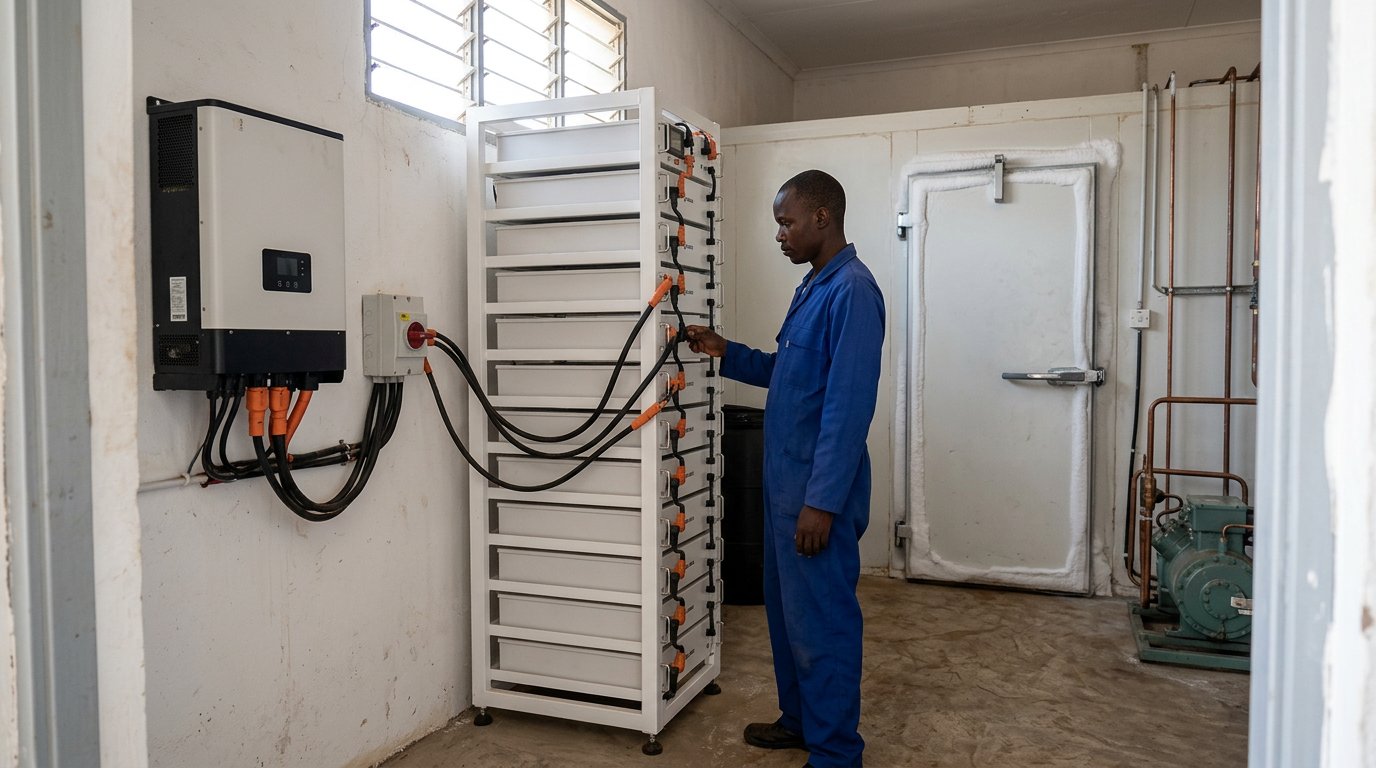
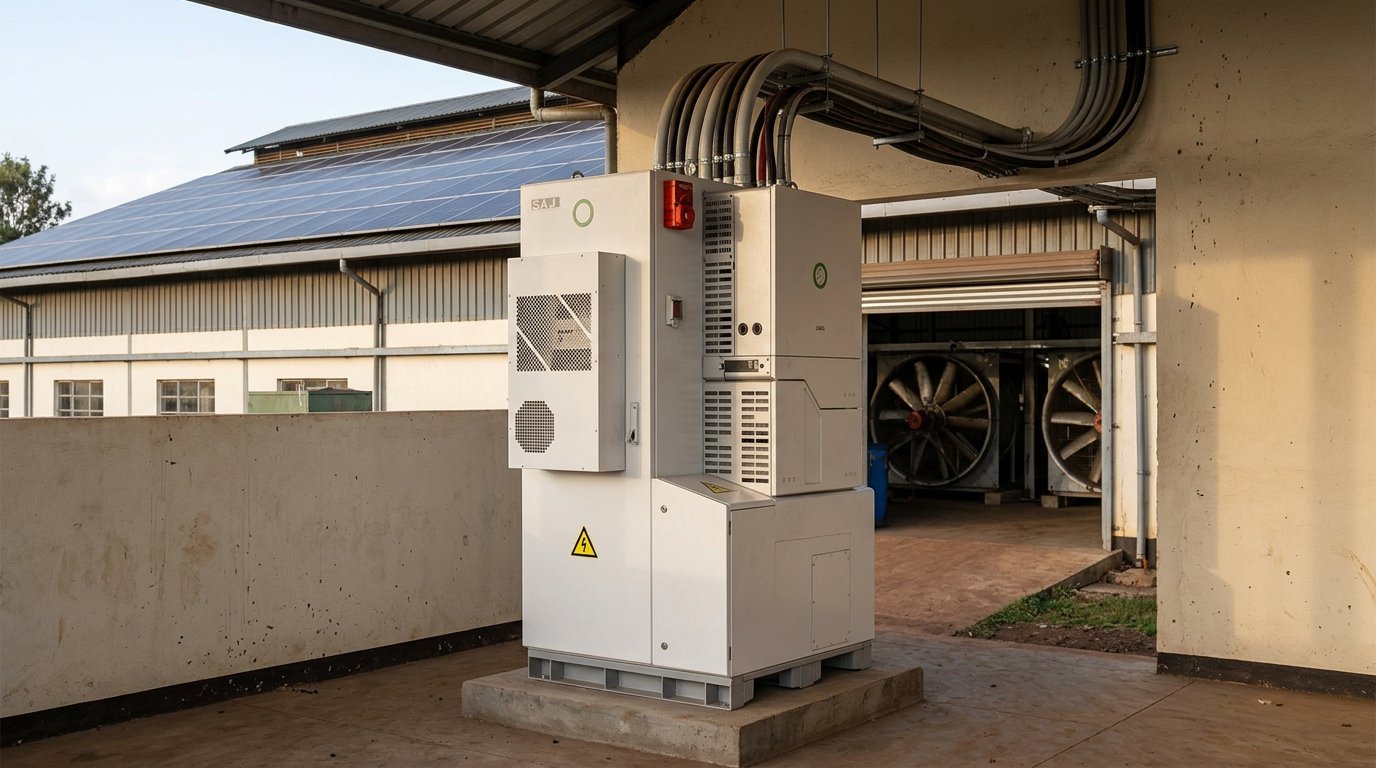
Over 80% of the power injected into Kenya’s grid comes from renewable sources. Battery energy storage systems in Kenya can store surplus electricity for later use, including during peak demand or when renewable generation falls, helping balance supply and demand rather than replacing the grid. This guide explains how battery storage works, how it can support solar and other renewable power, and when storing electricity closer to where it is used may help reduce transmission losses. It also looks at the role storage could play in Kenya’s energy future, the factors that shape its effectiveness, and what businesses, farms and households should consider when assessing a system. The central question is practical: how can stored power make renewable electricity more useful when generation and demand do not align?
Key Takeaways
- Understand how stored electricity can support grid stability and help match renewable supply with changing demand.
- See why solar and wind variability makes energy storage useful, and what storage can and cannot address.
- Learn what components define a battery energy storage system and how it connects to power generation and consumption.
- Explore battery technology options in Kenya and how Powerstack Africa Energy’s storage, inverter, solar EPC and audit offerings fit different energy needs.
What is a battery energy storage system?
A battery energy storage system stores electricity and releases it when generation and demand do not coincide. In Kenya, it can support renewable energy integration, grid balancing, backup power, or off-grid supply.
Its role depends on the grid connection, operating controls, and the loads it serves.
Grid Stability and Renewable Integration
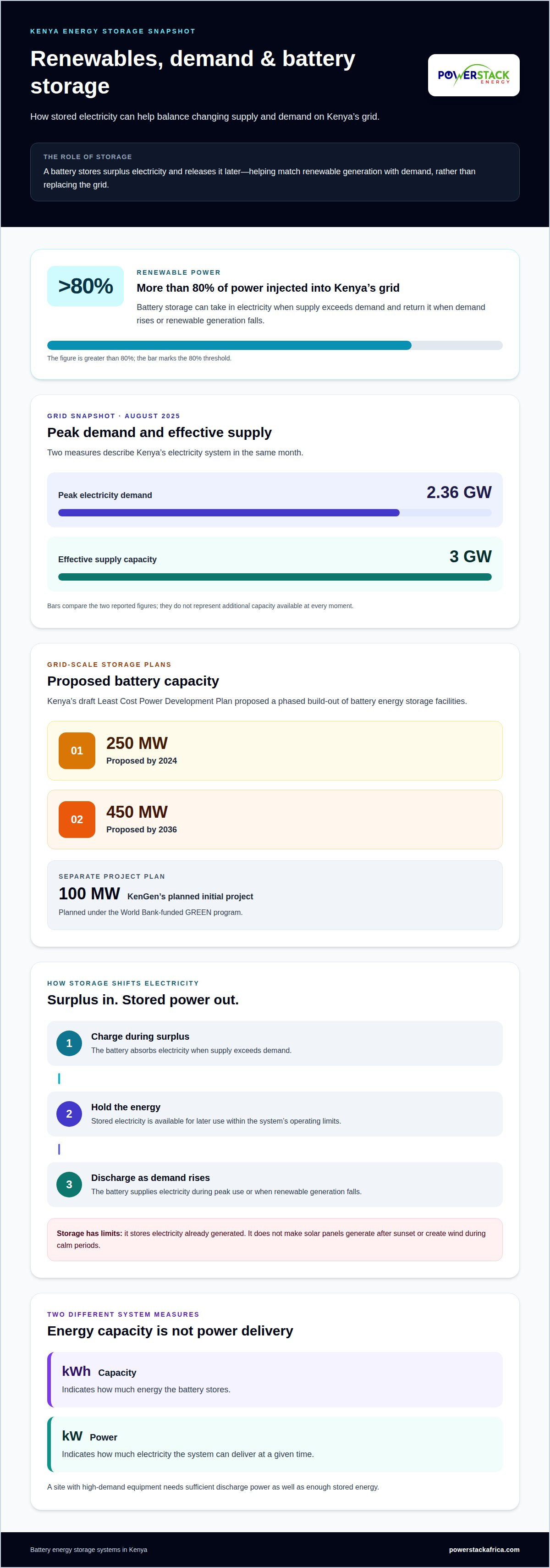
Battery storage supports grid stability by absorbing electricity when supply exceeds demand and releasing it when demand rises. Kenya gets over 80% of power injected into its grid from renewable sources, so storage can help align variable generation with consumption. Placement at grid nodes can address local congestion and transmission constraints by storing energy near demand. Kenya’s Feed-in-Tariff Policy 2021 provides procurement frameworks for solar, wind, and hydro, but does not cover battery storage. The 2024 Energy Regulations enable participation in the electricity market.
Off-Grid and Backup Power
In an off-grid system, batteries store electricity from renewable generation for use when production falls. At a grid-connected facility, they can supply selected loads during an interruption, depending on system design. For a home, farm, or business, the required capacity depends on the equipment to be supported and the backup duration needed. Configuration also depends on inverter requirements, installation design, and intended use. Lithium-ion options include lithium iron phosphate chemistry. Battery handling, warranty terms, and end-of-life recycling depend on the product and applicable arrangements.
Grid Balancing and Peak-Demand Supply
Grid balancing means adjusting supply to meet changing electricity demand. A battery can charge during lower-demand periods, then discharge during peak use, helping reduce pressure on generation and transmission assets. Kenya’s peak electricity demand reached 2.36 GW in August 2025, while effective supply capacity was 3 GW that month. System capacity is selected according to the loads served, backup duration, and discharge requirements. Lithium-ion batteries are increasingly popular for energy storage, while available technologies and brands vary. For a site with high-demand equipment, power delivery capability matters alongside stored energy.
Battery storage and renewable energy intermittency
Solar and wind output varies with the weather and time of day, while electricity demand follows its own pattern. This mismatch can leave renewable generation available when users need less power, then reduce supply as demand rises. A battery energy storage system charges during surplus production and discharges later. By shifting some renewable electricity across time, it can make generation more useful to a grid or facility.
Storage does not make solar panels generate electricity after sunset or create wind during calm periods. It stores energy already generated and supplies it within the battery’s operating limits. At a commercial site, the system’s role depends on the load profile, renewable generation pattern, and required discharge period. These factors determine whether storage serves evening loads, smooths short-term supply changes, or supports selected equipment.
Kenya’s draft Least Cost Power Development Plan 2022-2041 proposed 250 MW of battery energy storage facilities by 2024, increasing to 450 MW by 2036. KenGen also planned an initial 100 MW project under the World Bank-funded GREEN program. These plans reflect the grid-level need to shift surplus electricity and balance changing supply, though each project serves a defined system role.
Storage can also reduce renewable energy curtailment, which happens when available generation cannot be absorbed or transmitted at that moment. A battery near a constrained grid node can take in surplus power and release it when the constraint eases. This approach depends on connection capacity, battery controls, and the timing of local generation and demand. It complements network planning rather than replacing transmission upgrades.
For a business combining solar generation and storage, the operating strategy matters as much as battery capacity. An energy management system can coordinate charging, discharging, and site consumption with available generation. Load forecasting helps estimate when the site will need stored electricity. Together, these controls help align renewable output with actual operating requirements, without assuming that storage can cover every period of low generation.
A project-specific energy storage assessment can map generation timing, load patterns, and the required discharge role before system design.
Battery energy storage system definition
A battery energy storage system, or BESS, stores electrical energy chemically and returns it as electricity when needed. It is more than a battery bank: a complete installation includes battery cells, control equipment, power conversion, and connections to a building or grid. Each component plays a defined role in charging, storage, and discharge.
In a lithium-ion cell, the cathode and anode store and release lithium ions. A separator allows ions to move while keeping the electrodes apart, and the electrolyte carries ions between them. Charging reverses the ion flow to store energy; during discharge, ion movement enables current to flow through the connected circuit. Cells are assembled into modules and larger battery systems.
Two measures describe different system limits. Capacity, expressed in kilowatt-hours (kWh), indicates how much energy is stored. Power, expressed in kilowatts (kW), indicates how much electricity the system can deliver at a given time. A facility with a high-power motor load, for example, needs sufficient discharge power, not just high energy capacity.
A power conversion system (PCS) manages the electrical connection between the battery and the site or grid. Batteries supply direct current, while many facility loads use alternating current. The PCS converts between these forms and controls charging and discharging. A battery management system monitors cell conditions and coordinates operation within the system’s defined limits.
System design connects these components to a specific operating purpose. For a commercial building, designers map the electrical connection, the loads to be supplied, and when stored energy is needed. An energy management system can coordinate battery operation with generation and consumption. The result is a complete energy asset, not simply a collection of cells.
Keep the distinction clear: battery capacity describes stored energy, while PCS power describes delivery capability. Both must match the intended use. For example, a system may store ample energy but still fail to serve a site’s peak load if its conversion equipment cannot supply the required power.
What types of battery energy storage systems are available in Kenya?
Lithium-ion batteries are widely used for energy storage, including renewable energy projects in Kenya. Lithium iron phosphate, or LFP, is one lithium-ion chemistry used in storage systems. Lithium-ion options are valued for long working life, a wide operating range, light weight, and high energy efficiency. When comparing battery energy storage systems in Kenya, consider chemistry alongside the site’s load and intended use.
System configurations also vary. A standalone arrangement supplies loads without a grid connection, while a grid-connected system works with the facility’s utility supply. Hybrid systems can coordinate battery storage with solar generation and other power sources. The right setup depends on whether you need stored energy for backup, renewable energy use, or both.
Installations range from modular units for homes or small facilities to larger systems designed for commercial operations. Some use indoor equipment; others use outdoor enclosures near generation or electrical infrastructure. Available space, installation access, and integration with the site’s electrical equipment all shape the design.
Compare options by battery chemistry, usable capacity, power output, configuration, and compatibility with the inverter or power conversion system. Capacity indicates stored energy; power output indicates how much electricity the system can deliver at a time. A site serving high-demand equipment needs suitable output, while longer backup periods require enough stored energy for the intended loads.
Start with the operating requirement. A farm may prioritize backup for selected equipment, while a commercial facility may focus on matching solar generation to its demand schedule. These use cases call for different configurations. Clear load and operating requirements help narrow the options among battery energy storage systems in Kenya, rather than assuming one type is best for every site.
Assess commercial battery storage options against your site’s load profile and operating requirements.
Powerstack Africa Energy Ltd: Battery Energy Storage Systems
Powerstack Africa Energy Ltd helps businesses assess and integrate battery storage around their site requirements. Its Battery Energy Storage Systems can be paired with an Energy Audit to define load patterns, generation, and storage objectives. Commercial Solar EPC and Hybrid Inverters & PCS support projects that combine solar generation and storage.
This is a practical next step if you need to assess backup requirements, manage renewable generation, or align storage with facility demand. System design can account for the loads you need to support and how stored electricity fits your operations.
Contact Powerstack Africa Energy Ltd to discuss your site’s battery storage requirements.
Make storage part of a defined energy plan
For Kenyan organisations, frame storage around an operating objective rather than treating it as a standalone asset. Decide which loads need support, how renewable generation fits the site’s schedule, and what role storage should play in daily power management. This gives technical and financial teams a shared basis for evaluating battery energy storage systems in Kenya and planning an implementation suited to the site.
Powerstack Africa Energy Ltd offers Battery Energy Storage Systems, Commercial Solar EPC, and Hybrid Inverters & PCS. These capabilities support projects combining storage, solar generation, and power conversion in a coordinated design. The team can align the project scope with your facility’s energy requirements and operational priorities. Include operating responsibilities and performance reviews in the project brief to keep decisions aligned with business continuity.
Bring your site requirements into the next planning discussion. Contact Powerstack Africa Energy Ltd to discuss an energy storage approach and take the next step with clarity.
Frequently Asked Questions
What does the future hold for BESS in Kenya?
Kenya’s energy planning has identified battery storage as a way to manage renewable supply and grid demand. The draft Least Cost Power Development Plan 2022-2041 proposed 250 MW of storage by 2024 and 450 MW by 2036. These are planning proposals, not proof that those capacities were installed. For businesses, the direction points to a growing role for storage in renewable integration and electricity system balancing.
How do battery storage systems connect to Kenya Power or off-grid solar systems?
A grid-connected battery links to a site’s electrical system through power conversion equipment that controls charging and discharging. Its design must coordinate with the facility connection and the loads it serves. In an off-grid solar system, photovoltaic panels feed power through an inverter to supply loads and charge the battery. The inverter then converts stored electricity into alternating current for compatible equipment.
What are the best battery storage options for Kenya’s power outages and electricity tariffs?
The right option depends on the loads you need to support, outage patterns, and how you intend to use stored energy against your tariff. A short, high-power requirement calls for different system sizing than extended backup. For example, the SAJ 50 kW All-In-One Energy Storage Solution has 50 kW rated power and 100 kWh battery capacity. Its stated two-hour nominal energy-to-power ratio is subject to system limits.
Where can I buy and install battery energy storage systems in Kenya?
Powerstack Africa Energy Ltd supplies and integrates battery storage systems for customers across Kenya. Its work includes commercial energy storage, with solar EPC and hybrid inverters or power conversion systems for projects requiring coordinated equipment. A project discussion can establish the facility’s loads, generation, and operating goals. Contact Powerstack Africa Energy Ltd to discuss a technical proposal for your site.