Commercial solar panels can make sense for a Kenyan business when daytime electricity use, projected savings, and sustainability goals support the investment and installation requirements. A commercial solar investment assessment weighs these factors together instead of relying on a headline payback estimate.
Your operating schedule and electricity demand determine how much solar power you can use on site. Roof or land suitability, system design, and integration needs also affect project viability. Assess any applicable incentives based on your circumstances rather than assuming they apply.
This guide explains how financial modeling, self-consumption, sustainability targets, and site complexity shape the decision, and when an energy audit or commercial solar design assessment can clarify your next step.
Key Takeaways
- Assess projected generation, on-site use, operating requirements and relevant incentives together to judge financial viability.
- Match solar system design to your operating hours, electricity demand and sustainability objectives.
- Review electricity-use patterns and peak demand to identify how solar could fit your facility’s load.
- Account for roof condition, shading, structural capacity and electrical integration when evaluating installation complexity.
Financial projections, incentives, savings, and ROI
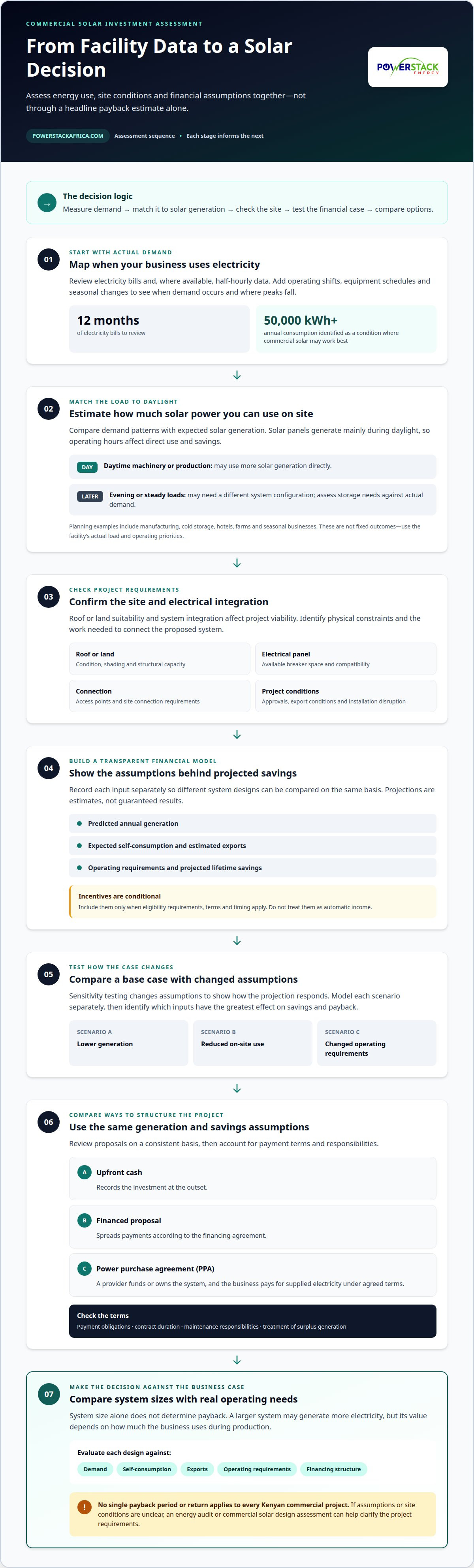
A financial projection compares expected solar generation with electricity used on site, exported power, and operating requirements. Include incentives in the calculation only when the project meets their eligibility requirements and terms.
Financial Modeling Assumptions
Financial modeling uses defined assumptions to project a solar project’s outcomes over time. A commercial solar investment assessment should make those assumptions visible so you can understand the basis for estimated savings. Include predicted annual generation, expected self-consumption, estimated exports, operating requirements, and projected lifetime savings. Record each input separately to compare system designs without treating estimates as guaranteed results.
Sensitivity Testing and Projections
A projection estimates cash flows and returns; sensitivity testing changes assumptions to show how the results respond. In a commercial solar investment assessment, model lower generation, reduced on-site use, and changes in operating requirements as separate scenarios. Compare each with the base case to identify which inputs affect payback and savings most. Include incentives only when their eligibility and timing apply, not as automatic income.
Cash and Financed Proposals
An upfront cash proposal records the investment at the outset, while a financed proposal spreads payments according to its agreement. Compare both using the same generation and savings assumptions. A power purchase agreement (PPA) is another option: a provider funds or owns the system, and the business pays for supplied electricity under agreed terms. Review payment obligations, contract duration, maintenance responsibilities, and how surplus generation is treated before comparing returns.
Payback Periods and Returns by System Size
Payback is the time it takes for cumulative project savings to equal the investment; system size alone does not determine it. No single payback period or return applies to every Kenyan commercial project. A larger system may generate more electricity, but its value depends on how much the business uses during production. Compare system sizes against demand, self-consumption, exports, operating requirements, and financing structure to see whether added capacity strengthens the financial case.
Business energy, sustainability, and ROI goals
Your operating schedule determines how much solar energy your business can use directly. Compare demand patterns with solar generation before setting system and sustainability targets.
Business Energy Consumption Patterns
Business energy consumption patterns show when a facility uses electricity and how solar panels could meet that demand. For example, a factory running machinery during the day may use more solar generation directly. A facility with substantial evening demand may need a different system configuration. Review operating shifts, equipment schedules, and seasonal changes together to choose an appropriate system size and understand how energy use affects savings and return on investment.
Solar Viability Across Business Sectors
Solar viability varies by sector because equipment, operating hours, and energy loads differ. Manufacturing may have daytime machinery demand, while cold storage needs steady power for refrigeration. Hotels combine daytime operations with evening loads; farms may use energy for irrigation or processing at different times. These are planning examples, not fixed outcomes. Match solar panels and any storage to the facility’s actual demand, operating priorities, and sustainability objectives.
Seasonal businesses should compare solar generation with their active periods. A farm’s irrigation schedule or a tourism facility’s peak season may not match year-round demand. Because solar panels generate mainly during daylight, a business that uses most electricity after hours may consume less generation directly. Map operating months and shifts against expected production to see whether seasonal demand supports the planned system or calls for a different design.
An energy audit brings facility consumption, equipment loads, and business objectives into one assessment. It can identify which processes run during daylight and where energy demand concentrates. For example, an audit at a processing site can distinguish production loads from office use. This helps define the solar system’s role, assess storage needs, and connect sustainability targets to measurable changes in energy use.
Set return on investment (ROI) goals alongside operational priorities. A business focused on reducing grid reliance may value a different system profile from one prioritising direct bill savings. Record sustainability objectives, critical loads, and planned operational changes before comparing designs. This gives decision-makers a clear basis for weighing solar performance against business needs.
Why should your business install solar panels?
Rooftop solar can reduce the grid electricity drawn while panels generate, while diesel generators provide controllable backup but require fuel. Include grid supply in the comparison. Kenyan project risks include financial assumptions, technical compatibility, approval or export conditions, and installation disruption.
Electricity Use and Peak Demand
Electricity-use and peak-demand reviews compare when your business consumes power with when solar generation is available. They matter because system capacity should match actual operating loads, not only total consumption. Review 12 months of electricity bills and, where available, half-hourly data. These records show demand timing and peak readings. Annual consumption of 50,000 kWh or more is identified as a condition where commercial solar may work best.
Capacity and Electrical Integration
Electrical capacity and integration determine whether existing equipment can accept a solar system and what work may be required. Review the electrical panel, available breaker space, access points, and site connection to establish compatibility. For example, limited breaker space may call for a revised integration design. Include any required electrical modifications in project planning because they affect system configuration and installation coordination.
Tariffs, Avoided Electricity Use, and Surplus Exports
Tariffs determine the value of grid electricity your business avoids using, while export terms affect surplus generation. Electricity used on site generally adds more financial value to a solar project than electricity exported. Compare generation with the facility’s tariff and consumption periods. Assess export income separately, using the applicable connection and purchase terms rather than assuming surplus power has the same value as avoided grid electricity.
For a practical comparison, align system output, demand, and tariff periods in one model. Test how changes in self-consumption or export arrangements affect savings. Annual totals can make a system look attractive even when generation and demand occur at different times. Peak-demand data also helps position solar within the facility’s electrical infrastructure and identify where grid supply or diesel backup remains necessary.
Installation complexity and project requirements
Installation scope depends on the building, electrical layout, and access conditions. These factors shape design work, site preparation, installation planning, and coordination with facility operations.
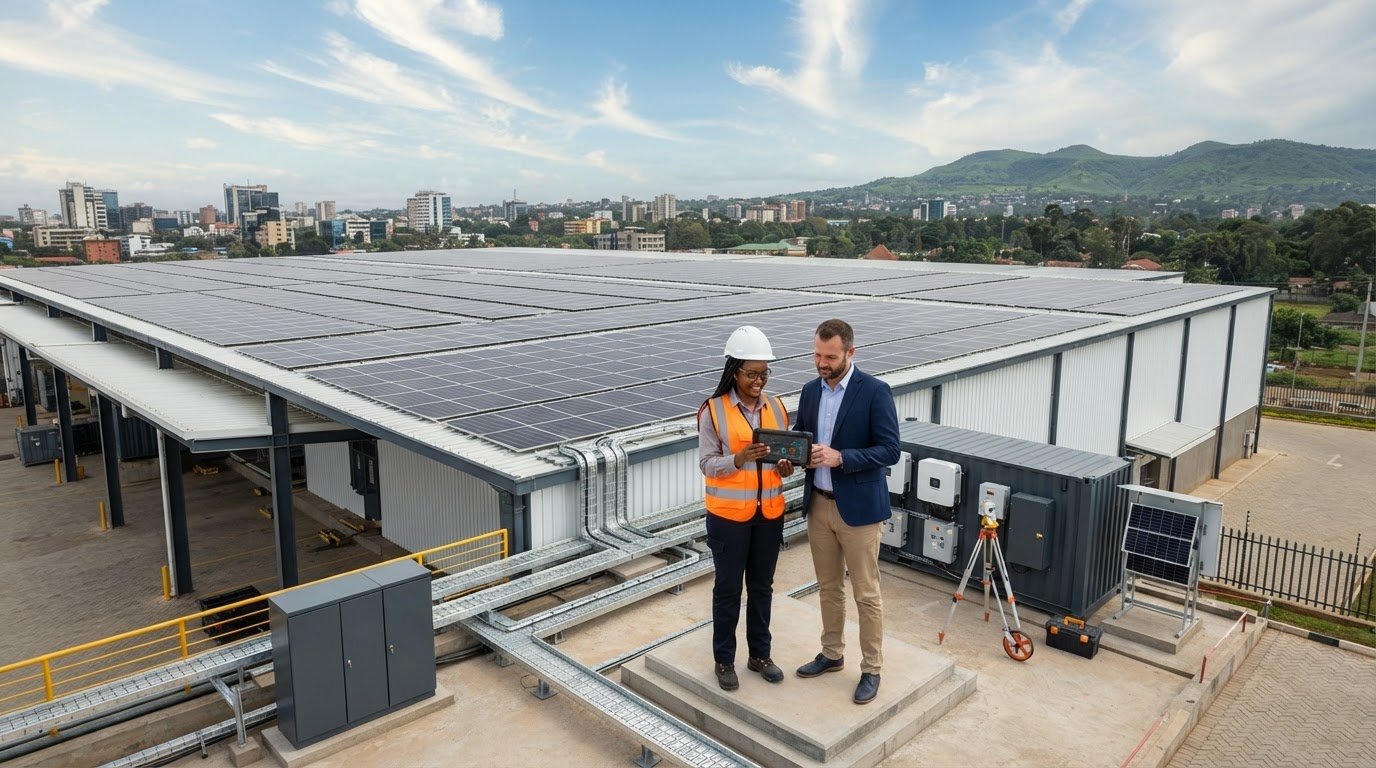
Roof condition is an early design consideration. A structural review assesses whether the roof can support panels and mounting equipment, including ballast where needed. Commercial arrays may weigh 15-20 kg per m². Roof orientation, shading from trees or nearby structures, and usable area also affect generation. If shading limits output, the design may need adjustment or a different installation location.
Ground-mounted systems can suit sites with limited roof space, but they bring distinct site requirements. Planning should account for available land, installation access, vegetation, and drainage. Uneven ground or physical obstructions may require additional preparation. Consider these conditions in the site plan before setting the installation sequence.
Electrical integration matters too. The design must account for existing switchgear, connection points, and operating loads. A layout that differs from a standard installation may require additional engineering, equipment, or coordination. Identify how installation work will interact with building operations, access controls, and critical equipment.
Before work begins, establish the installer’s relevant commercial project experience and technical scope. Review the proposed design, equipment schedule, responsibilities, installation sequence, and commissioning documentation. Clear records define the project scope and how system performance will be assessed. Local knowledge also helps plan for site access, weather exposure, and operating conditions across Kenya.
Ask how the design addresses roof structure, orientation, shading, electrical integration, and site preparation. A clear explanation links each condition to its effect on generation, installation scope, and operational disruption. This helps you compare proposals by technical fit and execution planning.
For a site-specific review, discuss a commercial solar site assessment before finalising project scope.
Powerstack Africa Energy Ltd
Powerstack Africa Energy Ltd helps Kenyan businesses assess and deliver commercial solar projects suited to their energy demand and site conditions. Turn to the team when you need to connect an investment case with practical system design, installation, and storage requirements.
Powerstack Africa Energy Ltd Energy Audits clarify consumption patterns and inform project decisions. Commercial Solar EPC, Battery Energy Storage Systems, and Hybrid Inverters & PCS support systems aligned with your operational priorities. Together, these services help you complete a thorough commercial solar investment assessment for your facility.
Contact Powerstack Africa Energy Ltd to discuss your commercial solar project and assessment needs.
Set a Clear Direction for Your Solar Project
Your next step is to turn the assessment into a decision framework your operations and finance teams can use. Define what a successful project must deliver, such as reducing grid dependence, supporting critical loads, or meeting sustainability targets. A commercial solar investment assessment can then guide system scope and clarify which trade-offs matter most to your business.
Powerstack Africa Energy Ltd supports this work through Commercial Solar EPC, Battery Energy Storage Systems, and Hybrid Inverters & PCS. The team aligns these project elements with your facility’s electrical requirements and operating priorities, giving the proposed system a defined role in your energy plan.
Bring your project requirements into a focused discussion and identify a practical way forward. Contact Powerstack Africa Energy Ltd to discuss your commercial solar project and take the next step with a clear direction.
Frequently Asked Questions
Are Commercial Solar Panels Worth It?
Commercial solar panels can be worthwhile when the electricity your business uses during generation supports its operational goals. For example, a distribution warehouse with daytime refrigeration may use solar differently from an office that operates mainly after hours. Assess expected energy use alongside system integration, operating needs, and sustainability objectives before deciding whether a system suits your facility.
Financial Returns: How Much Can Your Business Save?
Your savings depend on the electricity solar generation displaces and the system’s operating requirements. A useful estimate compares expected output with the electricity your business would otherwise buy, while accounting for maintenance. A facility that uses more solar power on site, for example, may avoid more grid purchases than one that exports much of its generation. Model projected savings against your actual energy records.
What Determines Your Savings Potential?
Savings potential depends on the relationship between solar generation and your business’s electricity use. Operating hours, equipment schedules, shading, system design, storage, and applicable tariff terms all influence the result. A processing facility running during sunny daytime hours may use generation differently from a business with evening-heavy demand. Production changes can also affect future savings, so include expected operational changes in your assessment.
What Incentives, Tax Rules, and Import Duties Apply to Commercial Solar in Kenya?
Include incentives, tax treatment, and import duties in your project model only when they apply to the specific equipment and transaction. Record the equipment classification, sourcing route, and eligibility basis used in the financial case. Treat any proposed tax benefit or duty exemption as a separate assumption, not guaranteed savings. This keeps the projected return from relying on an incentive that may not fit the project.
What Is the Average Commercial Electricity Tariff in Kenya, Including Demand Charges?
No single tariff figure represents every commercial electricity account and demand profile. Use your business’s electricity bills to identify applicable energy charges and any demand-related charges. Keep these components separate in the solar analysis: on-site generation may reduce purchased electricity, while the effect on demand charges depends on how facility peak demand changes. Review the billing structure alongside operating data.