A solar feasibility assessment in Kenya can indicate whether a roof appears suitable, but a visual survey alone cannot certify that its structure can support solar panels. A useful assessment combines a structural review with electricity bills, daytime demand and expected solar yield. A year of bills can reveal seasonal patterns, but may not show when electricity is used during the day. A positive result is an early decision tool, not a guarantee of savings, power export or grid approval.
Key Takeaways
- Model financial outcomes using clear assumptions, then test how changes in key inputs affect the decision.
- Define the management decision and assessment scope before commissioning technical analysis.
- Use electricity bills, interval data and operating schedules together to build a clearer demand profile.
- Assess commercial rooftops through coordinated structural, solar-yield and grid-connection checks.
Financial returns and sensitivity analysis
Assess residential and commercial systems against their intended use, site conditions and electricity demand. Funding arrangements and financial outcomes depend on the project scope, operating assumptions and how the system’s generation is used.
-
Define System Scope
Define the system scope before comparing project scenarios. Assess rooftop generation, battery storage, electrical integration and site works separately. For a residence, match the design to household demand and backup needs. For a business, assess its load profile and operating schedule. Do not use one system configuration as a benchmark for different buildings.
-
Set Financial Assumptions
Record the assumptions behind each scenario, including self-consumption, solar yield, utility tariff changes and financing structure. Funding may involve owner capital, third-party debt or equity, or a power purchase agreement (PPA). For a PPA, define the offtake arrangement and how risks are allocated. Include tax incentives or subsidies only when they apply to the project.
-
Assess Returns and Sensitivity
Compare projected electricity-bill reductions with the project’s financial inputs over its operational life. Then vary one assumption at a time, such as solar yield, daytime consumption, tariff changes or financing terms. Record how each change affects the result and identify the assumptions with the greatest influence. Show the range of outcomes instead of promising a fixed payback period.
Does a positive assessment guarantee savings or grid approval?
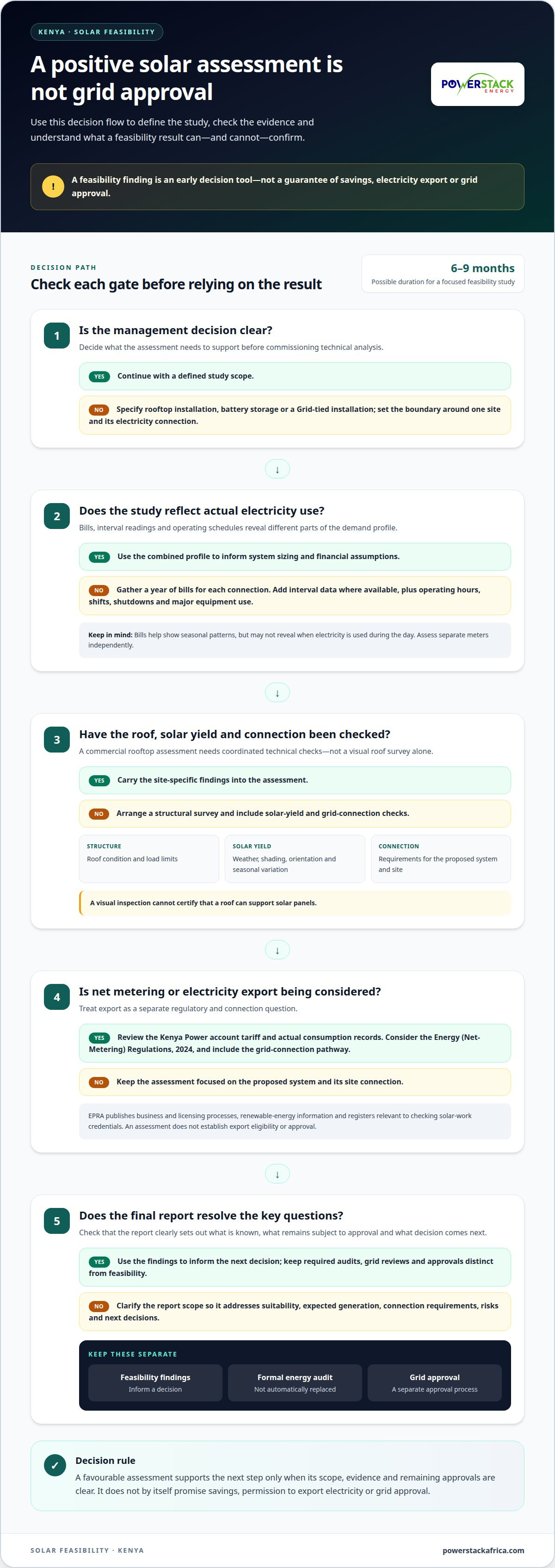
No. A positive assessment does not guarantee savings, electricity export or grid approval. Define the management decision first, then scope the technical and regulatory work around it.
- Specify the decision the assessment must support: rooftop installation, battery storage, or a grid-tied system. Set the boundary around one site and its electricity connection. A focused solar PV feasibility assessment can take 6-9 months, so align the study schedule with the decision deadline and required evidence.
- Use the Kenya Power account tariff and actual consumption records as inputs, rather than assuming one tariff applies to every customer. Kenya’s Energy (Net-Metering) Regulations, 2024 are relevant when assessing a potential net-metering option. The assessment itself does not establish eligibility or approval to export electricity.
- Map permits, licensing checks and technical standards to the proposed system and connection. EPRA publishes business and licensing processes, renewable-energy information and registers relevant to verifying credentials for solar work in Kenya. Include a grid-connection review in the scope: a positive technical assessment is not grid approval.
- Set out what the final report must resolve: roof and system suitability, expected generation, connection requirements, risks, and next decisions. Separate feasibility findings from later approvals and implementation. If a grid-tied installation is under consideration, include its connection pathway explicitly. A solar project scope review can help structure that assessment around the management decision.
A solar feasibility assessment is not automatically a formal or statutory energy audit. State the assignment’s purpose clearly, and do not treat feasibility findings as a substitute for an audit where one is required.
Data collection and financial analysis for the assignment were scheduled for 03 rd to 6 th Oct 2023. That schedule describes planned work, not a commitment that savings will result or that a connection will be approved. Use the analysis to inform the next decision, while keeping any required audit, grid review, and approvals distinct from the assessment.
How much electricity data is needed?
Use consumption records and operating schedules to size a system around actual demand, not a rule of thumb. For a commercial assessment in Kenya, a year of electricity bills helps reveal seasonal patterns, while interval data shows when loads occur.
-
Gather Bills, Interval Data, and Schedules
Collect a year of bills for each electricity connection and keep the accounts separate. Bills show consumption over time, but may not reveal daytime demand. Add interval readings where available, then compare them with operating hours, shift patterns, shutdowns and major equipment use. For example, a facility running production during daylight may use solar generation directly.
-
Match System Size to Electricity Usage
Compare daytime demand with the solar generation profile before selecting system capacity. At home, distinguish daytime appliance use from evening demand. At a business, map production shifts and equipment loads. Sizing a system only from total monthly consumption can miss peak demand or result in more electricity than the site can use. Include storage only when the load profile supports that need.
- Use the combined profile to set the system design basis. Check seasonal changes, planned operating shifts and expected demand growth before finalising assumptions. If a site has separate meters, assess each connection independently; do not combine bills as though electricity transfers automatically between connections. Record the data period used and any gaps so the sizing logic remains traceable.
The study reports that Kenya’s reservoir hydropower system can compensate for solar intermittency without investment in batteries or other storage capacity.
Feasibility studies for commercial rooftop solar
Assess a commercial roof as an operating asset, not just a place for panels. A credible study combines site-specific solar data, structural review, electricity demand, grid connection and maintenance planning.
-
Assess Solar Resource and Local Weather
Model the site’s solar resource using time-series data spanning more than 10 years. Project output across a 20-25-year operational life, accounting for local weather, shading, roof orientation, and seasonal variation. Kenya’s solar conditions differ by location, so the best-suited sites are identified through measured resource and usable roof area, not a national regional ranking. Sunshine hours alone do not predict system yield.
-
Evaluate Rooftop Installation Risks
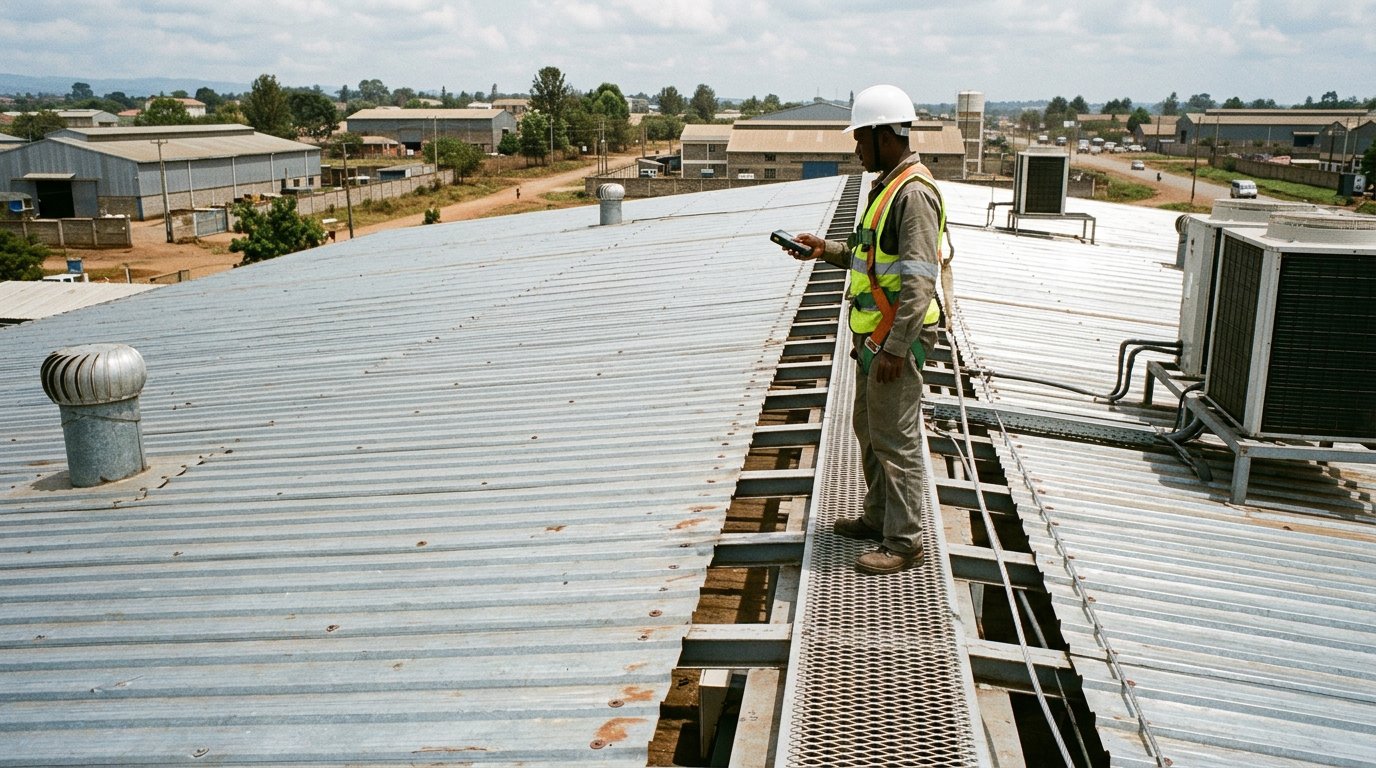
Arrange a structural survey: a visual roof inspection cannot certify that the structure can support solar panels. Assess roof condition, load limits, drainage, shading, safe access and the route for electrical equipment. Include maintenance access in the design, since difficult access can complicate inspections and cleaning. Review grid-connection requirements alongside these physical risks, rather than treating roof suitability as the only consideration.
- Match the study’s depth to the funding decision. For an owner-funded, behind-the-meter project, a structural survey, yield estimate, grid-connection check and payback calculation may be sufficient. Third-party debt, equity or a power purchase agreement calls for documented resource data, project assumptions, offtake arrangements and risk allocation. Focus the assessment on the evidence decision-makers and funders need.
Plan a commercial rooftop solar assessment around your building’s structure, site conditions, and operating requirements.
Powerstack Africa Energy
Powerstack Africa Energy Ltd is a practical next step when your solar feasibility assessment Kenya identifies a viable site but leaves questions about demand matching, storage or system integration. Its Energy Audits assess facility consumption and load profiles to inform system design. This is useful when your team is moving from initial feasibility findings toward a defined project scope.
For a commercial rooftop project, Commercial Solar EPC brings system design and project delivery together. The roof review, electricity profile, expected generation and grid-connection considerations from the assessment can inform the project scope. Use these findings to clarify the technical requirements and decisions still needed before implementation.
Battery Energy Storage Systems are relevant when the assessment identifies a need to manage energy beyond direct solar generation. Their role depends on the site’s demand profile and the purpose of storage. Hybrid Inverters & PCS address power conversion and control in integrated energy systems, helping account for how generation and storage work together.
Bring the assessment’s main findings to the next discussion: roof condition, electricity-use patterns, connection requirements and the decision the project must support. Powerstack Africa Energy Ltd can relate those findings to Energy Audits, Commercial Solar EPC, Battery Energy Storage Systems, or Hybrid Inverters & PCS, according to the project’s needs. Keep the scope grounded in evidence and operating requirements; a positive assessment is neither approval nor a promise of savings.
Contact Powerstack Africa Energy Ltd to discuss your solar assessment and the next project decisions.
Move from assessment to a defined project
Treat the study as a basis for a considered decision, then assign an internal owner to carry its findings into project development. That person can coordinate facilities, finance and operations teams, resolve competing priorities and keep the proposed design aligned with site requirements. A solar feasibility assessment in Kenya is most useful when its findings guide clear next steps and inform operational planning.
Before moving forward, document who is responsible for decisions on site access, operational continuity, grid coordination and performance review. This creates a practical handover from assessment to design and keeps key departments aligned as project details develop. Keep the decision criteria visible so technical changes can be weighed against business priorities.
Powerstack Africa Energy Ltd provides Commercial Solar EPC, Battery Energy Storage Systems, and Hybrid Inverters & PCS. These services help businesses move from evaluation toward an integrated system plan. The right next step depends on site requirements and the role solar needs to play in your energy strategy.
Contact Powerstack Africa Energy Ltd to discuss your project’s next steps with the team.
Frequently Asked Questions
Can feasibility confirm that a roof will carry solar panels?
A structural survey should assess roof members, spans, connections and how the proposed panel layout distributes load. Its findings can identify usable roof areas, sections that may need reinforcement or constraints that affect the design. Existing roof drawings and records of planned refurbishment can also help engineers interpret site conditions and coordinate solar installation with future building work.
Is a feasibility assessment the same as a solar quotation?
No. A feasibility assessment helps determine whether a project is technically and operationally suitable; a quotation sets out a defined system and delivery scope. The assessment may identify design decisions still to be made, such as equipment configuration or grid coordination. A quotation is more useful once those decisions have been developed into a specific proposal for your site.
What should you compare across solar panels, inverters, and batteries?
Compare how each component fits the proposed system’s electrical design and operating requirements. Panels generate direct-current electricity, while a solar inverter converts it into usable alternating current. Batteries store electricity for later use. For example, a site that needs backup during outages has different storage requirements from one focused on using solar generation during working hours.
How long is the payback period for solar in Kenya compared with grid electricity?
A modeled payback period is an estimate, not a guaranteed date. For a business, assess financial returns separately from the operational value of continuity during grid interruptions. A facility may consider reduced exposure to outages alongside projected bill changes. Keep these outcomes distinct in decision papers so management can see which benefits depend on financial assumptions and which address operational priorities.
How do grid-tied, hybrid, and off-grid solar systems compare in Kenya?
A grid-tied system operates in connection with the utility grid. A hybrid configuration combines solar with storage or another power source, depending on its design. An off-grid system supplies loads without relying on a grid connection. For example, a remote facility without grid access would assess an off-grid design, while a grid-connected site may compare grid-tied and hybrid options.
What are Kenya Power tariffs and applicable net metering rules for solar customers?
Use the tariff on the customer’s Kenya Power account and actual consumption records; tariffs should not be assumed to be the same for every customer. The Energy (Net-Metering) Regulations, 2024 are relevant to assessing net metering, but a feasibility assessment does not establish eligibility or approval to export electricity.