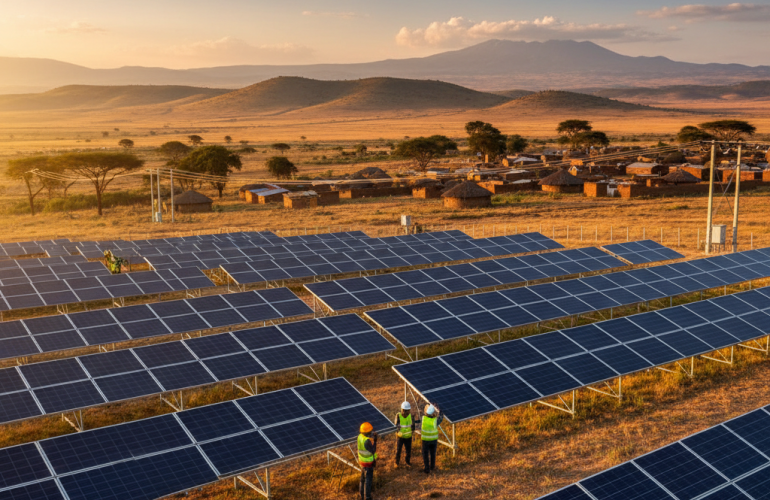
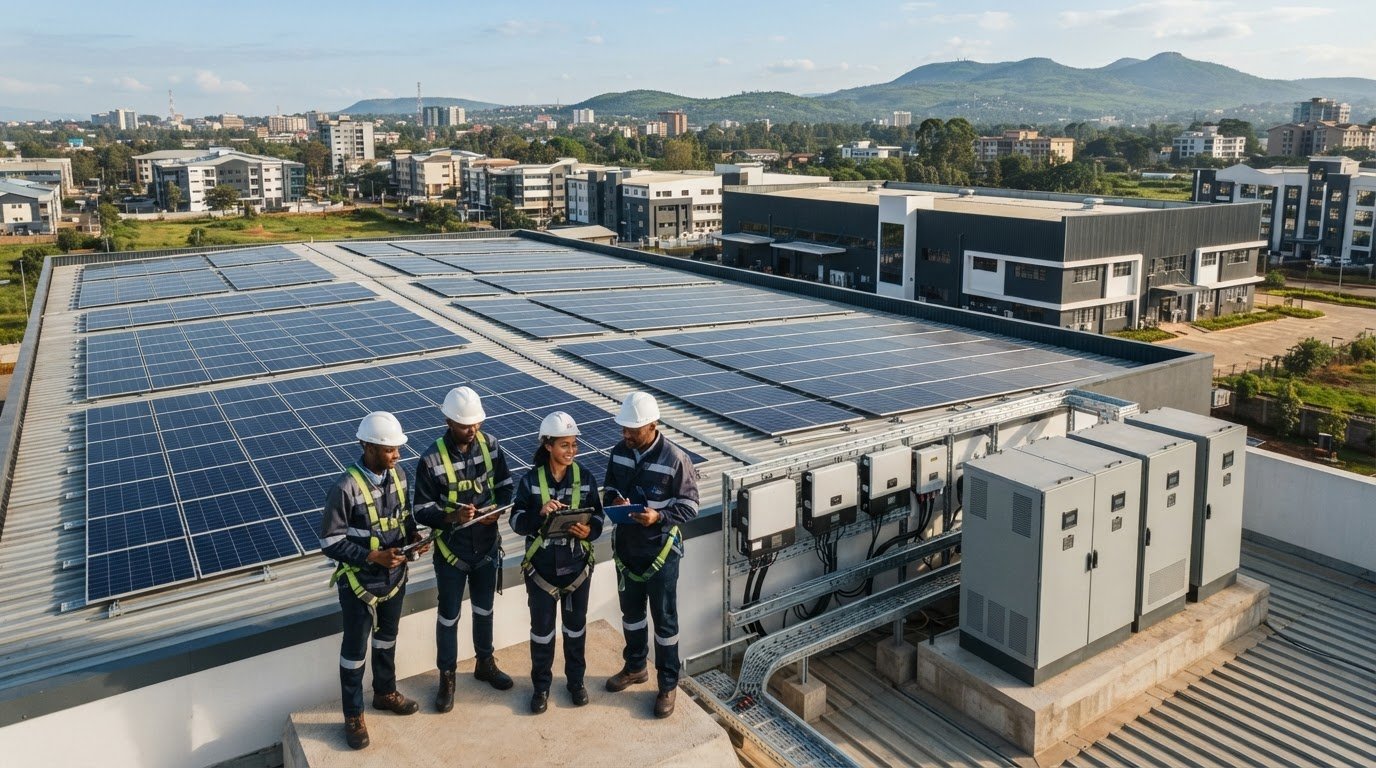
A low headline quote can conceal a costly mismatch between a solar system and the facility it is meant to serve. For Kenyan businesses, commercial solar project cost is meaningful only when the system scope and operating value are assessed together. Equipment, installation, facility demand and project objectives all shape what an investment includes.
It’s understandable to want a clear figure early. But without consistent assumptions, proposals can be difficult to compare, and projected savings may not reflect how your facility actually uses power. A credible assessment of commercial solar project cost Kenya businesses can act on starts with the facility’s consumption profile, load patterns and operational requirements.
This article explains the main cost drivers, compares solar-only and solar-plus-storage configurations, and outlines how to assess proposals against expected operating value. You’ll also see what project information supports a more reliable evaluation. Powerstack Africa’s energy audits and commercial solar EPC work follow this project-specific approach, examining facility demand and financial return metrics before system design.
Key Takeaways
- Assess project cost as a complete scope, from engineering and equipment through integration and commissioning, rather than comparing headline figures alone.
- Check how array capacity, panel layout and electrical requirements shape the system design and installation scope.
- Compare solar-only and hybrid proposals against operational objectives, including whether storage is needed for load shifting, peak shaving or continuity.
- Evaluate commercial solar project cost Kenya proposals using consistent equipment, integration, commissioning and monitoring assumptions.
- Use facility consumption records, load patterns, power quality and applicable tariff details to build a more credible assessment of operating value.
Why commercial solar project cost in Kenya cannot be reduced to one figure
A headline figure can’t describe two commercial projects with different equipment, site conditions and operating requirements. One proposal may cover panels alone; another may include engineering, mounting, electrical integration and commissioning. Treating them as equivalent makes it difficult to judge the investment or identify what remains outside the quoted scope.
The commercial solar project cost Kenya businesses need to assess is the cost of a defined project, not a generic system size. It reflects the combined scope of equipment, engineering, installation, integration and commissioning. Kenya’s solar sector includes projects with varied applications and scales; the Solar power in Kenya overview provides broader context, but a facility’s own requirements determine its system design.
Start with demand. Kilowatts (kW) describe system power capacity, while kilowatt-hours (kWh) measure energy used over time. Consumption records show how much energy a facility uses, while the timing of that use helps determine how a solar system can serve it. Operating hours and project objectives matter too.
What a commercial solar project cost estimate represents
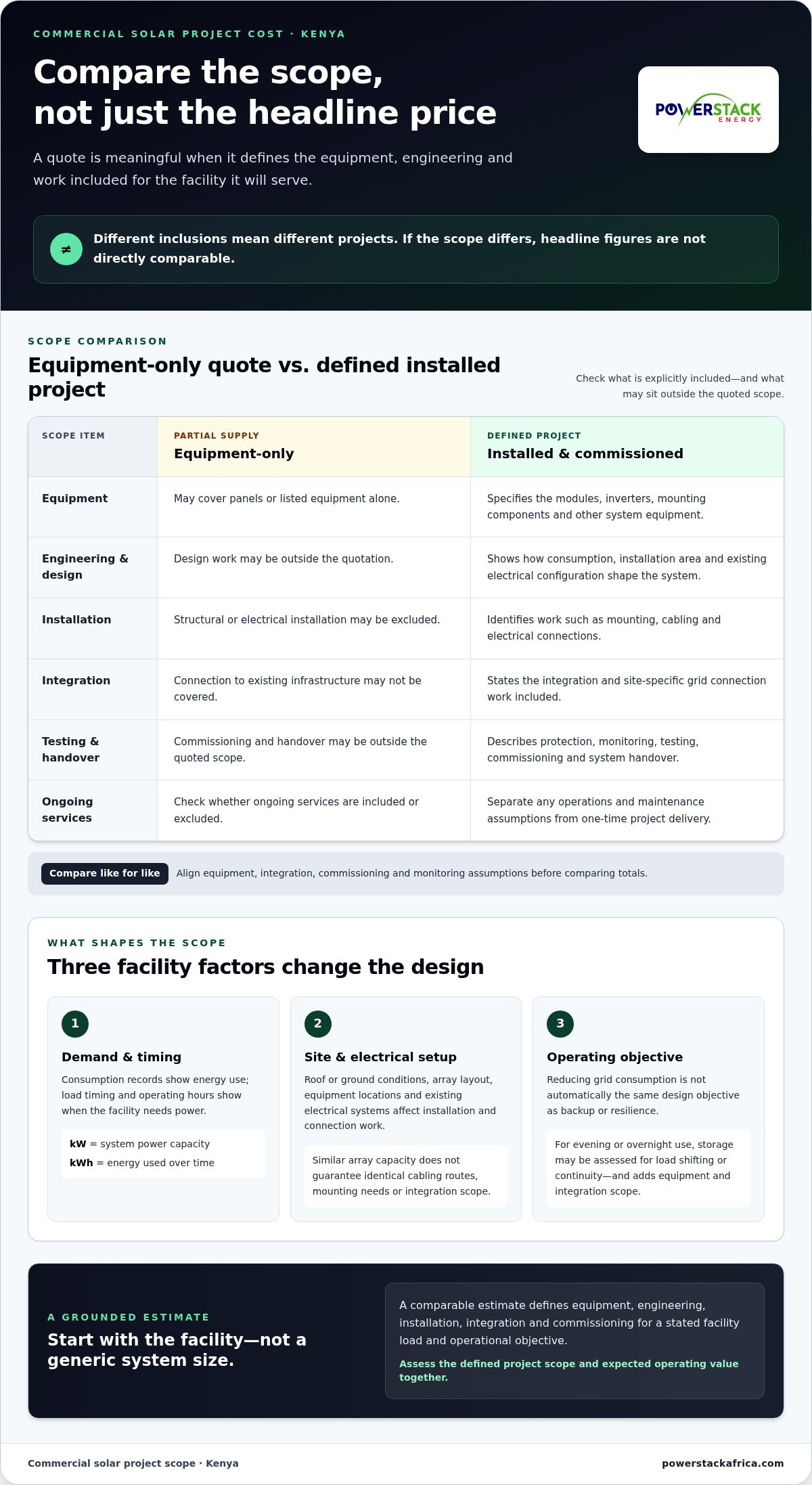
An estimate should describe a defined system scope, not just a panel count or equipment list. Equipment-only quotations may exclude design work, structural or electrical installation, integration with existing infrastructure, and commissioning. An installed project scope identifies the work and components covered through a functioning system handover.
A comparable commercial solar project estimate defines the equipment, engineering, installation, integration and commissioning included for a stated facility load and operational objective. Use that definition to distinguish a complete project proposal from a partial supply quotation. If the scope differs, the headline figures are not directly comparable.
Why two Kenyan businesses can need different project scopes
Consider a facility that uses most of its electricity during daylight hours. Its load may align with solar generation, so the design can focus on matching system output to daytime demand. A business operating into the evening or overnight has a different profile. Storage may be assessed if shifting energy use or supporting continuity is an objective, changing the system configuration and scope.
Available installation area also constrains design. Roof space, layout and the location of existing electrical equipment affect how an array can be arranged and connected. Electrical configuration influences integration requirements, so a site assessment must account for existing systems rather than assume every project can use the same layout.
Finally, distinguish the intended outcome. A project designed primarily to reduce grid consumption is not automatically the right design for backup or resilience. Those objectives can call for different system arrangements and storage scope. Powerstack Africa’s energy audits examine consumption profiles, load patterns and power quality to inform project design. This engineering basis helps turn a broad price request into a scope grounded in how the facility operates.
Which project components shape commercial solar cost in Kenya?
A useful proposal breaks the project into defined work packages. This makes it possible to see whether differences in commercial solar project cost Kenya proposals reflect equipment choices, site conditions or different inclusions. Compare scope before comparing totals.
Engineering, equipment, and installation scope
Engineering establishes how the system fits the facility. Assessment and design translate consumption patterns, available installation area and existing electrical configuration into an equipment and installation plan. Procurement then covers the specified solar modules, inverters, mounting components and other system equipment. Array capacity and panel layout affect the number of modules required and the mounting arrangement, while roof or ground conditions can change structural design and installation work.
Installation scope may include mounting, cabling, electrical connections and integration with existing infrastructure. Inverter selection also depends on the designed system and the facility’s electrical arrangement. Grid integration requirements are site-specific, so proposals should state the intended connection and associated work rather than assume every facility needs the same configuration.
Review the final stages too. Protection equipment, monitoring, testing, commissioning and handover should be described clearly. Cabling routes, equipment locations and site-specific electrical work can vary even between systems with similar array capacity. A complete proposal identifies these inclusions instead of grouping them under a vague installation line.
Separate one-time project delivery from recurring operations and maintenance assumptions. If ongoing services or maintenance are included, they should be identified separately from engineering, procurement, installation and commissioning. This distinction helps decision-makers understand what the initial project scope covers and what may be a later operating requirement.
When storage or backup objectives change the project
Battery storage adds equipment and integration scope beyond a solar-only design. Its relevance depends on the facility’s operating objective, such as shifting energy use, reducing peak demand or supporting continuity needs. Those goals affect how the battery system and related conversion equipment are integrated with solar and the facility’s electrical infrastructure.
Keep the comparison tied to purpose: a solar-only configuration and a hybrid system aren’t interchangeable simply because both include an array. Storage should be assessed against the load patterns it is intended to serve, rather than added by default. Powerstack Africa assesses solar and battery requirements together through its commercial EPC and energy audit work. A project-specific commercial solar assessment can help establish a coherent scope before proposals are compared.
- Engineering: assessment, design and defined system specifications.
- Equipment: modules, inverters, mounting, and storage components where required.
- Integration: electrical connections, grid interface, cabling and protection.
- Delivery: installation, testing, commissioning and handover.
How to compare commercial solar system configurations and proposals
Compare each proposal against the facility’s operating priorities, then check whether the technical scope and assumptions match. A lower total may reflect a smaller system, different equipment or excluded work rather than better value. For a meaningful commercial solar project cost Kenya comparison, align the design basis before weighing the investment.
Solar-only, hybrid, and solar-plus-storage approaches
A grid-connected solar-only system can suit a facility prioritizing on-site solar generation, particularly where daytime demand aligns with generation hours. A hybrid configuration coordinates solar, battery storage and grid power. It may be considered where the operating plan includes shifting energy use, peak shaving or continuity support. Neither configuration is inherently superior. The suitable design depends on load timing, resilience requirements and facility priorities.
Backup requirements need careful definition. Identify which loads are intended to receive support, under what operating conditions, and for how long the system is designed to serve them. A backup objective can change equipment selection, storage scope and electrical integration. It should not be treated as a promise of uninterrupted supply.
What a comparable commercial solar proposal should state
Review proposals using the same categories. A consistent comparison makes gaps visible without assuming that similarly named systems include identical work.
- Capacity and design basis: State the system capacity and the load data, operating schedule and other facility information used to size it.
- Equipment scope: Identify the solar modules, inverter or power conversion equipment, and, where applicable, battery storage included.
- Installation boundaries: Describe mounting, cabling, protection, electrical works and the point where integration with existing infrastructure begins and ends.
- Commissioning: Set out the testing, commissioning and handover deliverables, including any defined acceptance criteria.
- Monitoring: Specify whether monitoring equipment or functions are included and describe their stated scope.
Then compare the assumptions behind expected operation. Proposals should use equivalent load information, grid conditions and operating schedules. If one design assumes daytime use while another uses a different schedule or backup objective, the resulting performance expectations cannot be compared directly.
Read exclusions and dependencies closely. Site preparation, electrical upgrades, connection work or other site-specific requirements may affect the delivered scope if handled differently between proposals. Don’t treat an item as included unless the scope says so. Record each proposal’s capacity, equipment, storage, integration, commissioning and monitoring in one comparison sheet, then mark any differences in assumptions or exclusions.
Finally, assess the configuration against actual facility priorities. If the business needs on-site solar generation during operating hours, compare how each design serves that demand. If it also needs load shifting, peak shaving or continuity support, evaluate the stated storage and backup scope separately. This keeps the decision tied to operational value rather than a headline figure alone.
How to assess commercial solar project value and financial assumptions
A credible financial assessment connects the proposed system to how a facility actually consumes and pays for electricity. Treat projected savings and payback as model outputs, not guaranteed results. To assess commercial solar project cost Kenya proposals consistently, use the same facility data, tariff basis, operating assumptions and project scope for each option.
Build an assessment from facility data
Gather interval consumption data where available, electricity bills, operating hours and generator-use records. Map demand against site-specific solar production estimates, using engineering inputs for the proposed array and system design. Actual load data improves project assessment because it shows when energy is used, not only how much is consumed over a billing period.
Use a structured sequence to evaluate operating value:
- Establish the baseline. Compile consumption records, bills, operating schedules and generator-use information for the period being assessed. Note unusual operating conditions that could distort a typical demand profile.
- Model self-consumption. Estimate how much solar energy aligns with facility demand when it is generated. Avoid treating all expected generation as energy that will reduce grid purchases.
- Account for exports separately. Identify any energy expected to flow to the grid, then model its value using the applicable tariff and rules. Don’t assign exported units the same value as self-consumed energy by default.
- Model storage operation where relevant. State how charging and discharging would support the intended objective, such as load shifting, peak shaving or continuity. Keep those assumptions distinct from direct solar consumption.
- Assess generator displacement. Where records exist, estimate which generator operation the system could offset. State the operating assumptions used rather than treating all generator use as avoidable.
Test savings and payback claims before comparing them
Ask whether a savings or payback figure is a modeled estimate, and identify the assumptions behind it. Applicable tariff components, grid conditions and rules affecting exported energy can change the result. Verify current Kenyan tariff details and relevant requirements before using them in calculations. Keep these inputs consistent across proposals.
Then run sensitivity tests. Examine how results shift if operating hours change, tariffs are revised or actual solar performance differs from the model assumption. A proposal should make these boundaries visible, not present one projection as certain. Compare the same project scope and assessment period, and separate capital investment assumptions from operating value so decision-makers can see what drives the result.
Powerstack Africa’s energy audits examine consumption profiles, load patterns, power quality and financial return metrics to inform project design. The project-specific energy assessment grounds the financial model in facility data and operating objectives.
How Powerstack Africa scopes a commercial solar project in Kenya
A useful next step is a project-specific assessment, not a generic price request. The design needs to reflect how the facility consumes electricity, its electrical infrastructure and the operating outcomes the business expects. This gives decision-makers a defined scope to evaluate, rather than a headline figure detached from site requirements.
From facility data to an engineered project scope
Powerstack Africa’s energy audits examine facility load profiles, power quality and financial return metrics. Those inputs help inform system capacity, configuration and integration decisions. The resulting scope can connect engineering, procurement, construction and commissioning through turnkey commercial solar EPC. Each decision is tied to facility conditions and project objectives, not a universal system template.
Storage can be assessed alongside solar where the operating case warrants it. For example, the assessment can consider whether battery energy storage supports load shifting, peak shaving or continuity objectives. The need and configuration depend on the facility’s load patterns and requirements. No single battery or hybrid configuration fits every site, and projected savings depend on project-specific assumptions.
For a broader view of the engineering and delivery stages, the commercial solar EPC project guide outlines how a project moves from planning into implementation. Reviewing that scope alongside facility data helps keep the cost assessment connected to the work required.
Prepare the information needed for a project discussion
Gather available records before discussing a tailored assessment. A complete information set helps the engineering team understand demand patterns, operating constraints and the facility’s existing electrical arrangement. Useful inputs include:
- Electricity bills and available interval consumption data.
- Operating schedules, including shifts or periods of reduced activity.
- Generator-use records, where the facility maintains them.
- Site drawings and information about existing electrical infrastructure, where available.
- Known operational priorities, such as reducing grid consumption or assessing storage for continuity support.
These records provide a practical starting point. Consumption and operating data help clarify the load profile, while power-quality information informs system design and integration. Financial return metrics then connect the proposed scope to the project’s investment assumptions. The commercial solar project cost Kenya businesses evaluate should follow from this site-specific engineering, rather than precede it as an unsupported estimate.
Powerstack Africa brings energy auditing and turnkey commercial EPC together to develop a project scope grounded in facility requirements. The commercial solar assessment is a practical starting point for discussing available site and operating information.
Turn a cost estimate into a project decision
Move from reviewing estimates to defining what the investment must achieve for your facility. Agree internally on operational priorities, decision criteria and the information needed to evaluate a proposed scope. This gives your technical and finance teams a shared basis for deciding whether a design merits further development.
A useful commercial solar project cost Kenya assessment should support that decision, not stand alone as a figure on a page. Treat it as the starting point for a structured project discussion, where facility requirements and investment assumptions can be considered together. That clarity helps your organisation determine what to investigate next and who needs to be involved.
Powerstack Africa brings turnkey commercial and industrial solar EPC together with energy audits that examine facility consumption profiles, load patterns, power quality and financial return metrics. The aim is to develop an engineered project scope grounded in operational requirements, not a generic price request.
Learn about Powerstack Africa’s commercial solar assessment and the information that can help your team evaluate a project scope.
Frequently Asked Questions
How is commercial solar project cost calculated in Kenya?
It’s calculated from the engineered scope required for a particular facility. For a commercial solar project cost Kenya assessment, separate the proposed system investment from its modeled operating value. For example, a design that includes storage and backup integration is not directly comparable with a solar-only equipment quotation. Review the stated capacity, site work and deliverables together, then assess financial projections using the same facility data and assumptions.
What information is needed to estimate a commercial solar project?
Start with electricity bills, available interval data, operating hours and records for major loads. Generator logs can clarify how often backup power is used and which operating periods it serves. Site drawings and details of existing switchgear or electrical connections can also help identify integration considerations. Note unusual shutdowns, seasonal production changes or planned facility expansions, so the assessment reflects expected operations rather than an atypical period.
Does adding battery storage increase commercial solar project cost?
Battery storage adds equipment and integration requirements, so it changes the project scope and financial model. Whether it fits depends on the operating need. A facility seeking continuity for selected equipment, for example, should define which loads matter and the required support conditions. This helps distinguish a targeted storage objective from a broad backup expectation. Assess storage with the solar system and load profile, not as an automatic addition.
Is a grid-tied solar system always less expensive than a hybrid system?
No configuration is always less expensive across projects. A hybrid proposal may include storage and additional integration scope, while grid-tied proposals can also differ in equipment and site work. Compare equivalent capacities, included deliverables and operating assumptions. Also identify whether the design addresses backup requirements or only on-site generation. A lower headline total may reflect a narrower scope, so compare what the facility receives, not just the total.
How can a business evaluate commercial solar payback claims?
Check that the estimate is a model, not a guaranteed outcome, and review its inputs. These should include facility consumption, applicable tariff assumptions, expected self-consumption and the proposed system’s performance basis. Ask how the calculation treats exported energy, storage operation and generator displacement. Then test alternative operating schedules and tariff assumptions. This shows which inputs most affect the result and whether the proposal remains useful under changed conditions.
Can commercial solar reduce reliance on a diesel generator?
It can reduce generator use if solar production or storage operation aligns with periods when the generator would otherwise run. Review generator logs alongside facility demand to identify those periods. Fuel-use records and operating hours can strengthen the model, but the result depends on system design and site conditions. Treat any projected fuel displacement as an estimate based on stated assumptions, not a universal outcome or promise.
How do I compare commercial solar proposals fairly?
Use a side-by-side comparison based on the same facility records and project objective. Record each proposal’s capacity, equipment, installation boundaries, integration work, commissioning deliverables, monitoring scope and exclusions. Note differences in assumptions about operating hours, grid conditions and expected performance. If one proposal omits a work package, mark it as an exclusion rather than treating the lower total as an equivalent offer.
Does Powerstack Africa provide commercial solar project assessments in Kenya?
Yes. Powerstack Africa Energy Ltd provides commercial and industrial solar EPC and energy audits. Its assessments examine consumption profiles, load patterns, power quality and financial return metrics to inform system design. Businesses can prepare available bills, operating schedules, interval data and generator records for a focused project discussion. Site drawings and electrical infrastructure details can also help clarify the facility context and objectives.
Discuss a commercial solar project assessment with Powerstack Africa to begin planning a scope based on your facility’s requirements.