Effortless Refrigeration: Power Your Fridge with Solar
We’ve enabled thousands of homes and businesses to achieve energy independence. Discover how readily available and reliable solar power is for your refrigeration needs.

Table of Contents
- Can Solar Power run a Fridge? An Introduction
- What is Solar Powered Fridge and Why It Matters
- Why Businesses Choose Power Stack Africa for Solar Refrigeration
- Our Process for Delivering Solar Fridge Solutions
- Pricing & Packages for Solar Refrigeration Systems
- Common Mistakes to Avoid When Powering a Fridge with Solar
- Real Results: Solar Fridge Success Stories
- Frequently Asked Questions About Solar Fridges
Can Solar Power run a Fridge? An Introduction
Absolutely, yes! In our extensive experience delivering renewable solutions across Africa, solar power is not just capable of running a fridge; it’s often the most reliable and cost-effective solution, especially in off-grid or unreliable grid environments. We’ve seen firsthand how crucial consistent refrigeration is for businesses, clinics, and remote households, and solar energy provides that dependable power source.
The key isn’t just “can it”; it’s “how efficiently and reliably can it.” A modern, energy-efficient fridge can be powered quite effectively by a well-designed solar system. The process involves converting direct current (DC) generated by solar panels into alternating current (AC) suitable for most appliances, with a battery bank to ensure continuous operation, even after sunset or during cloudy days. It requires a precise calculation of energy consumption, solar panel output, and battery storage capacity, which is where our expertise becomes invaluable. We pride ourselves on crafting systems that outperform expectations, ensuring your perishables stay cold and your operations run smoothly.
For individuals asking “how can i use solar power in my home” for essential appliances like a fridge, the answer is a meticulously engineered home solar power unit. This isn’t just about throwing some panels on a roof; it’s about understanding load profiles, daily autonomy requirements, and component synergy. We focus on integrating high-quality inverters, robust battery storage, and smart charge controllers to build a resilient system that truly delivers consistent power. Our clients often report significant reductions in operational costs and enhanced reliability compared to traditional power sources.
Enery Meets Intelligence: Poweing The Future
Delivering reliable off-grid energy and smart infrastructure solutions designed for businesses, cities, and large-scale projects across Africa.
Expert Insight: Many clients initially underestimate the surge power required by a fridge compressor upon startup. We consistently design systems with inverters capable of handling 2-3x the fridge’s running wattage to prevent system overload and ensure smooth operation. Proper inverter sizing isn’t a luxury; it’s non-negotiable for reliable solar refrigeration.
What is Solar Powered Fridge and Why It Matters
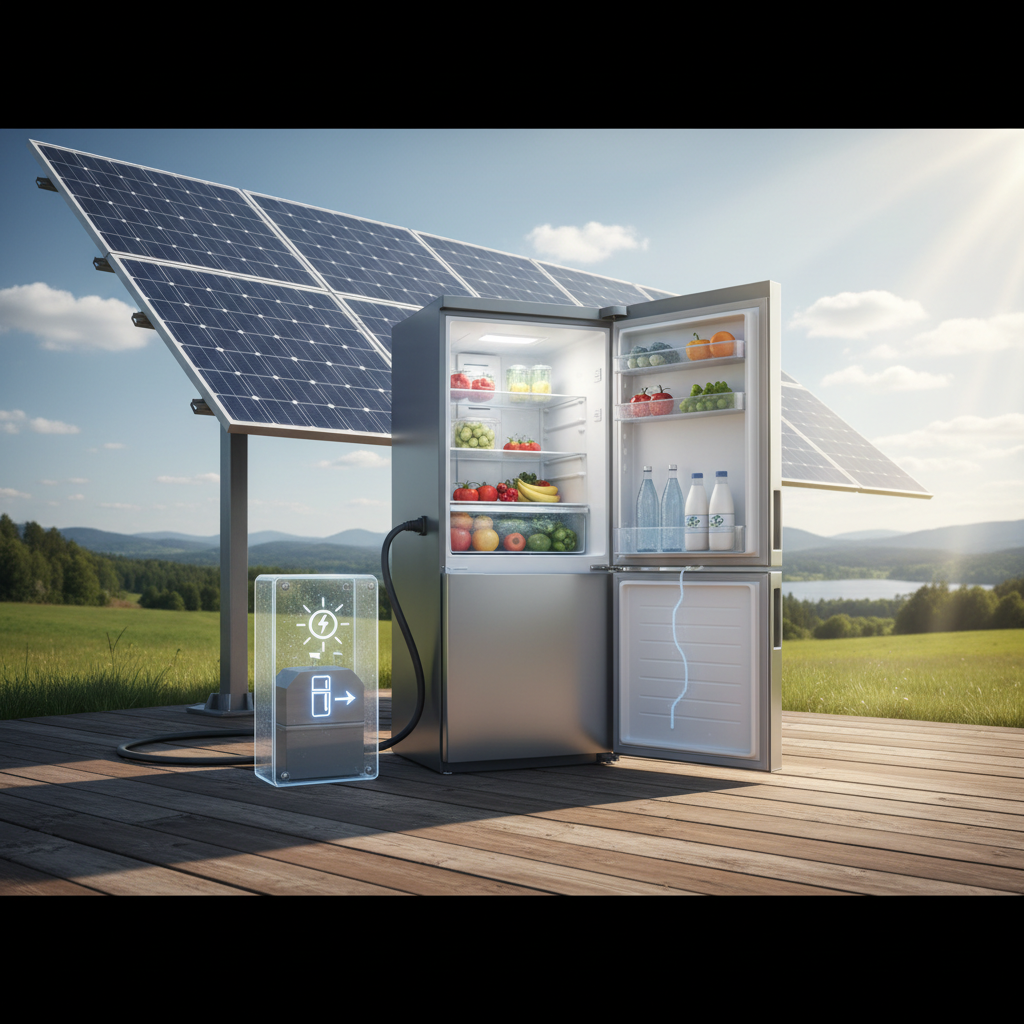
A solar-powered fridge is essentially a standard or specially designed refrigerator that draws its electricity from a solar energy system instead of the utility grid. This system typically comprises solar panels to capture sunlight, a charge controller to regulate the energy flow, a battery bank to store excess energy, and an inverter to convert the stored DC power into usable AC power for the fridge. The beauty of this setup lies in its self-sufficiency, enabling refrigeration anywhere the sun shines, without dependence on often erratic or non-existent grid electricity.
For businesses and communities in Africa, this technology is revolutionary. It means fresh produce lasts longer in remote markets, vaccines remain viable in rural clinics, and families can store food safely without constant worry about power outages. The ability to guarantee cold chain integrity has far-reaching economic and health benefits. We often consult with clients who previously relied on expensive, noisy, and polluting diesel generators for refrigeration. Switching to solar not only slashes their operational costs by upwards of 30% but also significantly reduces their carbon footprint and noise pollution. The impact on quality of life and business continuity is, in our view, immeasurable.
| Feature | Old Approach (Grid/Generator) | New Approach (Solar Power Africa) |
|---|---|---|
| Power Source | Grid electricity or fossil fuel generators | 100% Renewable Solar Energy |
| Operating Costs | High (electricity bills, fuel, maintenance) | Near-zero once installed (minimal maintenance) |
| Reliability | Susceptible to outages, fuel availability | High autonomy, battery backup for continuous power |
| Environmental Impact | Significant carbon emissions, noise pollution | Zero emissions, silent operation |
| Installation Complexity | Standard grid connection; generator setup | Custom system design, panel, battery, inverter integration |
| Maintenance Needs | Regular generator servicing, grid checks | Annual panel cleaning, battery checks (low frequency) |
| Scalability | Generator size limits; grid capacity challenges | Modular; easily expandable with additional panels/batteries |
Why Businesses Choose Power Stack Africa for Solar Refrigeration
After working with 500+ clients across diverse sectors, we understand that businesses aren’t just looking for a product; they’re looking for an ironclad solution. Power Stack Africa isn’t just a supplier; we’re a vertically integrated renewable energy solutions company with end-to-end capabilities, from initial energy audit to post-installation support. We offer complete transparency, detailed system sizing, and a proven track record of successful deployments in some of Africa’s most challenging environments.
Our competitive edge comes from our deep localized knowledge and our commitment to using only Tier 1 components. We don’t just sell you equipment; we architect a freezer solar power solution tailored to your specific operational needs, climate conditions, and budget. For example, a clinic in a remote region requires a system with higher redundancy and robust monitoring compared to a small food vendor. We account for these nuances, ensuring that the system we deliver isn’t just functional, but optimized for your unique context and built to last upwards of 20-25 years for panels and 10-15 years for batteries.
We’ve observed that many generic solar providers fail to adequately factor in seasonal variations in sunlight, leading to underperforming systems in the rainy season. Our designs incorporate detailed irradiance data and robust battery banks to ensure consistent performance year-round. This meticulous planning is precisely why we can confidently offer performance guarantees – a testament to our systematic approach and unwavering commitment to client success.
Enery Meets Intelligence: Poweing The Future
Delivering reliable off-grid energy and smart infrastructure solutions designed for businesses, cities, and large-scale projects across Africa.
Guaranteed Uptime
We engineer systems for maximum reliability and autonomy, ensuring your refrigeration never skips a beat, even through extended overcast periods.
Optimized Efficiency
Our designs minimize energy waste, prolonging battery life and maximizing power delivery to your critical appliances.
Reduced Operational Costs
Say goodbye to fuel bills and high running costs. Solar provides free, abundant energy, boosting your bottom line.
Scalable Solutions
Whether for a single fridge or an entire cold chain, our modular systems can grow with your business needs.
End-to-End Support
From consultation and design to installation and ongoing maintenance, we’re your single point of contact for worry-free solar.
Our Process for Delivering Solar Fridge Solutions
Our methodical approach ensures every solar refrigeration project is delivered with precision and performance. We don’t believe in one-size-fits-all; instead, we follow a rigorous multi-phase process designed to meet your specific needs and exceed your expectations, backed by data and our extensive field experience.
Detailed Energy Audit & Site Assessment
We begin by meticulously understanding your fridge’s power consumption (running watts and critical surge watts) and duty cycle. We also evaluate your site’s solar irradiance, shading patterns, and physical space for panel installation. This isn’t theoretical; we often deploy data loggers to capture real usage patterns over 24-48 hours. This data informs everything, from battery autonomy to inverter sizing.
Custom System Design & Component Selection
Based on the audit, our engineers design a bespoke system, specifying the optimal number of solar panels (e.g., three 330W panels totaling 990W), battery bank capacity (e.g., 400Ah LiFePO4 for 2-3 days autonomy), inverter size (e.g., 2000W pure sine wave with 4000W surge capability), and charge controller. We leverage simulation tools like PVsyst for accurate power production estimates, ensuring the system can handle critical loads even during less-than-ideal weather conditions.
Procurement, Installation & Commissioning
We source only high-quality, warrantied components from trusted manufacturers. Our certified technicians then execute the installation, ensuring adherence to the design and all safety standards. Post-installation, we thoroughly test and commission the system, verifying optimal performance and educating your team on its operation and basic maintenance. We check voltage, current, power factor, and harmonic distortion to ensure appliance compatibility and system longevity.
Monitoring, Maintenance & Support
Our relationship doesn’t end at commissioning. We offer ongoing monitoring packages to track system performance remotely, identifying and addressing potential issues proactively. Regular maintenance checks, including panel cleaning and battery health assessments, ensure peak efficiency and extend component lifespan. This proactive approach minimizes downtime and maximizes your return on investment.
Pricing & Packages for Solar Refrigeration Systems
The cost to solar power home appliances like a fridge varies significantly based on factors such as fridge size, energy efficiency, desired autonomy (how many days it needs to run without sun), and the quality of components. We offer tailored packages, acknowledging that a small domestic fridge has different requirements than a commercial cold room. Our pricing reflects the quality of our Tier 1 equipment, our expert installation, and the comprehensive support we provide.
To give you a general idea, powering a typical 250-liter domestic fridge (consuming around 300-500 Wh/day) might fall into our Standard Package range. For a larger commercial display fridge or a freezer solar power solution, the Advanced or Premium packages would be more appropriate due to the higher energy demand and increased battery storage requirements. We always provide a detailed, itemized quote after our site assessment, ensuring full transparency with no hidden costs.
*Note: All prices are estimates and subject to final site assessment and component availability. Contact us for a precise, personalized quote.
Enery Meets Intelligence: Poweing The Future
Delivering reliable off-grid energy and smart infrastructure solutions designed for businesses, cities, and large-scale projects across Africa.
Common Mistakes to Avoid When Powering a Fridge with Solar
In our years of experience, we’ve identified several common pitfalls that can undermine the performance and reliability of a solar-powered refrigeration system. Understanding these mistakes is crucial for any business or individual seeking a robust renewable energy solutions.
Underestimating Surge Current
Mistake: Many systems are sized only for the fridge’s running wattage. However, a compressor’s startup requires a significantly higher surge current, often 3-5 times its running current, lasting for a fraction of a second. If the inverter isn’t specified to handle this, it will trip or fail prematurely.
Our Solution: We meticulously calculate surge requirements based on fridge specifications and select inverters with ample headroom, ensuring smooth and reliable startup every time.
Insufficient Battery Autonomy
Mistake: Designing a system with just one day of battery backup. In reality, weather can be unpredictable, leading to multiple consecutive cloudy days. An under-sized battery bank means your fridge stops working when you need it most.
Our Solution: We typically design for 2-3 days of battery autonomy as a minimum, and up to 5 days for critical applications, using robust LiFePO4 batteries known for their deep cycle capabilities and longevity.
Ignoring Fridge Efficiency
Mistake: Trying to power an old, inefficient fridge with solar. Older models can consume 2-3 times more power than modern, energy-star-rated appliances, making the solar system much larger and more expensive than necessary.
Our Solution: We always recommend investing in a new, highly efficient DC or AC fridge designed for low energy consumption. This reduces the overall system size and cost to solar power home refrigeration significantly.
Poor Installation & Wiring
Mistake: Using undersized cables, poor connections, or incorrect grounding. This leads to voltage drops, power loss, increased fire risk, and reduced system lifespan.
Our Solution: Our certified technicians strictly adhere to international electrical codes and best practices, using appropriately sized cables and professional-grade components to ensure safety and maximum efficiency.
Real Results: Solar Fridge Success Stories
Don’t just take our word for it. Our passion at Power Stack Africa is seeing our renewable energy solutions company transform lives and businesses. We’ve compiled some anonymized case studies that highlight the tangible impact of our solar refrigeration installations.
Case Study 1: Remote Medical Clinic in rural Kenya
A rural clinic struggled with inconsistent grid power, endangering temperature-sensitive vaccines and medicines. They approached us for a reliable solution for their 300-liter medical fridge. We installed a 750W solar panel system paired with a 200Ah (24V) LiFePO4 battery bank and a 2000W pure sine wave inverter. Within the first month, they reported 100% uptime, eliminating the need for expensive, unreliable diesel generator backups. The clinic saved approximately $300 USD per month on diesel, with a projected ROI of under 3 years. The critical insight here was designing for robust over-capacity to handle unexpected surges from the medical equipment, not just the fridge.
Case Study 2: Off-Grid Restaurant in Tanzania
A restaurant operating entirely off-grid relied on daily ice deliveries for its large freezer and beverage fridges, costing them significant daily operational overhead. We deployed a 2.5kW solar array with a 600Ah (48V) battery bank and a 5000W inverter for their two display fridges and a large freezer. The owner can now store fresh ingredients for longer, offer a wider range of cold beverages, and has completely eliminated ice delivery costs. They experienced a 45% reduction in overall energy expenses, dramatically improving their profit margins. We also advised them on optimizing fridge placement to minimize heat gain and further reduce energy consumption.
Case Study 3: Small Family Farm in Uganda
A family farm wanted to store their fresh produce longer before transport to market, reducing spoilage. We installed a compact, efficient system for a small 120-liter DC fridge: a single 330W solar panel, a 100Ah 12V LiFePO4 battery, and a simple 12V DC charge controller. This direct DC setup minimized conversion losses. The farm reported extending the shelf life of their produce by an average of 4 days, leading to higher market prices and significantly less waste. This project underscored that for small DC appliances, a simplified system can be incredibly effective and affordable.
Frequently Asked Questions About Solar Fridges
What size solar panel do I need to run a fridge?
The size of the solar panel depends entirely on your fridge’s energy consumption. A typical energy-efficient domestic fridge might require a 200W-500W solar panel. We determine this by calculating your fridge’s daily Watt-hour consumption (Wh/day) and factoring in your local peak sun hours. For instance, a fridge consuming 500Wh/day in an area with 4 peak sun hours would need at least 125W of panel capacity (500Wh / 4h). However, we always recommend oversizing slightly (e.g., 200W-250W) to account for cloudy days and system losses, ensuring consistent performance for your home solar power unit.
How many batteries do I need for a solar fridge system?
The number of batteries required depends on your fridge’s daily power consumption and how many days of autonomy you need (i.e., how long the fridge should run without solar input). For a fridge using 500Wh/day, and aiming for 2 days of autonomy, you’d need a battery capacity of 1000Wh, plus a buffer for discharge limits and system efficiency. For example, a 12V 100Ah LiFePO4 battery provides 1200Wh. We work with clients to define their critical autonomy period, typically recommending 2-3 days minimum, especially for medical or commercial freezer solar power applications, to ensure reliability.
Can I run a normal fridge with solar power, or do I need a special DC fridge?
You can definitely run a normal AC fridge with solar power, but you’ll need an inverter to convert the DC power generated by your panels and stored in your batteries into AC power. While DC fridges are more efficient as they avoid inverter conversion losses, modern AC fridges, particularly energy-efficient models, work very well with solar systems. The decision often comes down to the fridge’s availability, cost, and your overall system design. We’ve successfully integrated both types into our renewable energy solutions.
What are the benefits of using solar power for refrigeration?
The benefits are substantial, especially in Africa. You gain energy independence, significantly reduce or eliminate electricity bills, lower your carbon footprint, and ensure reliable refrigeration in areas with unreliable grid power or no grid at all. For businesses, this means reduced operational costs, extended shelf life for products, and improved food safety. For families, it means fresh food and medicine. In our experience, clients often report a noticeable increase in business continuity and overall quality of life.
How much does it cost to set up a solar system for a fridge?
The cost to solar power home or commercial fridges varies widely based on fridge size, efficiency, desired battery autonomy, and component quality. A basic domestic fridge setup could range from $800 to $1,500, while a robust commercial cold room solution might be $6,000 to $15,000+. This includes panels, batteries, inverter, charge controller, and installation. We provide detailed, transparent quotes after conducting a thorough energy audit and site assessment, ensuring you understand every aspect of your investment.
How long do solar-powered refrigerators last?
The longevity of a solar-powered refrigeration system depends on the quality of its components. High-quality solar panels typically last 20-25 years with minimal degradation. LiFePO4 batteries, which we primarily use, have a lifespan of 10-15 years or 3000-6000 cycles, assuming proper usage and maintenance. Inverters usually last 5-10 years. With proper design, installation, and regular renewable solutions maintenance, your solar fridge system can provide reliable service for over a decade, with components replaced incrementally as needed.
What maintenance is required for a solar fridge system?
Solar fridge systems require relatively low maintenance. Key tasks include periodically cleaning the solar panels to ensure maximum sunlight absorption (dust and dirt can reduce efficiency by 15-20%). Battery terminals should be checked for corrosion, and the battery charge level monitored for optimal health. Inverters and charge controllers typically require little direct maintenance but should be kept in a well-ventilated, dry environment. We offer comprehensive maintenance plans to ensure your system continues to perform optimally.
Ready to Power Your Refrigeration with the Sun?
Stop worrying about power outages and high electricity bills. Power Stack Africa delivers custom-engineered solar refrigeration systems built for reliability, efficiency, and lasting performance. From remote clinics to bustling restaurants, we have the expertise to keep your cold chain intact.
Related Reading
Continue learning with these hand-picked resources: