
An industrial energy consumption audit maps how electricity and on-site fuels are used across your facility in Kenya. By reviewing utility bills, operating data and equipment, it identifies where energy is consumed and where performance may improve. The result is a set of practical recommendations grounded in measured conditions, not assumptions about what your plant should change.
A useful assessment looks beyond the energy bill. Production reliability, equipment operation, emissions and maintenance demands matter too. A sound audit compares consumption patterns with production needs, then evaluates each opportunity for its operational impact, implementation requirements and financial case.
This article explains how an audit is prepared and carried out, how recommendations are evaluated, and what energy and operational benefits may follow. You’ll learn what evidence supports decisions, why savings depend on operating conditions, and how findings can inform energy management, on-site solar and storage planning without treating every facility alike.
Key Takeaways
- Build the assessment around energy bills, operating data and equipment use to identify where consumption can be reduced.
- Rank recommendations by expected energy and emissions impact, operational requirements and financial case before committing to changes.
- Use a consistent baseline and measurement approach to assess whether implemented measures deliver the expected results.
- Look beyond energy savings: audit findings can also inform operational improvements and decisions about solar and battery storage.
Why focus on industrial energy efficiency?
An industrial assessment links energy use to production needs and identifies practical efficiency measures. In Kenya, applicable audit duties depend on the facility and sector; ISO 50015:2014 is a measurement-and-verification standard, not itself a Kenyan statute or regulation. According to the International Organization for Standardization, an audit’s measurement-and-verification plan can be based on its principles.
Prioritising Efficiency Measures
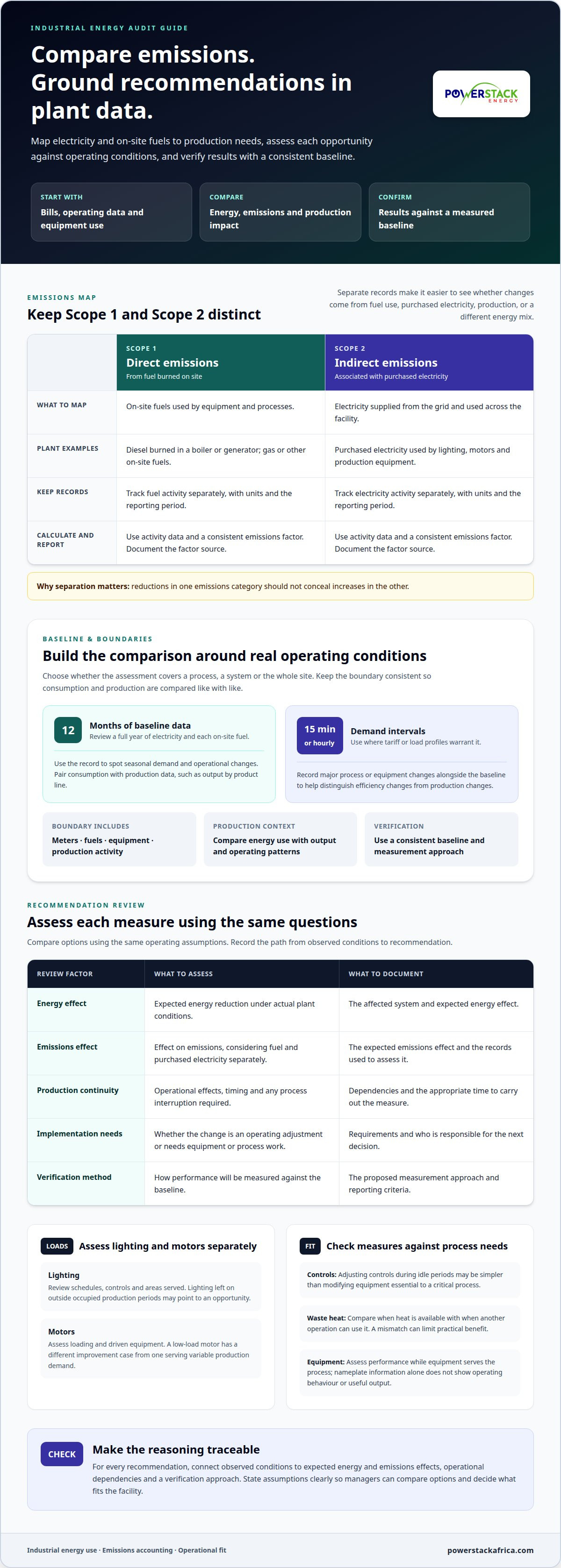
Prioritise measures by expected energy savings, operational effects and implementation requirements. Even a technically sound improvement can disrupt production if poorly timed. Compare options with actual plant conditions: adjusting controls during idle periods may be simpler than modifying equipment essential to a critical process. This helps managers choose measures that improve efficiency without compromising production.
Lighting and Motor System Savings
Assess lighting and motors as individual loads rather than treating the plant as one system. For lighting, review schedules, controls and the areas served. Lighting that remains on outside occupied production periods may indicate an opportunity. For motors, assess loading and the equipment they drive. A motor running at low load presents a different improvement case from one serving variable production demand.
Energy Data and Measurement Boundaries
Measurement boundaries define which meters, fuels, equipment and production activities the assessment covers. Review one year of historical consumption to identify seasonal patterns and operational changes. Where tariff or load profiles warrant it, electricity demand data may use 15-minute or hourly intervals. Set the boundary around a process, system or site so that benchmarking compares like with like.
Conservation Opportunities and Measures
Conservation measures change operating practices or equipment to reduce avoidable energy use while meeting production needs. Review schedules, controls, heat losses and equipment operation as distinct opportunities. For example, a plant may find heat escaping from a process or equipment running outside production hours. Record the affected system, expected energy effect, implementation needs and verification method to support clear decisions.
Economic and environmental assessment of audit recommendations
Evaluate recommendations against their effect on energy use, production continuity and environmental performance. For a Kenyan facility, compare options using the same operating assumptions, then rank them by expected energy reduction, emissions impact and practical requirements. This makes trade-offs visible, such as a measure that reduces fuel demand but requires a planned process interruption.
Use a documented assessment framework with clear boundaries, evidence and reporting criteria. Distinguish technical guidance from legal obligations: an international standard alone does not establish a sector-specific requirement in Kenya. Make the method’s assumptions explicit so managers can understand how each recommendation was assessed.
An on-site assessment connects equipment performance with production conditions. For example, assess a boiler while it is serving the process rather than relying only on its nameplate information. Record operating behaviour and useful output, then compare possible adjustments with process requirements. This grounds recommendations in the facility’s actual operating conditions.
A waste heat assessment considers where thermal energy leaves a process and whether another operation can use it. Recovery depends on the heat source, timing and receiving process. Compare these operating profiles before recommending recovery, because a mismatch between supply and demand can limit its practical benefit.
Document the assumptions behind each recommendation, its expected energy and emissions effects, operational dependencies and proposed verification approach. Audit quality improves when the reasoning can be traced from observed conditions to a recommendation. This also helps management distinguish measures achievable through operating changes from those requiring planned equipment or process interventions.
Use the results to set priorities and assign responsibility for the next decision. To discuss how an energy audit can support your facility’s planning, speak with Powerstack Africa Energy Ltd.
Industrial energy consumption and emissions
Energy consumption connects production activity with emissions from fuel use and purchased electricity. For a Kenyan plant, map electricity, diesel, gas and other on-site fuels to the equipment or process using them. This makes demand patterns visible and shows whether annual changes reflect improved efficiency, altered production, or a different energy mix.
Separate emissions into Scope 1 and Scope 2 before setting reduction measures. Scope 1 covers direct emissions from fuel burned on site, such as diesel used in a boiler or generator. Scope 2 covers indirect emissions associated with purchased electricity. Calculate each category from activity data and a consistent emissions factor, documenting the units, factor source and reporting period. Keep fuel and electricity records distinct so reductions in one category don’t conceal increases in another.
Use a 12-month baseline for electricity and each on-site fuel before setting reduction targets. A full-year record helps account for seasonal demand, production schedules and changes in operating patterns. Pair consumption with production data, such as output by product line, to distinguish lower energy intensity from a temporary fall in production. Record major process or equipment changes alongside the baseline.
Assess emissions reduction measures against both energy use and operating requirements. A control change that cuts generator runtime, for example, may lower direct fuel-related emissions; a reduction in purchased electricity affects Scope 2 accounting. Compare the expected effect with measured post-implementation data using the same boundary, units and emissions factors. This supports a credible assessment of improvement rather than relying on equipment claims alone.
Give thermal processes separate attention because fuel input, useful heat and waste heat can vary independently. Record thermal demand at the process boundary, then examine whether operating schedules, insulation or heat recovery could reduce fuel use. For each measure, document production conditions and any shift in emissions between electricity and fuel. This helps management assess overall energy performance rather than relying on a single meter or emissions category.
Energy and non-energy benefits of industrial audits
An audit can reveal operational benefits beyond reduced energy use. For example, a factory may identify a process control issue that causes inconsistent product quality while also increasing energy demand. Addressing the control issue can support more stable production and reduce avoidable consumption. Maintenance teams can also use equipment findings to prioritise inspections around actual operating conditions.
The value of a recommendation depends on how well it fits the facility’s production requirements. Changing operating schedules may suit equipment that runs outside production hours, while process modifications need closer coordination with production teams. Record expected operational effects alongside energy and environmental outcomes. This helps managers judge whether a measure supports consistent output, maintenance planning or clearer visibility of plant performance.
Audits can also improve management decisions by showing where further engineering analysis would be useful. If a finding points to recurring equipment faults, maintenance records can help establish whether they affect process reliability. If energy intensity changes while output remains stable, investigate operating conditions rather than assuming production volume explains the difference.
Which Kenyan industries must conduct audits, and how often? Whether an audit is legally required depends on the applicable sector rules and facility circumstances. As a planning practice, industrial audits are typically conducted every three to five years and after major production, equipment or site changes. This interval is not a universal legal requirement in Kenya.
Which Kenyan agencies and accredited energy auditors provide industrial audits? The relevant agency and accreditation route depend on the facility’s sector and applicable Kenyan requirements. An auditor’s credentials should match those requirements and the technical scope, such as process, electrical or thermal assessment. This distinction separates a voluntary improvement study from a sector-specific compliance assessment.
Turn findings into an operating plan by assigning responsibility, setting implementation priorities and tracking indicators relevant to production and maintenance. This makes follow-up part of routine facility management. To discuss how an energy audit can support your facility’s planning, speak with Powerstack Africa Energy Ltd.
Powerstack Africa Energy Ltd: Energy Audits
Powerstack Africa Energy Ltd provides Energy Audits to assess how your industrial facility uses energy and identify improvement opportunities. Consider an audit when consumption patterns, production demands or equipment changes make energy performance harder to manage.
If findings indicate that on-site generation or storage may help, the next step could be Commercial Solar EPC or Battery Energy Storage Systems. For commercial and industrial storage, Powerstack Africa Energy Ltd also offers the Deye BOS-B (AS, AF, LATAM, EU, AU) Lithium Ion Solar Battery System for Commercial & Industrial Applications. Audit findings help determine whether these options fit your facility’s energy requirements. A solar feasibility assessment in Kenya can further help evaluate rooftop suitability alongside demand and expected solar yield.
Contact Powerstack Africa Energy Ltd to discuss an energy audit for your facility.
Turn audit findings into an operating plan
The next step is to convert recommendations into defined decisions: assign responsibility, set implementation conditions and identify how each change will be assessed against production needs. This keeps an industrial energy consumption audit connected to operating priorities, rather than leaving its findings as a report without a clear path forward.
Powerstack Africa Energy Ltd offers Commercial Solar EPC, Battery Energy Storage Systems, and Hybrid Inverters & PCS. These services may be relevant when audit findings point to on-site generation, storage or power-conversion needs. The team can help you assess these options in light of your facility’s energy requirements and the operational constraints identified in the audit.
Choose the next action based on the opportunity your audit identifies, whether that means refining operating practices or evaluating an energy system project. For a practical discussion about your facility’s needs, contact Powerstack Africa Energy Ltd. A clear decision process puts your findings to work.
Frequently Asked Questions
How is the Audit performed?
An industrial energy consumption audit combines records review with on-site observation and measurement. The assessor traces selected energy flows from supply points to major users, then checks how equipment operates during representative production. Findings are compared with operating schedules and output data. This helps separate avoidable use from the energy needed to maintain product quality, process conditions and production continuity.
What is an industrial energy consumption audit and what does it cover?
An industrial energy consumption audit is a structured technical assessment of how a facility obtains and uses energy. It can cover purchased electricity, on-site fuels, major equipment, production processes and operating practices. Depending on the assessment boundary, it may also examine power quality, thermal systems and emissions linked to energy use. The findings help decision-makers identify, compare and plan measures suited to facility operations.
What are the steps involved in conducting an industrial energy audit?
An audit typically begins by defining its scope and collecting facility records. The assessment reviews energy supply, observes production and equipment operation, and measures selected loads or process conditions. The auditor analyses the findings, develops recommendations and documents assumptions and verification methods. After implementation, follow-up measurement compares actual performance with the baseline. This sequence links technical findings to decisions and operational results.
What data and documents should a factory prepare for an energy audit?
Useful records include utility bills, fuel purchase or delivery logs, meter readings, production volumes, shift schedules and equipment inventories. Maintenance logs, process diagrams, operating procedures and records of major equipment changes can help explain unusual consumption. Include generator run-hour logs where relevant. Organising records by date and production line helps the assessor connect energy use with operational changes and spot gaps in the facility’s records.
How can factories identify energy-saving opportunities in boilers, motors, HVAC, and compressed air systems?
For boilers, compare fuel input with steam demand and inspect operating controls and heat losses. For motors, assess loading, run schedules and the equipment they drive. In HVAC systems, review setpoints, operating hours and ventilation needs across production areas. For compressed air, check for leaks, review pressure settings and identify unnecessary demand. These checks can reveal where equipment operation does not match actual process requirements.
What energy savings and payback periods can Kenyan industries expect from energy efficiency measures?
There is no single savings or payback figure for every Kenyan plant. Results depend on the equipment affected, operating hours, production mix, energy sources and implementation requirements. Estimate savings from measured baseline use, then calculate payback using the project’s financial assumptions and expected annual energy reduction. After implementation, compare estimates with operating data to assess whether the measures are delivering the intended performance.