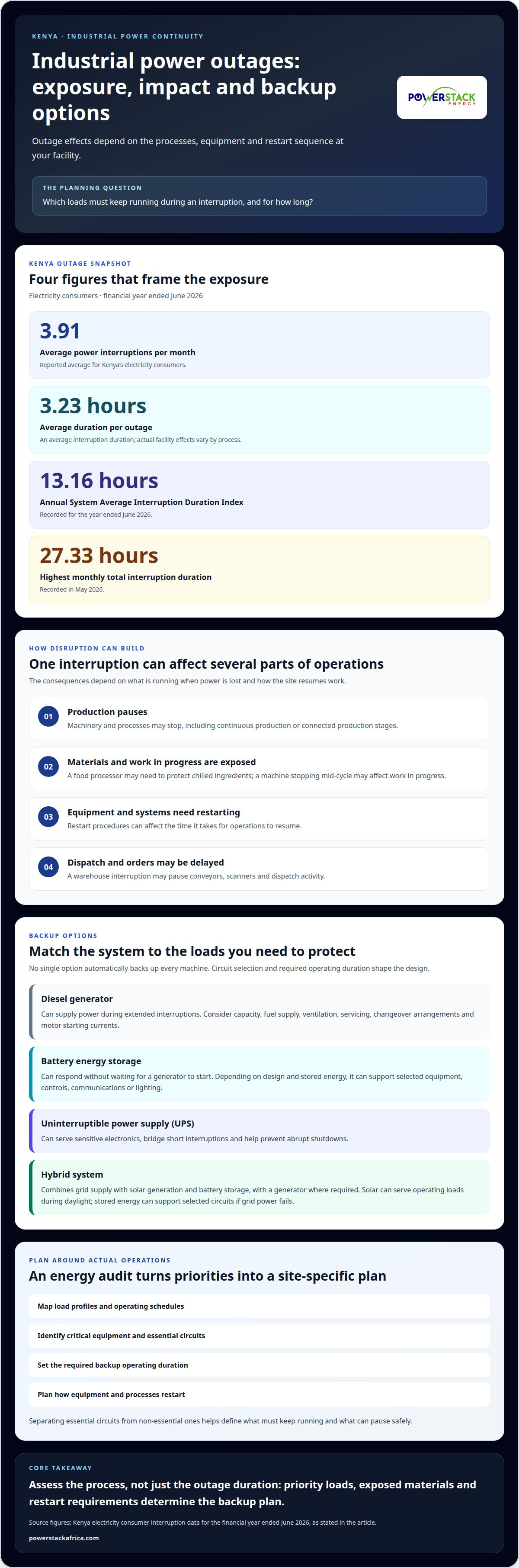
Kenya’s electricity consumers experienced an average of 3.91 power interruptions per month in the financial year ended June 2026, with an average duration of 3.23 hours per outage; industrial power outage financial losses in Kenya depend on production time lost, affected equipment, disrupted work in progress and the restart process.
For your business, the impact can extend beyond the time without grid power. Production may stop, orders may be delayed, materials in process may be affected, and equipment or systems may need to be restarted. Solar and battery storage, designed for backup, can support selected loads during an outage. Solar generation can also reduce reliance on grid electricity during operating hours.
This article explains how outages affect industrial operations, which factors shape their financial impact, and how solar and storage may fit into an energy plan in Kenya. It also explains how an energy audit and site-specific design help identify priority loads and plan for continuity.
Key Takeaways
- Map how interruptions affect production, equipment, work in progress and restart procedures to identify the operational impacts that matter most to your facility.
- Assess grid-connected solar, battery storage and generator integration against the loads your site needs to keep running during an outage.
- Understand the distinction between existing protections for injury or damaged equipment and claims for business losses caused by interruptions.
- Explore how a commercial power conversion system can fit into a battery storage plan, based on your facility’s electrical requirements.
How do power outages disrupt Kenyan industries?
Kenya’s electricity consumers experienced an average of 3.91 power interruptions per month in the financial year ended June 2026. Each outage lasted an average of 3.23 hours. The annual System Average Interruption Duration Index was 13.16 hours in the year ended June 2026. These figures frame the operational exposure behind industrial power outage financial losses in Kenya.
The impact depends on the process. A food processor may need to protect chilled ingredients and restart packaging equipment. A manufacturer running continuous production may lose work in progress if machinery stops mid-cycle. A warehouse may have to pause conveyors, scanners and dispatch. Assess the affected loads, materials and restart sequence, not just the outage duration.
Power interruptions can affect essential operations across East Africa. A tea processor in Kenya, a cold store in Uganda and a cement plant in Tanzania may all depend on electrically powered equipment, but their critical loads differ. These examples illustrate operational differences, not outage frequency; comparable figures are not available.
Outside the region, an automotive assembly line offers another example. Coordinated machinery can stop together, delaying connected production stages and subsequent quality checks. Kenya recorded its highest monthly total interruption duration, 27.33 hours, in May 2026. To assess your site’s exposure, map which processes stop first, what materials are exposed, and which systems restart in sequence. This gives you a facility-specific view without assuming every industry faces the same effects.
What backup power options can Kenyan industries consider?
Kenyan industries can choose backup power by matching the system to critical loads, outage patterns and restart requirements. A tea processor might prioritise pumps, controls and selected processing equipment, while a data room may need continuous power for servers and network equipment. Separating essential circuits from non-essential ones clarifies what must keep running and what can pause safely.
A diesel generator can supply power during extended interruptions, provided its capacity, fuel supply, ventilation and servicing are suitable. It may support heavy machinery or an entire production area, but the changeover arrangement matters. Automatic or manual changeover equipment switches the facility between grid and generator supply. The design must also account for motor starting currents, which can exceed normal running demand.
Battery energy storage can respond to an interruption without waiting for a generator to start. Depending on the design and stored energy, it can support selected equipment, controls, communications or lighting. A UPS can serve sensitive electronics, bridging short interruptions and helping prevent abrupt shutdowns. Neither option automatically backs up every machine: circuit selection and required operating duration shape the design.
A hybrid system combines grid supply with solar generation, battery storage and, where required, a generator. Solar can serve operating loads during daylight, while stored energy supports selected circuits if grid power fails. A generator can provide another source when needed. For a Kenyan factory, an energy audit maps load profiles, critical equipment and operating schedules, so the backup design addresses actual production needs rather than treating every circuit as equally essential.
What compensation or regulatory protections apply to Kenyan businesses during power outages?
Do not assume that Kenya Power or another licensee will compensate your business for outage-related losses. The applicable compensation position depends on current rules and terms, which should be checked with Kenya Power and the Energy and Petroleum Regulatory Authority (EPRA). A 2015 Kenyan Bill reportedly proposed compensation for outages exceeding three hours within a day; without an authoritative source confirming its status and outcome, its provisions should not be treated as current law.
Proposed electricity supply regulations have been reported to set out possible reporting and claim deadlines. The reported proposal would require a consumer to report a breach in writing within 30 days to qualify for compensation, lodge a written claim within 12 months after the breach, and, if the claim were determined, receive an approved amount within three months. Verify the proposal’s text and status with EPRA before relying on these details; they are not, by themselves, evidence of current compensation entitlements.
To keep an accurate record after an outage, assign a staff member to:
- Record the interruption’s start and end times, including the date and affected facility.
- Document affected machinery, production processes, equipment damage and any safety incidents.
- Keep relevant shift logs, maintenance records, alarm reports and evidence of interrupted operations.
- Report the incident to Kenya Power in writing, retaining the correspondence and any response.
Keep records factual and contemporaneous. A cold-storage operator, for example, can log temperature readings and identify affected refrigeration equipment. A manufacturer can preserve machine logs and production records showing when operations stopped and resumed. These records help distinguish outage-related damage from separate operational issues.
Keep reports of equipment damage or injury separate from internal records of lost production. Check current Kenya Power terms and applicable EPRA rules to establish what, if anything, may be claimed; do not assume that business losses are covered. Do not treat reported proposal timelines as active deadlines or as a guarantee of payment. Verify the status of the applicable rules before relying on them for a claim.
How can solar and battery storage improve industrial power resilience?
A solar photovoltaic module converts sunlight into direct-current electricity. A solar inverter converts it into alternating current for equipment such as pumps, conveyors and processing machinery. During daylight, a grid-connected solar system can supply part of a facility’s operating demand. However, a standard grid-tied installation may shut down during an outage. Backup operation requires a design that safely isolates the site and supplies selected loads.
Battery energy storage adds another option: it stores electricity for use when solar generation falls or grid supply is interrupted. A Kenyan factory might prioritise control systems, communications, essential lighting, refrigeration or selected production equipment. Backup duration depends on battery capacity, connected load and system configuration. Motors with high starting currents also need careful assessment, as their demand can exceed normal running requirements.
Solar and storage can work alongside the grid and an existing generator. Solar serves suitable loads when available, while the battery supports selected circuits during an interruption. A generator can remain part of the design when operating requirements exceed the storage system’s intended backup duty. This layered approach reduces reliance on a single supply source, but does not keep every machine running.
Start system design with an energy audit and a clear list of load priorities. Engineers assess site demand, operating schedules, essential equipment, starting currents and the required backup arrangement. An energy management system can coordinate generation, storage and consumption. Protection, changeover and isolation arrangements must also suit the facility’s electrical installation. For a plant with sensitive controls, account for transfer behaviour and restart procedures. Solar and battery storage support resilience when designed around the actual operating profile, not simply the facility’s total connected load.
Powerstack Energy: Golen LEG-250K/500K-TT-B Commercial Power Conversion System (PCS)
Powerstack Energy Ltd can assess whether the Golen LEG-250K/500K-TT-B Commercial Power Conversion System (PCS) suits your industrial power design. A commercial PCS manages electrical conversion between battery storage and a facility’s power system. Consider it when planning battery storage, integrating storage with an existing installation or defining how stored energy should support selected loads.
A PCS is one component of an engineered system, not a standalone guarantee of uninterrupted production. Its role depends on the wider design, including battery configuration, electrical loads, operating modes and protection interfaces. A manufacturer may prioritise control systems and selected production equipment, while a cold-storage facility may focus on refrigeration circuits. These operating priorities determine how the PCS fits into the site’s electrical system.
Powerstack Energy Ltd provides Battery Energy Storage Systems and Commercial Solar EPC. The DEYE BOS-B Commercial & Industrial Lithium Battery Storage System may form part of a storage design when it suits the project requirements. The design must align the PCS and battery with the facility’s load profile, solar generation, existing grid connection and backup objectives. This defines which circuits the system is intended to support and how it integrates with other supply sources.
Consider the Golen system when your facility needs a commercial power conversion component within a planned battery storage project. Powerstack Energy Ltd can assess the application and develop a system design around your operational requirements. Contact Powerstack Energy Ltd to discuss your facility’s requirements.
Frequently Asked Questions
How much do industrial power outages cost Kenyan businesses annually?
No single annual figure applies to every Kenyan business. Estimating industrial power outage financial losses in Kenya means reviewing interrupted output, spoiled or delayed materials, idle shifts, restart work and backup-power use. A food processor, for example, may face different operational effects from a factory able to reschedule production. Use outage and production records to estimate the impact at your facility.
What are the average financial losses per hour of outage for Kenyan manufacturers?
Hourly industrial power outage financial losses in Kenya depend on the production process and affected equipment. Consider which lines stop, their output at the time, work in progress, staffing and restart requirements. A plant with independent production lines may keep some operations running, while a connected process may require a wider shutdown. Record these factors separately to assess your facility’s hourly exposure.
Which Kenyan industries lose the most from power interruptions?
Continuous processes, temperature control and closely linked machinery can increase operational exposure. Food and agricultural processors may need to protect perishable materials, while flower farms rely on powered handling and storage systems. In sequential manufacturing, an interruption can affect connected production stages. These examples illustrate potential exposure, not a verified ranking of Kenyan industries by outage losses.
How many hours of power outages do industrial customers in Kenya experience each year?
No single annual outage duration represents every industrial customer. The total at an individual facility depends on the number and length of its supply interruptions. To calculate your site’s annual total, add the recorded duration of each grid interruption, keeping internal electrical faults separate. This facility-level record is more useful for operational planning than a national average.
How do outages affect production, equipment, inventory, and labour costs in Kenya?
An interruption can stop a production sequence, leave partly processed materials awaiting restart or expose temperature-sensitive stock to changing conditions. If a controlled process stops abruptly, equipment may need inspection before restarting. Staff may also need to reschedule tasks or complete delayed work on another shift. Record affected batches, machine status and work hours to identify these secondary effects.
What are the main causes of industrial power outages in Kenya?
Interruptions can result from faults in electricity network equipment, damaged power lines, planned maintenance or constraints in electricity supply. An internal electrical fault can also interrupt a facility while the wider grid remains available. Compare event timing, affected circuits and equipment alarms to determine whether the incident originated on the network or within the site’s electrical installation.