The highest-capacity model isn’t automatically the right choice: a hybrid solar inverter for a home in Kenya must match the loads you need to run, your battery voltage, and whether you’ll use the grid, solar, or both. Available configurations include 3.5 kW models rated at 24 V and 6 kW models rated at 48 V, but the suitable option depends on your installation.
If you’re comparing inverter sizes, look beyond the power rating. A mismatch between the inverter, battery bank, and household demand can affect system performance. This guide explains how to choose a hybrid solar inverter in Kenya, including the differences between grid-connected and off-grid systems and how capacity and voltage relate to your needs.
You’ll learn what to consider when planning backup power, sizing the system around your loads, and deciding whether to include battery storage. The sections below cover system types and key specifications, then explain how professional solar design and installation bring those decisions together.
Key Takeaways
- Choose inverter capacity around the loads you need to run, including appliances that start with a surge in demand.
- For Nairobi homes, plan how solar, battery storage, and grid or generator supply will work together when power is unavailable.
- Distinguish grid-connected and off-grid designs by the role the utility grid plays in your system’s operation.
- Match the inverter’s voltage to the battery bank and assess system compatibility before settling on a configuration.
Which Solar Inverter is Right for Your Installation?
Choose a hybrid inverter by matching its functions to your installation. Consider the equipment it must support, the battery configuration, and the technical support needed throughout the system’s service life.
Installation Requirements
Start by defining the installation’s requirements. Identify whether it must support household circuits, commercial equipment, or agricultural loads. Then consider the electrical supply, backup priorities, and intended use of solar, batteries, grid power, or a generator. These details help narrow the inverter type before you compare models.
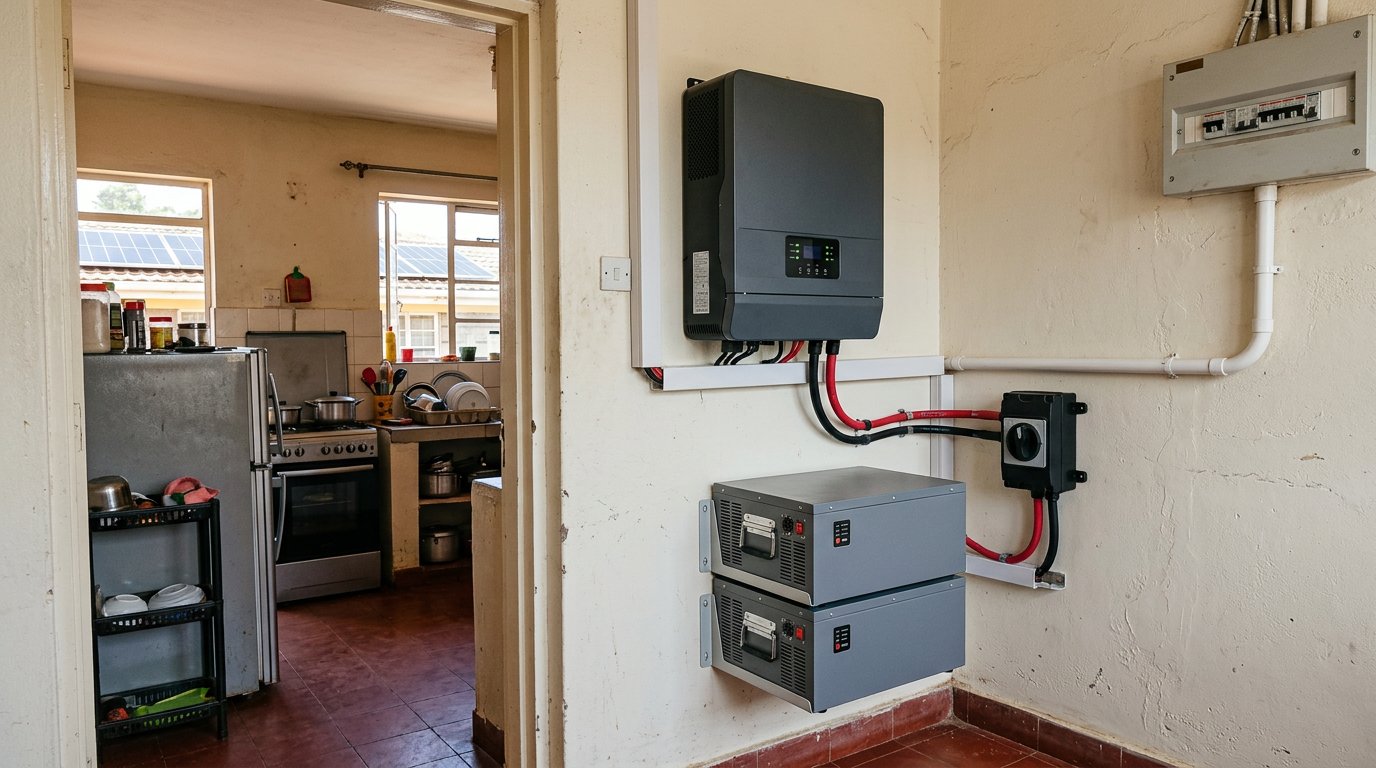
Confirm that the design accounts for installation location, ventilation, protection equipment, and commissioning. Clear technical documentation helps ensure the inverter configuration works with the rest of the electrical system.
Available Hybrid Inverter Brands
No single brand suits every Kenyan installation. Compare models by their documented functions, compatibility, and support arrangements, not name recognition alone. A household backup system and a commercial installation may have very different operating demands.
Review the manufacturer’s technical documents and warranty terms. Confirm that the model is intended for your type of installation and that its protections and controls suit the system design. These checks make brand comparisons useful without assuming one name is right for every project.
Compatible Battery Options
Choose a battery pairing supported by the inverter manufacturer. The inverter and battery must be electrically compatible, and their control systems must communicate when required. Battery chemistry also affects charging settings and operating limits.
For a proposed pairing, review both manufacturers’ compatibility documentation. A battery may appear to match the inverter’s voltage yet still have incompatible control settings. A documented match helps coordinate charging, discharging, and protection responses.
Maintenance Needs and Lifespan
Maintenance should include checking ventilation, connections, indicators, and recorded system alerts. Keep the inverter area clear and dry, and arrange a technical assessment if fault codes recur or operation becomes irregular. These steps can help identify issues before they disrupt normal operation.
Service life depends on operating conditions, installation quality, and maintenance. Warranty coverage varies by manufacturer and model, so retain purchase and installation records, warranty terms, and service history. For repeated shutdowns, charging faults, or unusual heat, use qualified technical support to diagnose the cause.
Hybrid inverter use in Kenyan homes
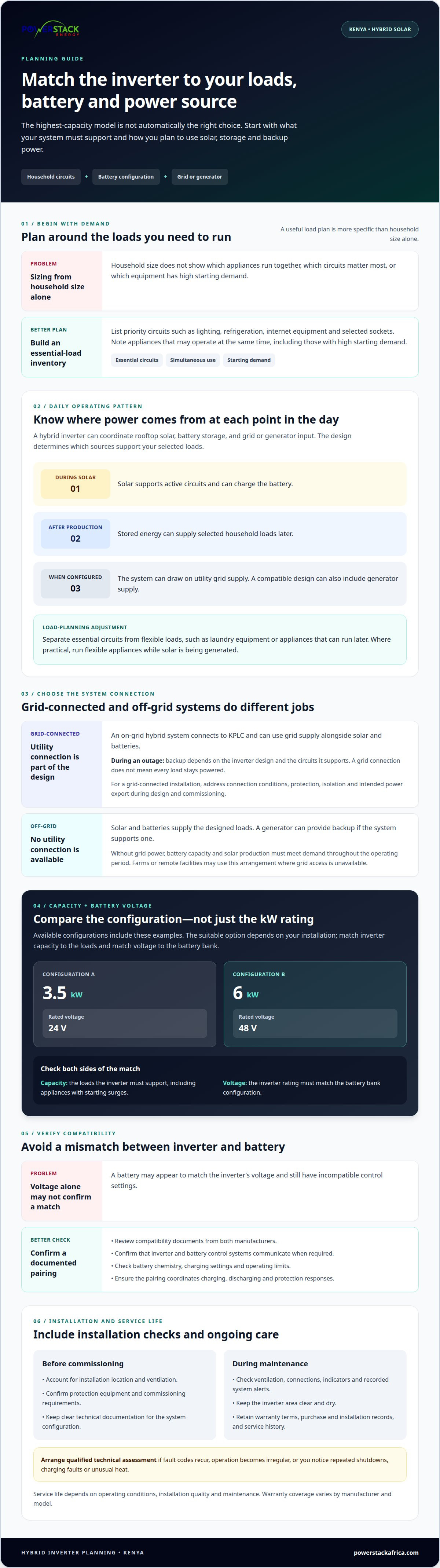
Across Kenya, a hybrid inverter can coordinate rooftop solar, battery storage, and grid or generator input. Solar can power household circuits while it is being generated, and surplus energy can charge the battery. Stored energy can then support selected loads later. The design should reflect local supply conditions and your household’s electricity use throughout the day.
Start with an inventory of essential circuits. For example, you might prioritize lighting, refrigeration, internet equipment, and selected sockets during an interruption. Note which appliances may run at the same time, especially those with high starting demand. This gives the designer a clearer operating brief than household size alone.
- During solar production: Solar supports active circuits and can charge the battery.
- After production: Stored energy can supply selected household loads.
- With grid supply: The system can draw on the utility connection when configured.
- With generator input: A compatible design can include generator supply.
Separate essential circuits from flexible loads, such as laundry equipment or appliances that can run later. This directs stored energy toward the functions you need most. The inverter settings and circuit arrangement should reflect those priorities.
Household routines also affect system use. Running flexible appliances while solar is being generated can reduce demand on stored energy later. Consider when you cook, pump water, or use other high-demand equipment. Coordinating these activities with solar production can make daily operation more efficient without changing the system’s core design.
A clear household load plan helps connect circuit priorities with system settings. To discuss your requirements, plan a hybrid inverter system around the appliances and routines that matter in your home.
Hybrid off-grid and on-grid inverter types
A hybrid inverter combines solar, battery storage, and another power source. The key distinction is whether the installation connects to the utility grid. That choice affects operation during outages, battery charging, and whether grid power supports household or site loads.
An on-grid hybrid system connects to KPLC and can use grid supply alongside solar and batteries. During an outage, backup depends on the inverter’s design and the circuits it supports. A grid connection does not mean every load will stay powered. The design must define essential circuits and how the inverter manages available power sources.
An off-grid system operates without a utility connection. Solar and batteries supply the designed loads, with a generator providing backup if the system supports one. Without grid power, battery capacity and solar production must meet demand throughout the operating period. Farms or remote facilities may use this arrangement where grid access is unavailable.
For a grid-connected installation in Kenya, applicable KPLC connection requirements govern the grid interface. The design must address connection conditions, protection, isolation, and intended power export. Resolve these technical details during system design and commissioning, not through inverter settings alone.
A hybrid inverter can work with KPLC grid power and a generator if the model supports those inputs and the system is configured for them. The design must coordinate source priority, changeover, and battery charging to prevent incompatible sources from operating together.
- Choose grid-connected when KPLC supply forms part of normal operation or backup planning.
- Choose off-grid when the installation must operate independently of utility supply.
- Include a generator when the selected inverter supports generator input and the system design requires it.
Before selecting equipment, define the connection type, priority loads, backup source, and expected power flow. A home using KPLC for backup has different requirements from a remote site relying on solar, batteries, and a generator. These decisions determine the appropriate inverter configuration.
Inverter capacity and voltage options
Choose inverter capacity to match the loads operating simultaneously. Then match its battery voltage to the battery bank. In Kenya, listed configurations include 1.6 kW, 3.5 kW, 5.5 kW, and 6 kW models. Voltage options include 12 V, 24 V, and 48 V. These figures describe different system designs, not interchangeable settings.
A 3.5 kW hybrid inverter rated at 24 V provides a specific example. Its rated output is 3,500 W, with a stated surge capacity of 7,000 VA. Rated output relates to sustained operation; surge capacity concerns brief starting demand. A 230 VAC output is also listed for this model. Check appliance requirements against both ratings.
Solar input limits matter alongside output capacity. The 3.5 kW example lists maximum input power of 5,000 W, a 500 VDC maximum open-circuit voltage, and a 120 to 450 VDC operating range. These specifications guide photovoltaic panel configuration. Array voltage must remain within the inverter’s stated limits across operating conditions.
Battery voltage is a separate compatibility requirement. This example has a 24 VDC battery input and a 220 VAC AC input. A 48 V battery bank cannot be treated as a direct substitute for a 24 V input. Confirm the inverter and battery specifications align before finalizing the system design.
- List simultaneous loads: include equipment that starts with a surge.
- Compare ratings: check continuous output and surge capacity.
- Match battery voltage: align the bank with the inverter input.
- Check solar limits: keep array voltage and power within specifications.
For larger commercial installations, capacity planning must also account for operating loads and power conversion requirements. A system design review can align inverter ratings, battery voltage, and solar input. Request inverter capacity planning for your project.
Use a battery bank whose voltage matches the inverter’s battery input. The listed options are 12 V, 24 V, and 48 V; for the 3.5 kW example, the battery input is 24 VDC.
Powerstack Africa Energy: Hybrid Inverters & PCS
Powerstack Africa Energy Ltd supports projects requiring hybrid inverters, power conversion, or integrated storage. Its Hybrid Inverters & PCS offering helps align power-conversion equipment with a project’s load and storage design. For commercial and industrial applications, the IESP 60kW HV C&I Storage Inverter is one available option.
Turn to Powerstack Africa Energy Ltd for coordinated equipment selection and project delivery. Its Commercial Solar EPC service brings system design and installation together, while Battery Energy Storage Systems integrate storage with project requirements. The right configuration depends on site loads, backup priorities, and electrical design.
For a project-specific discussion about hybrid inverters, power conversion, or storage integration, contact Powerstack Africa Energy Ltd.
Make your next system decision with a clear design brief
Before selecting equipment, define what the installation must support now and what it may need to accommodate later. A hybrid solar inverter in Kenya should be part of a design that accounts for operating priorities, backup expectations, and the property’s electrical setup. A clear brief gives the project team a practical basis for evaluating these requirements.
Powerstack Africa Energy Ltd works across Commercial Solar EPC, Battery Energy Storage Systems, and Hybrid Inverters & PCS. These services connect power conversion and storage decisions with the wider project design. Homeowners and businesses can take the next step from equipment research to a defined solar project.
Share your project requirements with Powerstack Africa Energy Ltd to discuss the next step. A well-defined design starts with the loads and operating priorities that matter to you.
Frequently Asked Questions
What is a hybrid solar inverter and how does it work?
A hybrid solar inverter coordinates solar generation, battery storage, and other available power sources. Its controls determine how electricity flows between those sources and connected circuits. For example, settings may prioritize solar generation before drawing from stored energy. The operating mode and electrical configuration determine how the system responds as solar production, battery charge, and household demand change.
What information helps determine a suitable inverter size?
List the appliances and equipment, noting which need to run at the same time. Include motors, pumps, and refrigeration equipment because their starting demand can differ from normal operation. For a business, record important processes and when they run. This load profile helps a designer assess inverter capacity and identify circuits that need priority.
What should a hybrid inverter system power during an outage?
Decide which circuits are essential before configuring the system. A household might prioritize lighting, refrigeration, and communications, while a business could identify critical controls or selected work areas. Separating priority circuits from other loads defines the intended backup function. The inverter and system design must support the selected circuits under expected operating conditions.
What happens if the battery runs low?
The system’s response depends on its configuration and whether another power source is available. If supported grid or generator input is present, the inverter may draw from it according to its settings. Without an available backup source, the system must manage remaining battery capacity against connected demand. Clear load priorities help reserve stored energy for essential functions.
How does a power conversion system differ from a hybrid inverter?
A hybrid inverter typically coordinates solar, battery, and grid functions within an installation. A power conversion system, or PCS, manages power exchange between battery storage and the electrical system, particularly in larger storage designs. The required equipment depends on the project architecture, storage arrangement, and operating requirements. These terms describe related equipment, but they do not always refer to the same role.
What should you review before choosing a hybrid inverter?
Review the inverter’s technical documentation, operating modes, electrical compatibility, and warranty terms. Keep records of the site’s load profile, existing electrical equipment, and intended backup priorities. For commercial projects, include operating schedules and critical processes. A documented design basis helps align equipment selection, installation, and commissioning, and gives future technicians useful context for maintenance or fault diagnosis.