
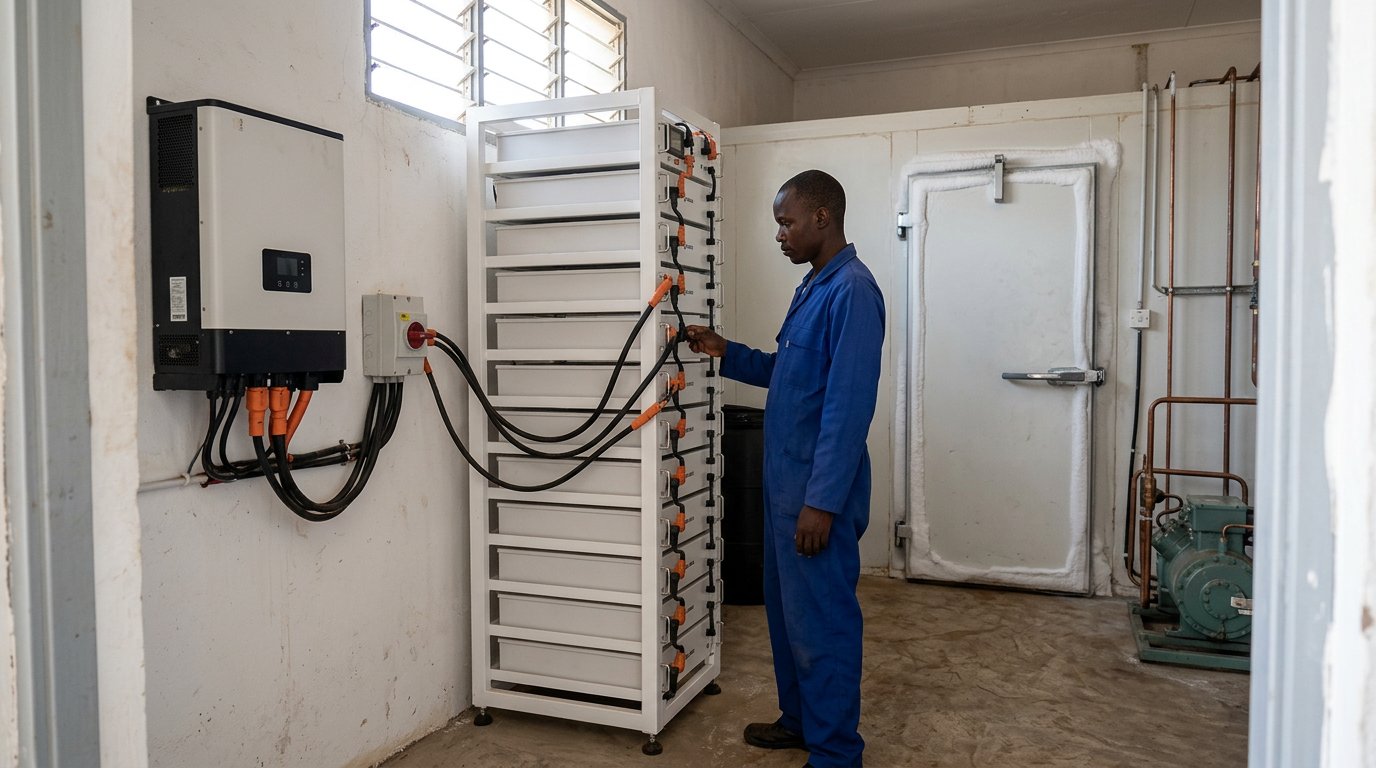
A battery can replace a generator for a defined critical load and backup period, but commercial battery storage in Kenya must match the facility’s demand, inverter output and charging source. For many operations, a battery is practical for frequent interruptions and peak demand, while a generator remains available for longer outages.
This guide explains how to compare voltage and capacity, assess storage without solar, plan battery-generator integration, and account for demand data, system configuration and fire safety.
Key Takeaways
- Assess whether battery storage can cover your critical loads during outages or should operate alongside a generator.
- Compare battery voltage and capacity with inverter output to understand how system configuration affects performance.
- Plan fire safety around recognised battery standards, installation conditions and the storage system’s layout.
- Use your demand profile and operating priorities to shape a commercial storage design, including whether solar is part of the system.
Is storage worth it without solar?
A commercial battery can operate without solar by charging from the grid or a generator. It stores electricity for outages, demand peaks or scheduled use, so its value depends on the facility’s operating pattern.
Battery storage without solar
Without solar panels, a battery can still provide backup power or shift when a facility draws electricity. For example, a business can charge storage when grid supply is available, then power selected equipment during an outage. A generator can also recharge batteries, depending on the system design. For commercial battery storage in Kenya, the key question is whether the avoided interruptions or demand peaks justify the charging and operating requirements. Storage does not generate electricity; it shifts energy from one time to another.
Bill Savings and Demand Charges
Battery storage can lower bills by supplying stored electricity when demand is high, rather than drawing all the required power from the grid at once. This is peak shaving: the battery discharges as facility demand rises, which can reduce a billed peak where demand charges apply. Savings depend on the tariff, load profile, battery efficiency and control settings. A battery reduces demand charges only when its discharge coincides with the measured peak; it does not automatically reduce total electricity use.
Incentives and Financing Options
Tax incentives, grants and financing are separate ways to fund a battery project, each with its own eligibility conditions. Before factoring in a potential benefit, a Kenyan business should assess the programme’s rules, its tax position and the project structure. No single funding assumption suits every installation. Compare the expected repayment schedule with projected energy savings and operating requirements. Do not count a grant or tax treatment as guaranteed savings.
Solar Self-Consumption and Net Metering
With solar, a battery can store surplus daytime generation for later use, increasing self-consumption when the facility’s demand continues after solar production falls. This can reduce the amount of electricity exported or drawn from the grid, depending on operating schedules. Kenya’s Energy (Net-Metering) Regulations, 2024 provide a credit of fifty percent of an exported unit of electricity. Compare that export credit with the value of using stored solar electricity on site. The stronger option depends on when the business consumes power and how the system is configured.
Battery safety standards and fire planning
For Kenyan businesses, key risks include fire, incorrect installation, missed maintenance, unclear warranty limits and unsafe battery disposal. Reduce these risks with documented installation procedures, scheduled inspections, clear warranty records and an end-of-life handling plan.
The International Electrotechnical Commission cites IEC 62619 as an example of a recognised safety standard for industrial lithium batteries. For an energy storage system, IEC 62933 is also cited as a recognised standard. These identifiers help define the safety framework; they do not replace system-specific design, installation or operating instructions.
Plan the installation according to the battery manufacturer’s instructions and the facility layout. Choose a suitable location with controlled access, clear inspection and maintenance routes, and appropriate separation from routine work areas. Include the battery, inverter, cables and protection equipment in the site plan. Keep equipment accessible so staff can isolate the system and responders can reach it.
Fire planning should specify who raises the alarm, who isolates electrical equipment and how staff leave the affected area. Record the battery location and isolation procedure in the facility’s emergency plan. Before commissioning, train relevant staff on these steps and keep instructions near the equipment. A generic building procedure may not address the risks of stored electrical energy.
Follow the system manufacturer’s maintenance schedule, including checks for visible damage, connection condition, ventilation and monitoring alerts. Keep inspection records with the commissioning documents. Warranty terms vary by battery and may specify coverage, operating limits, exclusions and claim procedures. Review the terms before installation and retain service records to support any future claim.
At end of service, batteries require controlled handling because damaged lithium-ion units can present fire and environmental risks. Keep retired batteries out of ordinary waste streams and arrange appropriate specialist handling. A documented end-of-life plan clarifies responsibility before replacement becomes urgent. For project-specific safety planning, explore commercial battery system design as part of the installation scope.
Battery voltage and capacity options
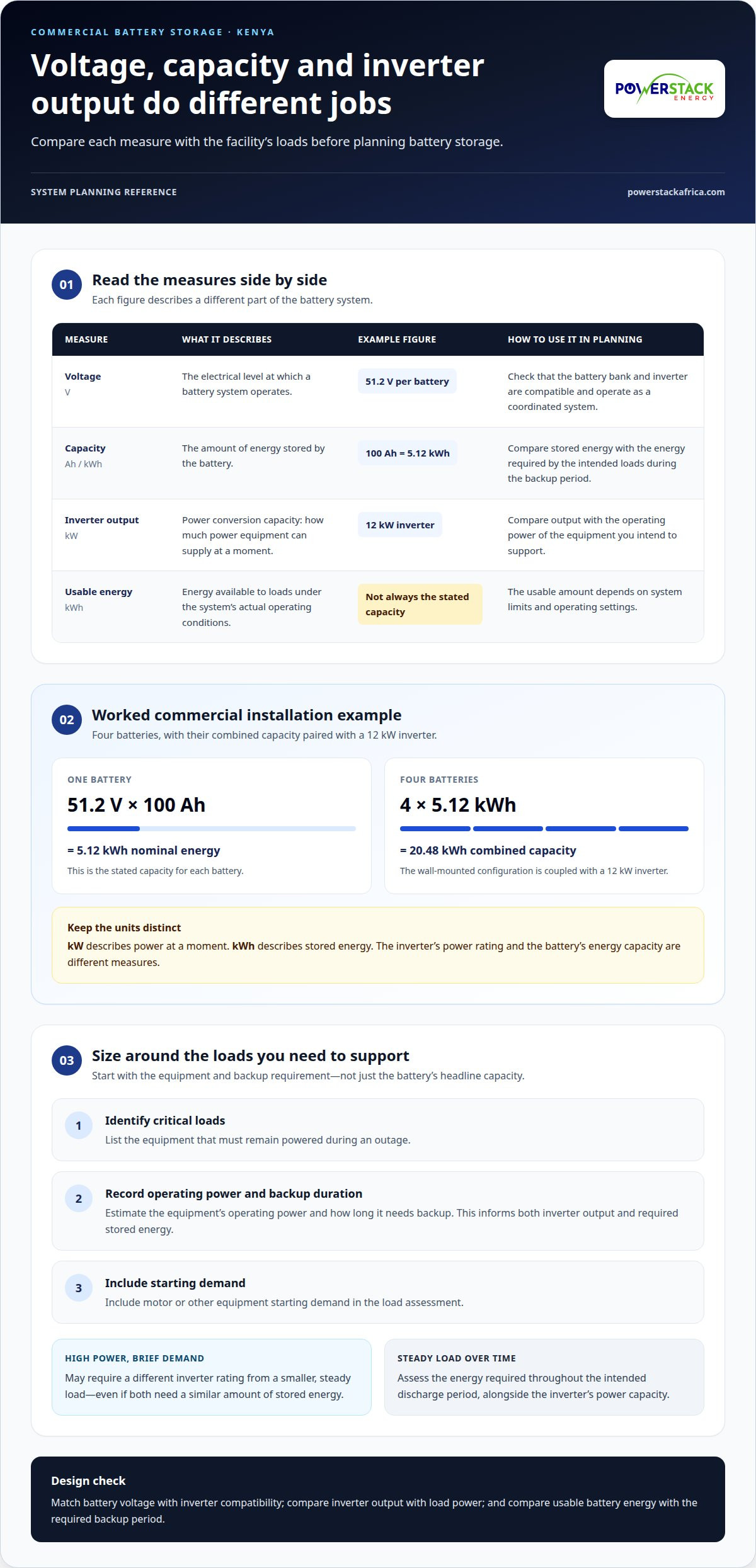
Voltage describes the electrical level a battery system operates at; capacity measures stored energy. A Kenyan commercial installation illustrates how these figures relate: four batteries rated at 51.2 V and 100 Ah each provide 20.48 kWh of combined capacity. Its wall-mounted configuration was completed in August 2025 and is coupled with a 12 kW inverter. The example shows why voltage, capacity and inverter output must be considered together.
For each battery, multiplying 51.2 V by 100 Ah gives 5.12 kWh of nominal energy. Four units therefore total 20.48 kWh. That calculation describes the stated capacity, not necessarily all the energy available to loads. The usable amount depends on system limits and operating settings. In planning, distinguish the battery’s stated energy capacity from the energy required during the intended discharge period.
Voltage compatibility matters because the battery bank and inverter must operate as a coordinated system. The 12 kW inverter in the Kenyan example indicates power conversion capacity, while 20.48 kWh describes stored energy. These are different measures: kW relates to how much power equipment can supply at a moment; kWh relates to energy over time. A facility should compare both with its load profile.
Start sizing with the equipment you intend to support. List the critical loads, their operating power and how long they need backup. A brief, high-power demand may require a different inverter rating from a smaller, steady load, even if both need a similar amount of stored energy. Include motor or other equipment starting demand in the load assessment, as it can affect inverter selection.
Then match the battery configuration to the required runtime and charging plan. More capacity can extend operation, but it does not increase inverter output by itself. The Kenyan 51.2 V, 100 Ah example provides a reference point, not a universal design. Commercial battery storage in Kenya should be sized around actual loads, required autonomy, inverter compatibility and available charging sources.
Commercial and industrial battery storage
Commercial battery storage can support peak management, backup power and grid-connected operations. Planning starts with demand data, site conditions and the facility’s electrical connection.
Site and Grid Connection Requirements
A site and grid assessment determines where the battery can be installed and how it will connect to the facility’s electrical system. The team reviews available space, equipment layout, maintenance access and the connection point. It also assesses existing electrical infrastructure and protection equipment. These details shape the design and clarify how storage will work alongside grid supply, solar or a generator.
Installation Steps
Installation proceeds from load and site assessment to system design, equipment placement, electrical integration and commissioning. The design matches the battery, inverter and control system to the facility’s intended operating mode. During commissioning, the installed system is tested against its design and operating settings. This sequence helps identify integration issues before normal operation and gives facility staff a clear operating procedure.
Use at least twelve months of 15- or 30-minute demand data to capture seasonal production changes. Interval data shows when peaks occur and how long they last. For example, a plant that rises about 150 kW above normal demand for up to 30 minutes may need about 75 kWh of usable energy for peak shaving, before losses and margins. This is an illustration, not a universal system size.
Backup sizing follows a different target. An illustrative 150 kW critical load requires about 300 kWh of usable energy for two hours of backup. That estimate addresses energy duration, while the inverter must also supply the required power. Separate critical loads from equipment that can pause during an outage. This prioritisation helps define the battery’s role and prevents designing around non-essential demand.
For a commercial project, align operating goals, connection design and commissioning records. Plan your commercial battery installation around demand data and site integration.
Powerstack Africa Energy Ltd
Powerstack Africa Energy Ltd helps Kenyan businesses assess and plan battery storage around their operating requirements. Turn to the team to evaluate backup duration, peak demand, solar integration or compatibility with existing electrical infrastructure.
Energy Audits help establish how a facility uses electricity, while Commercial Solar EPC, Battery Energy Storage Systems, and Hybrid Inverters & PCS support system planning and integration. The goal is to match the design to your demand profile, site conditions and operating priorities, rather than choosing battery capacity in isolation.
Discuss your facility’s storage requirements with Powerstack Africa Energy Ltd to plan a system around your operational needs.
Set the project direction with confidence
Before approving a commercial battery storage project in Kenya, align operations, facilities and finance around one decision: what outcome must the system support? A shared project brief can record the operating priority, the role of stored energy and how the system should fit the site’s existing power strategy. This gives decision-makers a clear basis for reviewing the design and assigning internal responsibilities.
Powerstack Africa Energy Ltd’s engineering team supports this planning through Energy Audits, Commercial Solar EPC, Battery Energy Storage Systems, and Hybrid Inverters & PCS. Its engineering-led approach links facility requirements to an energy system design based on how the business uses power.
Move the project forward with a focused discussion about your facility’s requirements. Contact Powerstack Africa Energy Ltd today to discuss the next step for your site.
Frequently Asked Questions
Can a battery replace my generator?
Yes, a battery can replace a generator for selected loads when its stored energy and inverter output match your operating needs. For example, a shop could use battery power for point-of-sale equipment, lighting and network devices during brief interruptions. A generator remains useful during extended outages or when loads exceed the battery system’s capacity. A hybrid design can assign each power source a defined role.
What data do I need before asking for a proposal?
Prepare recent electricity bills, available interval demand records, a list of essential equipment and your preferred backup duration. Include motor starting loads, details of existing solar or generators, and any facility electrical drawings. Note operational changes that could affect future demand, such as planned production expansion or new machinery. These details help engineers assess the system configuration and integration requirements.
What does a commercial battery storage system actually do?
A commercial battery storage system stores electricity and releases it according to the facility’s operating needs. Its power conversion equipment manages electricity flowing between the battery and connected systems. For example, a warehouse can store energy during one operating period and supply selected equipment later. Depending on the design, a system can support backup power, load shifting, peak shaving, solar self-consumption or generator hybridisation.
What drives the cost of a commercial BESS?
Key factors affecting the project configuration include required storage capacity, power conversion equipment, installation requirements and site conditions. Integration with existing solar, a generator or facility electrical equipment also shapes the design. Operating goals matter: backup duration and peak management require different system choices. For commercial projects, pricing depends on system configuration, installation requirements and project location.
What commercial battery storage systems are available in Kenya?
Commercial options include the DEYE BOS-B Commercial & Industrial Lithium Battery Storage System, DEYE BOS-G Pro Commercial & Industrial Battery Storage System and DEYE BOS-W Commercial Solar Battery Storage System. Other options include Dyness STACK100 High Voltage LiFePO₄ Battery Energy Storage System and SAJ 50kW All-In-One Energy Storage Solution – 100kWh. Each system has distinct configurations; selection depends on the facility’s electrical design and operating requirements.
How much does commercial battery storage cost in Kenya?
There is no single fixed price for commercial battery storage in Kenya. Pricing depends on system configuration, installation requirements and project location. A proposal is based on the facility’s demand, required storage capacity, power conversion equipment and integration scope. To get a project-specific quotation, request a pricing and technical proposal from Powerstack Africa Energy Ltd, including the facility details and operating priorities that will shape the system design.