A high voltage storage inverter isn’t automatically the better household backup choice; the right option depends on how battery voltage, continuous discharge, inverter output and your essential loads align. In residential storage, high-voltage systems are designed for battery packs above 100 volts, while low-voltage systems commonly pair with 12-, 24- or 48-volt batteries; typical efficiency ranges are 95-98% and 90-95%, respectively. That difference affects battery setup and the current needed to supply backup loads, but voltage alone doesn’t determine how well a system performs: battery discharge capability, inverter capacity and MPPT configuration must also suit your solar array and household demand. This guide explains how high- and low-voltage systems compare in backup power, conversion efficiency and MPPT performance, so you can assess which configuration fits your home in Kenya and the loads you need to keep running.
Key Takeaways
- Match battery voltage and continuous discharge capability to the inverter output your backup loads require.
- Separate essential loads from peak-demand appliances to plan backup capacity around how your household uses power.
- Account for installation layout, cable runs, protection and battery compatibility when assessing a high-voltage setup.
- Compare conversion efficiency and MPPT configuration against your solar array to understand how the system may perform.
What Actually Changes Between High Voltage and Low Voltage Hybrid Inverters?
In Kenya, high voltage storage inverter options include hybrid inverters for homes and power conversion systems for commercial and industrial storage. The key difference is the battery-side architecture, which affects current, cabling and how storage equipment integrates with the rest of the system.
In a high-voltage battery bank, cells are connected in series to raise pack voltage. Low-voltage designs commonly increase capacity by connecting compatible batteries in parallel. These approaches affect conductor sizing, protection design and how the installer connects batteries to the inverter. The battery configuration must match the inverter’s operating requirements.
At equivalent power, higher battery voltage means lower current. Lower current can reduce resistive cable losses and heat, although conductor selection and connection quality still matter. This can inform cable routing and equipment layout, especially when components cannot be installed close together. High voltage does not remove the need for correctly sized wiring and suitable protection.
For a household, compare the inverter’s operating modes with your solar, battery and utility use. A hybrid unit can coordinate electricity from these sources, while its control settings determine how energy is directed during normal operation or an outage. Commercial and industrial systems may use a power conversion system to manage larger storage installations and interaction with the facility grid.
Smart energy management can set priorities for solar use, battery charging and grid supply. Define those priorities around actual operating needs, such as preserving stored energy for backup or supporting facility loads. For photovoltaic power converters, IEC 62109-1 is identified as a safety standard by the International Electrotechnical Commission.
Options include high-voltage hybrid inverters for homes and power conversion systems for commercial and industrial storage.
Backup loads and power requirements
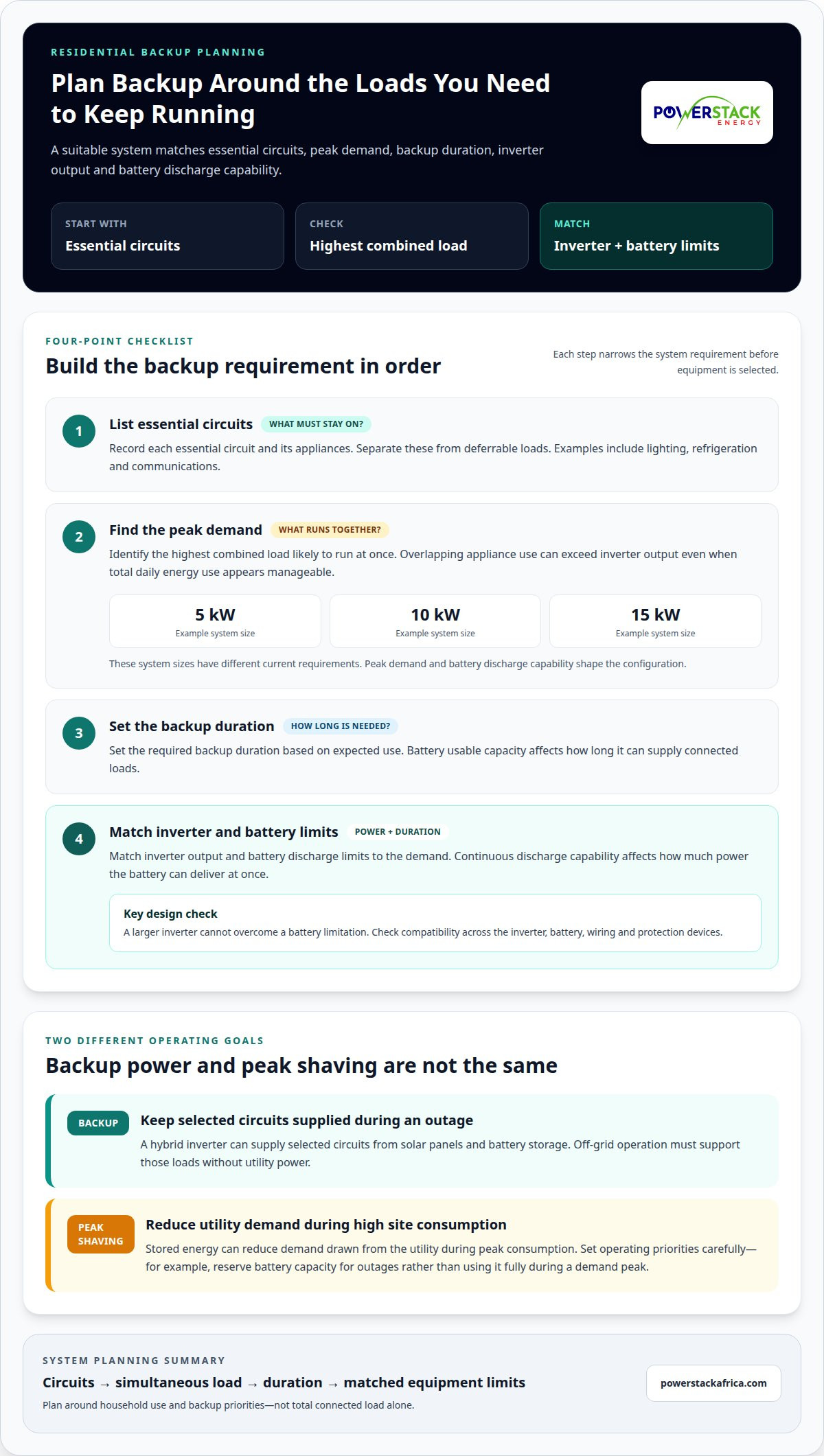
Size backup around the loads you need to keep operating, not the total connected load alone. A 5 kW, 10 kW or 15 kW system has different current requirements, so peak demand and battery discharge capability shape the configuration.
Backup and Off-Grid Operation
During a utility outage, a hybrid inverter can supply selected circuits from solar panels and battery storage. For off-grid operation, the system must support those loads without utility power. Separate essential circuits, such as lighting, refrigeration and communications, from deferrable loads. Then consider which appliances may run at the same time: overlapping demand can exceed inverter output even when total daily energy use seems manageable.
Peak Shaving with Backup Power
Peak shaving uses stored energy to reduce demand drawn from the utility during periods of high site consumption. Backup serves a different purpose: supplying selected circuits when grid power is unavailable. A hybrid configuration may address both, but operating priorities need to be defined. For example, a facility may reserve battery capacity for outages rather than discharge it fully during a demand peak.
Use this sequence to establish the required inverter and battery capacity:
- Record each essential circuit and its appliances.
- Identify the highest combined load likely to run at once.
- Set the required backup duration based on expected use.
- Match inverter output and battery discharge limits to that demand.
Compatibility matters across the inverter, battery, wiring and protection devices. A battery’s usable capacity determines how long it can supply connected loads, while its continuous discharge capability affects how much power it can deliver at once. A larger inverter cannot overcome a battery limitation.
A system-design discussion with Powerstack Africa Energy Ltd can turn your circuit list, peak demand and backup priorities into a practical configuration.
What is a High-Voltage Battery System?
For installations in Kenya, applicable electrical and utility-connection requirements depend on the system design and whether it connects to the grid. Plan around the inverter, battery capacity, protection equipment, wiring layout and available space so the components work as a coordinated system.
High-Voltage System Safety
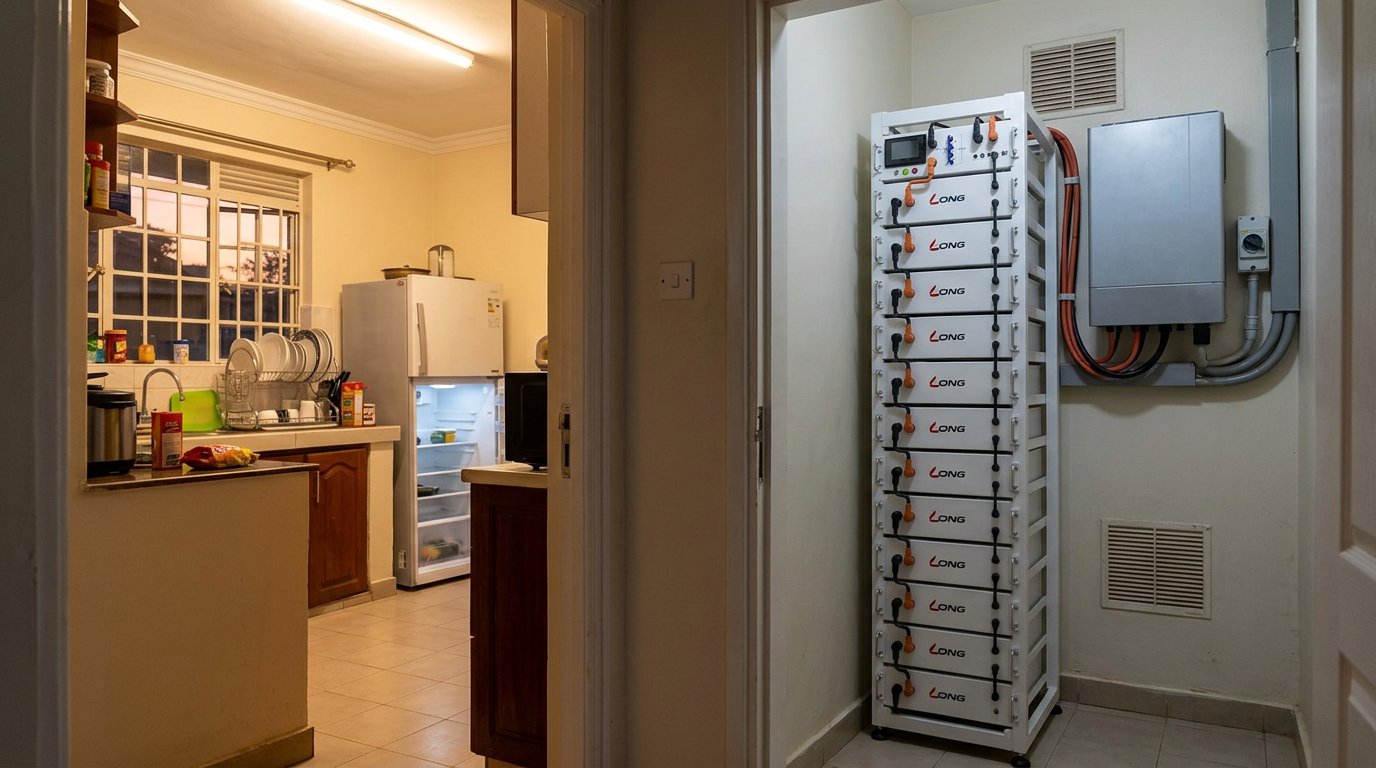
High-voltage battery storage requires coordinated protection and careful installation. The design should include correctly sized fuses and circuit breakers, grounding, surge protection and wiring suited to the system voltage and current. Place equipment in a cool, dry, shaded area with airflow. Air-cooled equipment needs clear ventilation paths to dissipate heat.
Electrical faults, loose connections and overheating are key risks. Routine inspection should cover wiring, fuses, breakers and grounding. Manufacturer warranty terms vary by equipment; the stated 10-25-year warranty range applies to solar panels and inverters, not universally to batteries.
Voltage Ranges and Modular Expansion
A typical high-voltage inverter input range is 300-800 V DC. In broader electrical engineering and utility contexts, high voltage may refer to systems above 1000 V DC. These figures describe different contexts. For modular expansion, confirm that added battery modules remain within the inverter’s permitted voltage and current limits. Expansion also depends on compatible controls, protection and available installation space.
Compatible Battery Types and Capacities
Compatibility depends on battery chemistry, voltage range, capacity and communication with the inverter’s battery management system. Lithium iron phosphate batteries are one available chemistry, but the inverter and battery must share compatible control protocols. CAN and RS485 are common communication interfaces; matching the interface alone does not establish protocol compatibility.
Select batteries within the inverter’s operating range and match continuous discharge capability to backup demand. Capacity determines stored energy, while discharge limits determine power delivery. In Kenya, applicable permits, standards and utility rules depend on the installation and grid connection, so establish requirements during system design. Review equipment warranty terms and schedule inspections of wiring and protective devices to support safe operation.
Conversion efficiency and MPPT performance
Efficiency measures how much input energy becomes usable output; MPPT affects how effectively solar panels supply power. Compare both with your array, battery voltage and operating profile before selecting an inverter. For a high voltage storage inverter, check the manufacturer’s stated operating range against your planned configuration.
Typical high-voltage inverter efficiency is 95-98%, while low-voltage models are commonly listed at 90-95%. Some high-voltage hybrid inverters are described as exceeding 97%, depending on model. Treat these figures as model-level measures, not a guarantee of household energy delivered. Conversion losses also occur during battery charging, discharge and changes between direct current and alternating current.
MPPT means maximum power point tracking. It adjusts the solar input operating point to capture available panel power as sunlight and conditions change. For example, panels facing different directions may produce different amounts of power throughout the day. Separate MPPT inputs can help manage distinct array groups if the inverter supports that configuration. Match each string’s voltage and current to the manufacturer’s input limits.
Assess performance using the equipment documentation and your system layout:
- Compare peak and weighted efficiency figures on the same basis.
- Check the MPPT operating voltage range against the solar array.
- Review the permitted input current for each tracker.
- Confirm the battery’s charging and discharge limits match the inverter.
A high voltage storage inverter can reduce battery-side current for a given power transfer, but that alone does not establish higher whole-system efficiency. Battery compatibility, conversion stages, cable design and operating conditions also affect delivered output. When assessing an inverter, compare manufacturer data across expected loads rather than relying on a single headline figure.
Powerstack Africa Energy Ltd can align inverter selection, battery storage and solar input through its hybrid inverter and storage integration.
Powerstack Africa Energy: Hybrid Inverters & PCS
Powerstack Africa Energy helps you assess hybrid inverter and power conversion requirements when commercial or industrial loads need coordinated solar, battery storage and backup operation. Its Hybrid Inverters & PCS offering includes the IESP 60kW HV C&I Storage Inverter, suited to consideration in commercial and industrial storage designs.
For projects that need a complete system plan, Commercial Solar EPC and Battery Energy Storage Systems connect inverter selection with generation and storage requirements. The design should account for load profiles, backup priorities, battery compatibility and interaction with the grid. This helps align equipment choices with your facility’s operating demands.
Contact Powerstack Africa Energy to discuss your inverter and storage requirements.
Plan Your Next Storage Decision
Choose your next step based on what you need from a high voltage storage inverter: dependable household backup, better use of solar generation or a system ready for future demand. A clear operating profile gives the design process a practical starting point and ties equipment selection to real-world use.
Powerstack Africa Energy Ltd’s engineering team can align project requirements with its Commercial Solar EPC, Battery Energy Storage Systems, and Hybrid Inverters & PCS offerings. Share your load priorities and system objectives to start a focused discussion about the right scope for your property or facility.
Contact Powerstack Africa Energy Ltd to discuss your storage requirements and take the next step with clarity.
Frequently Asked Questions
What About System Expansion?
Expansion works best when the system is designed for staged additions from the outset. Before adding storage, review the inverter’s control settings, battery management system limits, protection devices and commissioning records. A change in battery arrangement may require updated configuration and testing. Keep records of installed modules and system settings so future adjustments can be assessed against the original design.
What is a high-voltage battery storage inverter and how does it work?
A high voltage storage inverter controls electrical power between a battery and connected equipment. During discharge, it converts the battery’s direct current into alternating current for loads; during charging, it manages incoming power according to compatible battery controls. The inverter and battery management system exchange operating information to coordinate charging, discharge and system protection within their configured limits.
What voltage range qualifies as a high-voltage storage inverter?
In residential and commercial storage, the term generally refers to battery systems above 100 V. This classification concerns the battery side, not the inverter’s solar input specification. Read the equipment datasheet for its battery operating window and permitted limits, then distinguish those values from the PV input range. Selecting by the label alone can lead to a mismatch between the inverter and battery bank.
How do high-voltage and low-voltage storage inverters compare in efficiency and performance?
High-voltage configurations can transfer the same power at lower battery-side current, while low-voltage arrangements may suit smaller or simpler systems. Performance also depends on how the inverter handles load changes, battery controls and solar input. Compare the manufacturer’s efficiency curves across expected operating conditions, not just peak figures. Check whether the system can maintain stable output as household demand changes throughout the day.
What should you include in a Kenyan installation proposal?
Ask for a proposal outlining the equipment configuration, installation scope, protection components, commissioning process and expected system operation. Powerstack Africa Energy Ltd assesses these requirements through its energy storage and inverter offerings. Include the site layout, intended use and any existing solar or backup equipment in the project brief to help align the technical proposal with the installation conditions.
What inverter size is suitable for a Kenyan home or business energy storage system?
Use appliance nameplate data and operating schedules to build a realistic load profile. For equipment with motors, account for starting demand as well as normal running demand, since the initial draw can differ. For a business, also consider phase requirements and critical processes that cannot be interrupted. The inverter’s continuous output and short-duration capability should suit these operating conditions.